By Paul Goldberg — Senior Correspondent | LGBT Business Finance News
NEW YORK, NY — (November 10, 2026) — Wall Street came under renewed selling pressure Tuesday after a hotter-than-expected October inflation report rattled financial markets, pushed U.S. Treasury yields toward the psychologically significant 5% threshold, and intensified concerns that the Federal Reserve could deliver another interest rate increase before the end of 2026.
The latest inflation figures disrupted investor confidence following Monday’s powerful stock market rebound, placing the Dow Jones Industrial Average, S&P 500, and technology-heavy Nasdaq Composite back under pressure as traders reassessed the direction of U.S. monetary policy.
Trending LGBTQ Business and Politics News on JRL CHARTS:
• Pornhub Parent Aylo Faces $120 Million Settlement as Federal Judge Clears Major Legal Hurdle
• Federal Workers Take Trump Healthcare Ban to Court as 2027 Benefits Deadline Looms
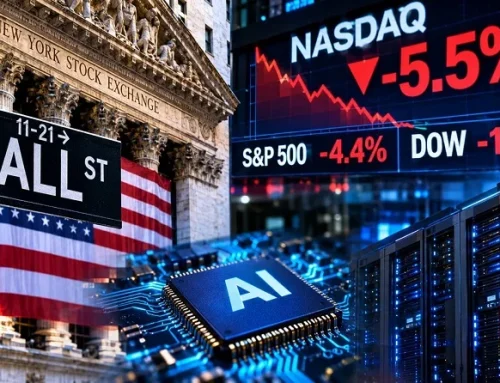
• Wall Street’s AI Bubble Warning: Democratic Sweep Triggers $2.5 Trillion Nasdaq Meltdown
• Google’s AI Gamble: Can Gemini Save Search Without Destroying Its Cash Machine?
• Exxon, Chevron Cash In as $130 Billion Oil Boom Threatens Trump’s Midterms
• Get the Latest in LGBT Business Finance News on JRL CHARTS
For investors already navigating volatility across artificial intelligence, technology stocks, and the broader economy, Tuesday’s inflation surprise introduced another significant obstacle to a sustained Wall Street recovery.
October Inflation Exceeds Wall Street Forecasts
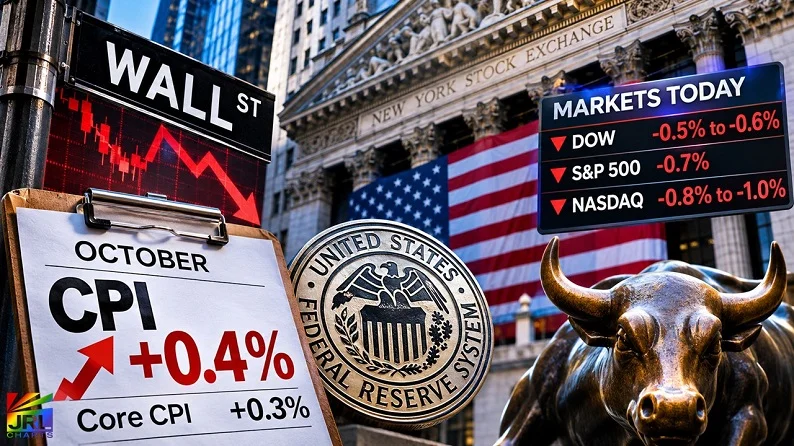
According to the U.S. Bureau of Labor Statistics, the Consumer Price Index increased 0.4% in October, exceeding economists’ expectations of a 0.3% monthly increase.
Although the figure represented a slowdown from September’s 0.6% advance, the higher-than-anticipated reading reinforced concerns that inflationary pressures remain deeply embedded in the American economy.
Core CPI, which excludes volatile food and energy prices, increased 0.3%, compared with economists’ forecasts of 0.2%.
The report also revealed continued pressure on household expenses:
• Shelter costs: Increased 0.3%, accounting for more than 30% of the overall monthly CPI increase.
• Food prices: Climbed 0.5%, including increases in grocery and restaurant prices.
• Energy prices: Advanced 0.7%, following September’s much sharper increase.
The figures highlight the continuing challenge facing the Federal Reserve as policymakers attempt to bring inflation closer to their long-term 2% objective without destabilizing economic growth.
Federal Reserve Rate-Hike Fears Return
The inflation surprise immediately shifted attention toward the Federal Reserve’s December monetary policy meeting.
Federal Reserve Governor Christopher Waller has signaled that persistent inflation could justify a more aggressive policy response, including consideration of a 50-basis-point interest rate increase.
Such a move would represent a larger adjustment than the conventional quarter-percentage-point increase and could place additional pressure on businesses, consumers, and financial markets.
Investors are increasingly concerned that the central bank may need to maintain restrictive monetary conditions longer than previously anticipated.
Higher interest rates typically increase borrowing costs, discourage corporate investment, and reduce the relative attractiveness of equities, particularly growth-oriented technology stocks whose valuations depend heavily on expectations of future earnings.
The latest inflation report has therefore transformed December’s Federal Reserve meeting into a critical event for Wall Street’s year-end outlook.
Treasury Yields Surge as Bond Markets React
The U.S. Treasury market delivered one of Tuesday’s clearest warning signals.
The benchmark 10-year Treasury yield climbed toward 4.99%, approaching the closely watched 5% level, while the policy-sensitive two-year Treasury yield jumped approximately 19 basis points to around 4.73%–4.75%.
These movements reflect expectations that interest rates could remain elevated or increase further.
Rising Treasury yields have important consequences beyond Wall Street.
They can influence mortgage rates, corporate financing expenses, commercial lending, and the cost of servicing government debt.
For publicly traded companies, higher borrowing costs can constrain expansion plans and reduce future profitability. For consumers, tighter financial conditions can make purchasing homes, financing vehicles, and carrying credit card balances increasingly expensive.
The bond-market reaction underscores how a single inflation report can rapidly alter expectations across the entire financial system.
Dow, S&P 500 and Nasdaq Retreat After Monday’s Rally
Major U.S. stock indexes moved lower during Tuesday’s trading session, surrendering part of the previous day’s gains.
Early market reports indicated:
• Dow Jones Industrial Average: Declined roughly 0.5%–0.6%, with losses fluctuating throughout the session.
• S&P 500: Fell approximately 0.7%.
• Nasdaq Composite: Dropped roughly 0.8%–1%, reflecting renewed pressure on technology and growth stocks.
These figures reflect intraday market movements, not final closing results.
The downturn followed Monday’s strong rebound, illustrating how quickly investor sentiment can reverse when inflation and interest-rate expectations change.
Technology companies remain particularly vulnerable to rising bond yields because higher discount rates can reduce the present value investors assign to anticipated future profits.
AI and Technology Stocks Face Another Test
Tuesday’s inflation-driven decline comes amid broader uncertainty surrounding technology valuations and the sustainability of the artificial intelligence investment boom.
Wall Street has already experienced sharp fluctuations as investors reassess the enormous capital expenditures associated with AI infrastructure, data centers, semiconductor manufacturing, and next-generation computing systems.
The combination of elevated valuations and renewed interest-rate concerns creates a challenging environment for companies whose market prices depend on ambitious long-term growth expectations.
Although the inflation report is not directly connected to the underlying performance of AI companies, tighter monetary conditions can amplify existing market volatility.
Investors must now determine whether the latest sell-off represents a temporary adjustment or the beginning of a more sustained repricing of risk across technology and other growth sectors.
What Higher Inflation Means for American Businesses
The consequences of persistent inflation extend well beyond the stock market.
Small businesses, independent retailers, manufacturers, and service providers face a difficult operating environment when borrowing costs remain elevated and household purchasing power comes under pressure.
Higher financing expenses can discourage inventory expansion, equipment purchases, commercial real estate investment, and new hiring.
For specialty retailers and distributors, the combination of increased operating costs and cautious consumer spending can also complicate inventory management and long-term planning.
These pressures are particularly relevant to independent businesses competing against larger corporations with greater access to capital.
A prolonged period of restrictive monetary policy could therefore create additional challenges for entrepreneurs and business owners heading into 2027.
Wall Street’s Next Challenge: Inflation, Interest Rates and Investor Confidence
The immediate question facing financial markets is whether October’s inflation surprise will force the Federal Reserve to pursue a more aggressive interest-rate strategy.
Investors will closely monitor additional economic releases, Treasury yield movements, and comments from Federal Reserve officials for indications of how policymakers intend to respond.
The upcoming Producer Price Index report will provide another measure of inflationary pressures within the economy.
Meanwhile, volatility across technology stocks and the broader equity market could persist as investors adjust expectations for corporate earnings and borrowing costs.
The Bottom Line: Wall Street’s latest retreat demonstrates that inflation remains one of the most powerful forces shaping financial markets. With Treasury yields approaching 5%, renewed speculation surrounding Federal Reserve rate increases, and technology valuations under scrutiny, investors face another period of uncertainty as 2026 moves toward its final weeks.
JRL CHARTS — LGBTQ Digital Media Network continues delivering independent coverage of Wall Street, Federal Reserve monetary policy, U.S. economic developments, and the financial forces affecting businesses, investors, and global markets.
His reporting focuses on federal court rulings, legislative developments, international human rights issues, and government actions impacting LGBTQ communities worldwide.
With nearly two decades of experience, Goldberg is recognized for his balanced analysis, investigative insight, and commitment to accurate, fact-based journalism that informs readers on the political forces shaping equality and justice.
- Wall Street Sinks as Inflation Shock Sends Treasury Yields Toward 5% - November 10, 2026
- Pornhub Parent Aylo Faces $120 Million Settlement as Federal Judge Clears Major Legal Hurdle - November 9, 2026
- Colorado Voters Approve Trans Youth Surgery Ban as LGBTQ Rights Battle Erupts - November 9, 2026