By: Paul Goldberg — Senior Correspondent | LGBT Business Finance News
NEW YORK, NY — (November 7, 2026) — Wall Street’s celebration of the Democratic Party’s sweeping 2026 midterm election victories lasted barely 24 hours before one of the year’s most aggressive stock market selloffs exposed growing anxiety over America’s multibillion-dollar artificial intelligence expansion.
After surging Wednesday as investors reacted to Democrats gaining control of Congress, U.S. stocks reversed dramatically Thursday, November 5, as technology companies, semiconductor manufacturers, and AI infrastructure providers suffered steep losses.
Trending LGBTQ Business and Politics News on JRL CHARTS:
• Fed Holds Rates at 4% as Wall Street Bets on December Hike
• Stocks Up 12%, Bonds Under Pressure — Morningstar Reveals Wall Street’s Growing Divide
• American Express Profits Surge 28% — Then Comes the 3,500 Job Cut Bombshell
• Jamie Dimon Sounds the Alarm: 5 Economic Threats That Could Shake America
• LGBTQ Nonprofit Makes $3 Million Move to Transform Downtown Buffalo
• Breaking Now on LGBT Business Finance News
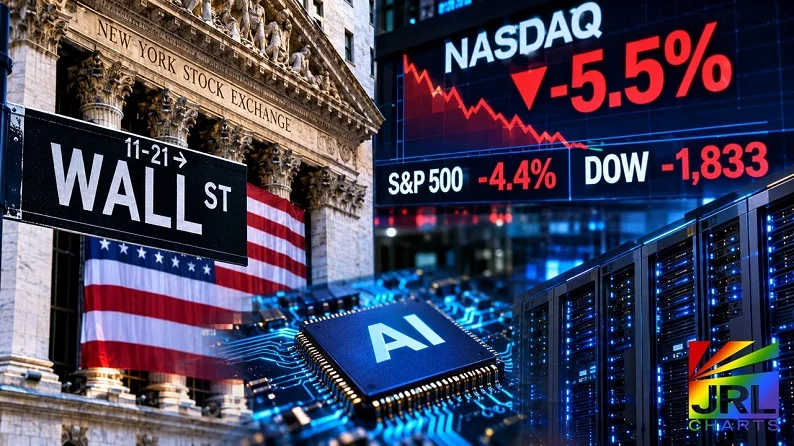
The Dow Jones Industrial Average plunged approximately 1,833 points, while the S&P 500 declined 4.4%. The technology-heavy Nasdaq Composite tumbled 5.5%, pushing the index into correction territory, generally defined as a decline of at least 10% from a recent high.
According to Reuters, the selloff erased approximately $2.5 trillion in Nasdaq market capitalization, highlighting the financial vulnerability of an AI investment boom increasingly dependent on massive data center construction, affordable electricity, and continued investor confidence.
The dramatic reversal underscored a growing contradiction facing American technology companies: investors remain enthusiastic about artificial intelligence’s commercial potential, but the infrastructure required to support it is becoming a political, environmental, and financial flashpoint.
From Democratic Victory to Wall Street Panic
Wednesday’s trading session initially reflected investor relief following the midterm elections.
The Dow gained more than 1,500 points as markets welcomed greater clarity over the political direction of Washington. The S&P 500 advanced approximately 1.6%, while the Nasdaq rose around 1.4%.
The rally suggested that investors were adjusting to the possibility of divided government, changes in regulatory priorities, and a different balance of power between Congress and the White House.
However, the optimism concealed growing pressure on technology valuations.
By Thursday, investors were aggressively reducing exposure to companies closely associated with the AI infrastructure boom.
The selloff extended beyond individual technology stocks, affecting chip manufacturers, electricity suppliers, and businesses involved in financing and constructing data centers.
Charles Schwab’s market analysis identified concerns about potential restrictions on data center development, profit-taking, and the possibility of slower AI investment as contributors to the downturn.
The AI Infrastructure Boom Meets a Political Roadblock
For years, the investment thesis supporting artificial intelligence has depended on a straightforward assumption: demand for AI computing power will continue expanding rapidly.
That expectation has encouraged technology companies to commit enormous amounts of capital toward specialized semiconductor chips, cloud computing infrastructure, electrical systems, and industrial-scale data centers.
But the political environment surrounding those investments is changing.
Across the United States, communities are questioning whether massive data center projects will increase electricity prices, strain water supplies, require costly grid upgrades, or provide sufficient long-term economic benefits.
Those concerns have attracted attention across party lines.
The 2026 elections elevated several candidates who advocated stronger oversight of data center development, creating uncertainty over how quickly planned projects could receive necessary approvals.
Reuters reported that investors were reassessing the industry’s expansion prospects as concerns intensified over permitting delays, financing conditions, and the economic returns on AI infrastructure spending.
Texas Governor-Elect Gina Hinojosa Becomes a Major Factor in AI Investment
One of the most consequential developments emerged in Texas.
Governor-Elect Democrat Gina Hinojosa defeated Republican Governor Greg Abbott in the November election after campaigning on a proposal to temporarily halt new data center approvals until stronger community protections could be enacted.
Hinojosa has argued that communities deserve greater influence over projects affecting local electricity supplies, water resources, and public infrastructure.
According to The Texas Tribune, her proposed moratorium would remain in place until lawmakers establish new safeguards governing data center construction.
Her proposals include stronger transparency requirements, protections against higher electricity costs for residents, and greater accountability over the industry’s use of public resources.
For technology investors, Texas represents a particularly important market because of its substantial pipeline of planned data center development.
Any prolonged restrictions could affect construction schedules, capital expenditure plans, and demand forecasts for the semiconductor and energy industries.
However, Hinojosa’s proposed moratorium has not yet become an implemented policy. Its eventual scope and economic consequences will depend on executive authority, legislative action, and regulatory decisions.
The debate reflects a broader conflict between the economic benefits of technological expansion and the infrastructure costs borne by surrounding communities.
Nvidia, AMD and Semiconductor Stocks Face an AI Reality Check
Semiconductor companies were among the hardest-hit businesses during Thursday’s market rout.
Nvidia, whose advanced processors have become central to AI computing, declined approximately 9.3%.
Advanced Micro Devices fell roughly 17.3%, while the Philadelphia Semiconductor Index dropped approximately 12%.
The losses reflected investor concerns that delays in data center construction could eventually reduce demand for the processors, networking equipment, and related technologies powering the AI industry.
The issue is not necessarily whether artificial intelligence will remain commercially important.
Rather, investors are questioning whether current valuations adequately account for the financial risks associated with building and operating the infrastructure.
Large-scale AI facilities require substantial investments in power generation, cooling systems, specialized equipment, and long-term financing.
When construction schedules become uncertain, the potential consequences can extend throughout the supply chain.
For chipmakers, delayed projects may mean slower order growth.
For data center operators, permitting restrictions can postpone revenue generation while financing costs continue accumulating.
And for investors, the combination creates uncertainty over when ambitious AI spending plans will produce sustainable returns.
Wall Street’s $2.5 Trillion Warning: Is the AI Trade Overextended?
The market’s extraordinary reversal has revived questions about whether AI-related stocks have become excessively concentrated within investment portfolios.
A significant portion of recent market enthusiasm has centered on companies expected to benefit from continued spending on artificial intelligence.
That concentration can amplify market volatility.
When investors simultaneously reassess the profitability of a popular investment theme, selling pressure can spread rapidly across multiple sectors.
Thursday’s losses illustrated that risk.
The Nasdaq Composite finished approximately 11.9% below its previous record, officially entering correction territory.
Meanwhile, market volatility increased sharply as investors sought to reduce exposure to riskier assets.
A correction does not automatically establish that a speculative bubble has burst.
Nevertheless, the decline demonstrated how quickly enthusiasm surrounding emerging technology can turn into uncertainty when financial expectations encounter regulatory or economic obstacles.
What the AI Stock Selloff Means for Digital Advertising and Independent Publishers
The market turmoil also carries implications for the digital media economy.
Artificial intelligence has become increasingly integrated into online search, advertising technology, content discovery, audience measurement, and automated marketing systems.
Companies such as Alphabet, Microsoft, Amazon, and Meta are investing heavily in AI infrastructure while simultaneously operating major digital advertising and cloud computing businesses.
If investors begin demanding stronger financial returns from AI expenditures, these companies may face increased pressure to demonstrate how their investments translate into measurable revenue growth.
For independent publishers, including LGBTQ-focused digital media networks, the consequences could emerge through changes in search technology, advertising products, and content distribution.
However, a decline in AI stock valuations does not automatically translate into lower digital advertising revenue or reduced publisher earnings.
Advertising markets respond to a different combination of factors, including consumer spending, advertiser budgets, audience quality, campaign performance, and economic conditions.
The connection is therefore indirect but worth monitoring.
As AI technology becomes more deeply embedded in search and advertising infrastructure, publishers have a growing interest in understanding how technology companies balance capital spending with the needs of the open web.
For specialized publishers serving identifiable business communities, diversified revenue streams and direct advertiser relationships may provide an additional measure of resilience against fluctuations in programmatic advertising markets.
Friday’s Rebound Fails to Erase the Damage
U.S. technology stocks recovered modestly on Friday, November 6, but the rebound was insufficient to reverse the previous session’s steep losses.
The Nasdaq Composite advanced approximately 1.09%, while the S&P 500 gained 0.31%.
The Dow Jones Industrial Average declined approximately 0.46%.
The mixed session suggested that investors were still evaluating the consequences of the election results, potential data center restrictions, and the broader outlook for artificial intelligence spending.
The market’s direction will ultimately depend on more than political developments alone.
Corporate earnings, interest rates, financing conditions, energy availability, and the profitability of AI investments will continue influencing investor sentiment.
The Bigger Question: Can America’s AI Boom Deliver on Its Promises?
Wall Street’s turbulent election week revealed a growing challenge for the artificial intelligence industry.
Building increasingly powerful AI systems requires more than advanced software and semiconductor innovation.
It also requires access to electricity, water, land, financing, and the support of communities where new infrastructure is constructed.
Investors must now evaluate whether the financial assumptions supporting the industry’s expansion remain realistic under changing political and economic conditions.
For technology companies, the challenge is demonstrating that substantial capital investments can produce sustainable profits.
For policymakers, the challenge is balancing economic development with environmental protections, infrastructure capacity, and consumer affordability.
And for Wall Street, the question is whether AI’s long-term promise can justify the enormous valuations attached to its leading companies.
The Democratic sweep did not single-handedly cause the market correction. But it intensified scrutiny of an AI investment boom already facing significant financial and infrastructure challenges.
The extraordinary reversal from Wednesday’s rally to Thursday’s collapse demonstrates how rapidly investor expectations can change when political uncertainty collides with an expensive technological transformation.
JRL CHARTS — LGBT Business Finance News continues tracking Wall Street, artificial intelligence investments, technology-sector valuations, and the economic policies reshaping global markets. From financial market volatility to the future of digital advertising and independent publishing, JRL CHARTS delivers business intelligence examining the forces influencing today’s interconnected economy.

His reporting focuses on federal court rulings, legislative developments, international human rights issues, and government actions impacting LGBTQ communities worldwide.
With nearly two decades of experience, Goldberg is recognized for his balanced analysis, investigative insight, and commitment to accurate, fact-based journalism that informs readers on the political forces shaping equality and justice.
- Wall Street’s AI Bubble Warning: Democratic Sweep Triggers $2.5 Trillion Nasdaq Meltdown - November 7, 2026
- Trump White House Reportedly Weighed Jailing Journalists — Stephen Miller Backed the Move - November 7, 2026
- ACLU Warns Senate Permitting Bill Could Fast-Track ICE Detention Centers - November 5, 2026