By Paul Goldberg — Senior Correspondent | LGBT Politics USA
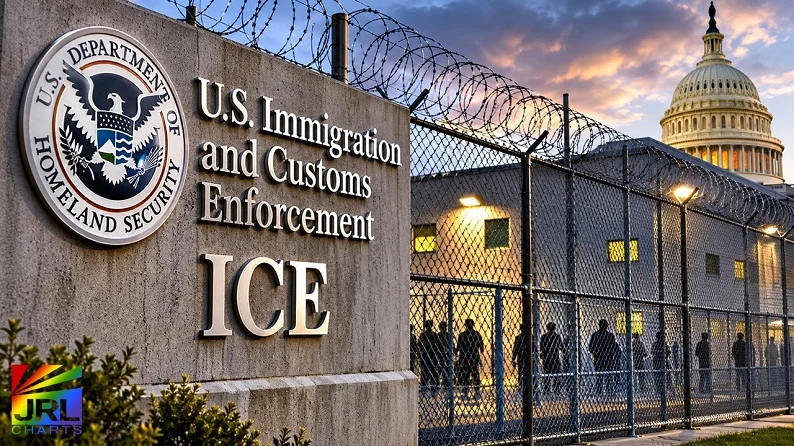
WASHINGTON, D.C. — (November 5, 2026) — The American Civil Liberties Union (ACLU) is warning congressional lawmakers that a bipartisan Senate permitting reform bill could unintentionally accelerate the construction of immigration detention facilities, potentially allowing the Trump administration to expand its detention infrastructure while limiting environmental oversight and legal challenges.
The warning, detailed in an ACLU memorandum obtained by POLITICO, has opened a new front in Washington’s debate over energy permitting reform, immigration enforcement and federal accountability.
Trending LGBTQ Business and Politics News on JRL CHARTS:
• Get the Latest in LGBT Politics USA on JRL CHARTS
• Breaking Military News involving LGBTQ Service Members and Security
• LGBT Politics Europe – Updates on Hate Crimes, Judicial Rulings
• Stay Up to Date on the Happenings in LGBT Politics Asia
• Breaking Now on LGBT Business Finance News
• Now Trending on LGBTQ Entertainment News
According to POLITICO’s reporting, the civil liberties organization argues that provisions designed to streamline federal infrastructure approvals could also benefit U.S. Immigration and Customs Enforcement (ICE), potentially allowing major detention projects to advance with fewer procedural obstacles.
The accusation is disputed by Democratic negotiators who insist that the proposed legislation would not exempt federal detention centers from environmental review.
The dispute comes as Senate lawmakers prepare to revisit the legislation next week, with Democrats divided over whether to advance a bipartisan agreement negotiated with Republicans and the White House.
ACLU Raises Alarm Over Environmental Review Loophole
At the center of the controversy is the National Environmental Policy Act (NEPA), the federal statute requiring agencies to evaluate environmental consequences when undertaking certain major federal actions.
NEPA reviews can examine issues including water consumption, wastewater management, air quality, transportation impacts and effects on surrounding communities.
The ACLU contends that proposed changes to federal permitting procedures could narrow the circumstances in which environmental reviews are required, potentially benefiting projects far beyond energy infrastructure.
That concern extends to immigration detention centers, particularly large industrial warehouses being converted into facilities designed to hold thousands of detainees.
According to POLITICO, the ACLU’s memorandum argues that the legislation could reduce opportunities to challenge major detention projects before construction or conversion proceeds.
The central legal question is whether the Senate’s proposed NEPA changes would actually apply to federal immigration detention facilities. That remains disputed, and the ACLU’s interpretation should not be treated as an established legal conclusion.
ICE’s Billion-Dollar Warehouse Expansion Already Faces Federal Scrutiny
The ACLU’s warning comes against a documented backdrop of costly detention expansion initiatives.
A September 24, 2026, report from the U.S. Government Accountability Office found that ICE had purchased 11 warehouses for approximately $1.07 billion as part of a broader initiative to increase immigration detention capacity.
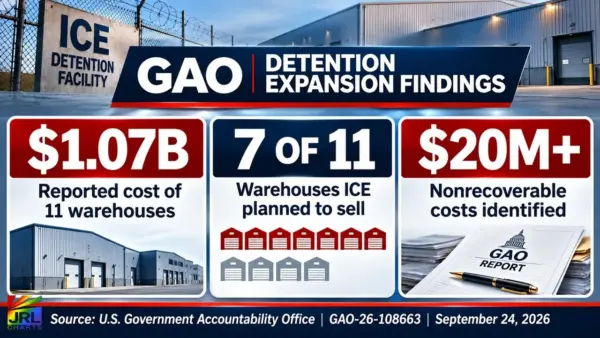
A September 2026 Government Accountability Office report details approximately $1.07 billion spent on 11 ICE warehouses, seven facilities planned for sale, and more than $20 million in nonrecoverable costs. Graphic: JRL CHARTS | LGBT Politics USA. Source: U.S. GAO.
Federal auditors concluded that ICE had pursued multiple expansion initiatives without sufficient strategic planning or consistent evaluation of financial risks.
The watchdog also documented more than $20 million in nonrecoverable expenses associated with warehouses the agency intended to sell, including property assessments, security and other costs.
The findings strengthen concerns about the financial accountability of large-scale detention projects, although they do not independently establish the ACLU’s interpretation of the pending Senate legislation.
Federal Courts Have Already Challenged ICE Warehouse Conversions
Environmental oversight is not merely a theoretical issue in the detention expansion debate.
In April 2026, a federal judge in Maryland issued a preliminary injunction concerning the proposed conversion of a warehouse in Williamsport into an immigration detention facility.
The court found serious deficiencies in the federal government’s handling of environmental review obligations under NEPA.
The ruling demonstrated that environmental law can provide a meaningful mechanism for examining federal detention projects before they become operational.
A separate dispute in Arizona resulted in federal authorities agreeing to pause conversion work at a proposed detention facility while additional environmental review proceeded.
These cases help explain why civil liberties organizations are closely examining any congressional proposal that could alter NEPA’s application to federal construction and conversion projects.
Senator Sheldon Whitehouse’s Office Rejects ACLU Interpretation
Not every Democrat involved in the permitting negotiations agrees with the ACLU’s warning.
A spokesperson for Sheldon Whitehouse rejected the suggestion that the legislation would remove environmental review requirements for immigration detention facilities.
According to the statement provided to POLITICO, Whitehouse’s office maintains that the proposed NEPA provisions do not exempt detention centers housing federal detainees.
That disagreement places the legal interpretation of the bill at the center of the negotiations.
Whitehouse and fellow Democratic negotiator Martin Heinrich have continued advocating permitting reform as a means of accelerating energy infrastructure development and addressing electricity costs.
Their argument is that reducing unnecessary permitting delays could help expand clean energy capacity, strengthen the electric grid and lower costs for households.
However, critics contend that the legislation must include sufficiently clear safeguards to prevent its provisions from being applied to unrelated federal projects.
Democrats Face New Political Divisions After Election Victories
The controversy arrives immediately after Tuesday’s elections, which have strengthened the position of Democrats skeptical of making further concessions to the Trump administration.
According to POLITICO, incoming House Natural Resources Committee chair Jared Huffman is among the progressive lawmakers resisting the current permitting framework.
A spokesperson for House Democratic leader Hakeem Jeffries also expressed opposition to the Senate proposal in its current form, telling POLITICO that the legislation remains insufficient in several areas.
The disagreement highlights a broader strategic challenge for congressional Democrats.
Some lawmakers see permitting reform as essential to expanding renewable energy, modernizing infrastructure and reducing household electricity costs.
Others are concerned that a broadly written bipartisan compromise could weaken environmental protections or inadvertently advance the administration’s immigration enforcement agenda.
Those competing priorities could complicate efforts to pass the legislation before the end of 2026.
New GAO Report Raises Additional Questions About ICE Oversight
The permitting debate also coincides with a separate Government Accountability Office report released November 5 examining changes in federal immigration detention inspections.
According to the report, ICE added more than 40 facilities holding detainees for longer than 72 hours between April 2025 and April 2026.
During that period, the average daily detained population increased by more than 50 percent to 61,817 individuals.
Federal auditors found that inspection procedures had changed as detention capacity expanded, including reduced inspection frequency in some circumstances and increased reliance on facility self-inspections.
The GAO recommended that ICE evaluate whether its revised oversight procedures adequately identify deficiencies and ensure compliance with detention standards.
Although the report addresses operational inspections rather than environmental permitting, its findings provide additional context for lawmakers weighing the consequences of accelerating detention infrastructure development.
Why the Debate Matters for LGBTQ Communities and Civil Liberties
For LGBTQ civil rights advocates, the controversy raises questions about the treatment and legal protections of vulnerable individuals in federal immigration custody.
LGBTQ asylum seekers and transgender detainees may face particular safety, medical care and discrimination concerns within detention environments.
The ACLU and other civil rights organizations have repeatedly called for stronger detention oversight, access to legal representation and protections against mistreatment.
Changes to environmental permitting rules would not automatically alter those protections. Nevertheless, the potential expansion of detention infrastructure has implications for the number of people held in federal custody and the government’s ability to maintain adequate oversight.
For LGBTQ communities, the issue is therefore part of a larger national debate involving immigration policy, civil liberties, government transparency and accountability.
Senate Faces Critical Test as Permitting Vote Approaches
With the Senate expected to return from recess next week, lawmakers face competing demands to accelerate energy development while preserving environmental and legal safeguards.
Supporters argue that permitting reform is necessary to address infrastructure bottlenecks and rising electricity costs.
Opponents warn that the legislation must be carefully written to prevent unintended consequences for federal projects unrelated to energy development.
The ACLU’s intervention adds a politically sensitive immigration dimension to a debate already complicated by environmental policy and partisan negotiations.
Whether lawmakers revise the proposal, clarify its application to detention facilities or advance the existing framework remains uncertain.
For now, the controversy illustrates how legislation designed for one policy objective can raise significant questions about its effects elsewhere in federal government operations.
JRL CHARTS will continue monitoring the Senate permitting negotiations, federal immigration detention expansion and the legal battles shaping civil liberties and government accountability across the United States.
JRL CHARTS | LGBT Politics USA — Independent political reporting on Washington, LGBTQ civil rights, immigration policy and the legislative decisions shaping America’s future.

His reporting focuses on federal court rulings, legislative developments, international human rights issues, and government actions impacting LGBTQ communities worldwide.
With nearly two decades of experience, Goldberg is recognized for his balanced analysis, investigative insight, and commitment to accurate, fact-based journalism that informs readers on the political forces shaping equality and justice.
- ACLU Warns Senate Permitting Bill Could Fast-Track ICE Detention Centers - November 5, 2026
- Salon Shuts Down After 31 Years as Digital Journalism Faces Financial Reckoning - November 5, 2026
- Democrats’ 2026 Blue Tsunami Rewrites History: Gay Leaders Win, Black Governors Break Barriers and Statehouses Flip - November 4, 2026