By: Paul Goldberg — Senior Correspondent | LGBT Business Finance News
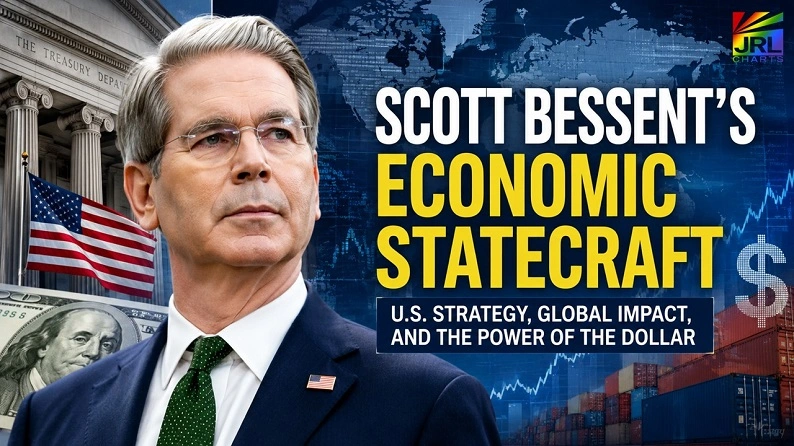
WASHINGTON, D.C. — July 16, 2026 — Openly gay U.S. Treasury Secretary Scott Bessent is facing growing international scrutiny after outlining an aggressive vision for what he calls American economic statecraft, a strategy that places national economic security, industrial strength, and financial leadership at the center of U.S. foreign policy.
Bessent’s remarks, delivered during a major policy address celebrating America’s 250th anniversary, have sparked debate among economists, foreign policy experts, and international observers over whether Washington is embracing a new era of economic nationalism while expecting other nations to continue operating under a different set of rules.
Now Trending on LGBT Business, Finance and Politics News on JRL CHARTS
• Federal Judge Voids Trump-IRS Settlement That Created Controversial Weaponization Fund
• LGBTQ Consumers Shift Spending Away from Target, Walmart and Amazon
• Trump Targets New York Times in New Lawsuit as War on DEI Programs Intensifies
• ACA Subsidy Loss Triggers Healthcare Shock for LGBTQ Americans
• Millions of Working Americans Are Going Hungry—and Nobody Is Talking About It
• Get the Latest In LGBT Politics News on JRL CHARTS
A New Economic Doctrine
In his speech, Bessent argued that the global economy has fundamentally changed since the post-World War II era and that the United States must modernize its economic strategy to compete with geopolitical rivals.
He emphasized five guiding principles centered on rebuilding American manufacturing, protecting critical supply chains, ensuring reciprocal trade relationships, maintaining leadership in emerging technologies, and preserving the U.S. dollar’s dominant position in global finance.
According to Bessent, economic strength is no longer separate from national security.
“Economic security begins with national capacity,” Bessent said during his address.
The Treasury Secretary argued that nations dependent on geopolitical competitors for essential products or strategic industries expose themselves to unnecessary economic and national security risks.
Critics Question Double Standards
The speech quickly generated criticism from international analysts who argue the United States is promoting principles abroad that differ from those it now seeks to apply domestically.
Critics point to decades of U.S.-backed globalization policies encouraging open markets and reduced trade barriers, while Washington is now increasingly supporting domestic industrial policy, strategic tariffs, and supply-chain reshoring.
Some foreign policy analysts contend that this represents a shift away from the free-market principles the United States previously championed.
Others argue that every major economic power—including China, the European Union, India, and Japan—already employs similar industrial strategies to protect key domestic industries.
Dollar Dominance Remains Central
Another major focus of Bessent’s doctrine is preserving the global role of the U.S. dollar.
The Treasury Secretary defended the continued use of sanctions and financial restrictions against governments that violate international norms or attempt to circumvent existing sanctions regimes.
Supporters argue these financial tools remain among Washington’s most effective non-military instruments for protecting national interests.
However, critics counter that extensive use of dollar-based sanctions has encouraged several nations to accelerate efforts toward alternative payment systems and reduced dependence on the U.S. financial system.
Industrial Policy Returns
Bessent also called for renewed investment in American manufacturing and strategic industries, arguing that long-term economic resilience requires rebuilding domestic production capacity.
His comments reflect a growing bipartisan consensus in Washington that critical sectors—including semiconductors, artificial intelligence, pharmaceuticals, energy infrastructure, and defense manufacturing—should receive greater domestic investment after years of overseas production.
Supporters See Strategic Realism
Supporters of Bessent’s approach argue that the global economy has entered a new geopolitical era where economic competition increasingly overlaps with national security.
They contend that supply-chain disruptions, cyber threats, geopolitical conflicts, and technological competition require governments to play a more active role in protecting domestic industries and ensuring economic resilience.
International Debate Continues
The debate surrounding Bessent’s economic statecraft highlights broader questions facing policymakers worldwide:
- Should economic policy prioritize national security over globalization?
- Can free trade coexist with strategic industrial protection?
- Will the U.S. dollar maintain its dominant position amid growing geopolitical competition?
- How should economic sanctions be balanced with international diplomacy?
As Washington continues reshaping its economic strategy, Bessent’s doctrine is likely to remain a central topic in global finance, trade negotiations, and international political discourse.
Stay with JRL CHARTS LGBT Business Finance News for continuing coverage of global financial policy, international markets, and the economic decisions shaping the future of world commerce.
His reporting focuses on federal court rulings, legislative developments, international human rights issues, and government actions impacting LGBTQ communities worldwide.
With nearly two decades of experience, Goldberg is recognized for his balanced analysis, investigative insight, and commitment to accurate, fact-based journalism that informs readers on the political forces shaping equality and justice.