By: Paul Goldberg – Senior Correspondent | LGBT Business Finance News
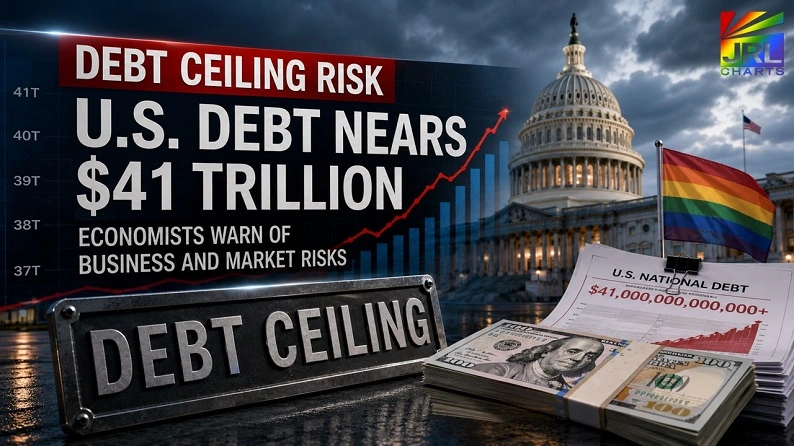
WASHINGTON, D.C. — (June 4, 2026) — The United States is on track to reach its $41.1 trillion debt ceiling as early as late winter 2027, setting the stage for another high-stakes debate in Washington that economists warn could have far-reaching consequences for businesses, investors, and financial markets.
The latest projection comes from the Bipartisan Policy Center (BPC), which analyzed current Treasury cash flows and federal borrowing trends. The nonpartisan think tank estimates that lawmakers may need to raise or suspend the nation’s borrowing limit sometime between late winter and mid-summer next year to prevent the risk of a federal default.
Now Trending on LGBT Business Finance News on JRL CHARTS:
• China’s Rising Yuan Could Hit LGBTQ Businesses Worldwide
• FTC Warns Platforms: New Federal Takedown Law Takes Effect May 19
• Project 2025 Already 50% Complete: Inside Trump’s Plan Reshaping America
• U.S. Banking Rule Ends ‘Reputational Risk’ Barrier, Expands Access for Legal Businesses
• Inflation EXPLODES to 3.8% as Iran War Drives Prices Higher, Wages Fall Behind
• LGBTQ Corporate Participation Plunges 65% in 2026 as DEI Retreat Reshapes Business Landscape
The forecast follows congressional action in 2025 that increased the debt ceiling by $5 trillion, pushing the current limit to approximately $41.1 trillion. Once that threshold is reached, the Treasury Department will be forced to implement what it calls “extraordinary measures” to continue meeting the government’s financial obligations.
While those temporary accounting maneuvers can delay a crisis for several months, economists caution that they are not a long-term solution.
Debt Continues to Outpace Economic Growth
Federal debt has become an increasingly significant concern among economists, policymakers, and voters alike.
According to projections from the Congressional Budget Office, debt held by the public is expected to climb from more than 100 percent of Gross Domestic Product (GDP) today to approximately 120 percent within the next decade. That would exceed the previous post-World War II record of 106 percent set in 1946.
At the same time, the federal government remains on track to spend roughly $2 trillion more than it collects in revenue during the current fiscal year, further widening the nation’s deficit.
Growing public concern mirrors those trends. Recent polling from Pew Research Center found that Americans increasingly view the federal deficit as one of the country’s most pressing economic challenges, alongside healthcare affordability and inflation.
Why Businesses Are Paying Attention
For many business owners, debt ceiling debates may appear to be a political issue. However, financial markets often react sharply when uncertainty surrounds the federal government’s ability to meet its obligations.
Past debt ceiling standoffs have triggered market volatility, increased Treasury borrowing costs, and even contributed to credit-rating downgrades for the United States.
Financial analysts warn that prolonged uncertainty could result in:
- Higher interest rates for businesses and consumers
- Increased borrowing costs for commercial loans
- Reduced investor confidence
- Lower business investment activity
- Greater volatility in stock and bond markets
Even without a default, uncertainty alone can create challenges for businesses seeking financing or planning long-term expansion projects.
Potential Impact on LGBTQ-Owned Businesses
The LGBTQ business community could face unique challenges if debt ceiling negotiations create turbulence in lending and investment markets.
Access to capital remains one of the most significant hurdles facing many LGBTQ entrepreneurs. Research has consistently shown that LGBTQ-owned businesses often encounter barriers when seeking traditional financing, venture capital funding, and private investment.
Should market uncertainty increase, lenders may tighten credit standards while investors become more cautious about funding early-stage or growth-oriented businesses.
That environment could lead to:
- Higher borrowing costs for LGBTQ-owned businesses
- Reduced access to small business loans
- Slower venture capital investment activity
- Delayed expansion and hiring plans
- Increased pressure on startups seeking growth capital
Industries with strong LGBTQ entrepreneurial participation—including hospitality, entertainment, retail, technology, and tourism—could be particularly sensitive to shifts in consumer confidence and financing conditions.
Global Trade and Investment Concerns
The impact of a debt ceiling standoff would not be limited to the United States.
Because U.S. Treasury securities serve as a cornerstone of the global financial system, any disruption in confidence surrounding federal debt can ripple through international markets.
A prolonged impasse could contribute to:
- Currency market volatility
- Higher trade financing costs
- Reduced foreign investment activity
- Slower global economic growth
- Increased uncertainty for importers and exporters
For LGBTQ-owned businesses engaged in international commerce, e-commerce, tourism, and cross-border services, those developments could affect everything from supply chains to customer demand.
The Stakes Continue to Rise
Economists generally agree that the greatest risk is not the level of debt itself, but the possibility that political gridlock could delay action long enough to undermine confidence in the world’s largest economy.
While most analysts expect Congress and the White House to eventually reach an agreement, the path toward that resolution could create significant uncertainty for businesses and investors.
As Washington prepares for another debt ceiling battle, entrepreneurs, lenders, and financial markets will be watching closely for signs that lawmakers can avoid a disruption that could reverberate throughout the U.S. and global economies.
About LGBT Business Finance News
LGBT Business Finance News is a dedicated section of JRL CHARTS covering economic policy, entrepreneurship, capital markets, global trade, and the financial issues impacting LGBTQ-owned businesses and investors worldwide.
For continuing coverage of economic policy, entrepreneurship, access to capital, and the financial trends shaping LGBTQ-owned businesses worldwide, stay with JRL CHARTS LGBT Business Finance News.
His reporting focuses on federal court rulings, legislative developments, international human rights issues, and government actions impacting LGBTQ communities worldwide.
With nearly two decades of experience, Goldberg is recognized for his balanced analysis, investigative insight, and commitment to accurate, fact-based journalism that informs readers on the political forces shaping equality and justice.