By: Andy Powell – Senior Correspondent | LGBT Business Finance News
DECATUR, GA — (August 12, 2026) — Adult retailers operating in one of metro Atlanta’s largest counties are facing a significantly narrower real estate landscape after DeKalb County moved to tighten where adult entertainment businesses can operate.
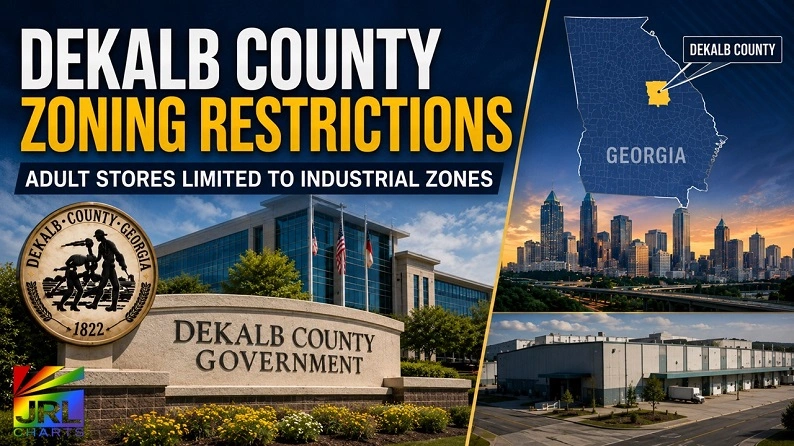
The DeKalb County Board of Commissioners voted Tuesday to revise zoning regulations governing adult entertainment businesses in unincorporated areas of the county, removing future approvals for such businesses from commercial zoning districts and directing them instead toward industrial districts.
Trending B2B Pleasure Products News on JRL CHARTS:
• Honey Play Box Turns Two-Way Play Into a Connected Wellness Retail Trend
• Nasstoys Silicone Tingle Ring Gives Retailers 10-Function Men’s Wellness Upgrade
• XR Brands’ K-Pop Idols Collection Turns Up the Volume on Retail Merchandising
• Hismith MAX 200W Brings App-Controlled Power to Retailers
• Our Erotic Journey’s The Max Anal Plug Earns Anal August Retailer Spotlight
• Catch Up with the Latest in B2B Pleasure Products News
For adult retail operators, developers and commercial property owners, the change represents more than a technical rewrite of the county code. Restricting adult-oriented businesses to industrial zones can potentially reduce the inventory of viable locations available to operators while making zoning and licensing considerations an increasingly important part of expansion and investment decisions.
DeKalb County Moves Adult Businesses to Industrial Zones
Under the ordinance adopted by commissioners, adult entertainment businesses will no longer receive approval to operate in commercial zones in unincorporated DeKalb County. Instead, qualifying establishments will be restricted to industrial zoning districts.
The move follows a review of DeKalb County’s zoning and adult business licensing requirements.
Rachel Bragg, deputy director of DeKalb County Planning and Sustainability, told commissioners that inconsistencies existed between portions of the county’s zoning code and requirements governing adult business licenses.
Bragg characterized the changes primarily as an effort to establish consistent definitions and terminology across county regulations.
“This is primarily a cleanup and coordination effort to make sure that we’re using current terminology and applying it consistently throughout the different sections of the county code,” Bragg told commissioners.
The action arrives as DeKalb County is conducting a much broader modernization of its zoning regulations. The county says its ongoing Zone DeKalb initiative is designed to modernize an ordinance that has not received a comprehensive update in roughly a decade, with goals including clearer regulations, updated use tables and streamlined procedures.
What the Zoning Change Could Mean for Adult Retailers
For businesses, zoning restrictions can have direct financial consequences even when an ordinance does not prohibit an industry outright.
Location availability is particularly important for brick-and-mortar retailers. Moving an entire business category from commercial districts to industrial districts can affect the number and type of properties operators can consider when opening, relocating or expanding stores.
Industrial properties can also present a dramatically different retail environment from conventional commercial corridors.
Adult retailers evaluating DeKalb County could consequently have to place greater emphasis on zoning due diligence before negotiating leases, purchasing property or committing capital to new locations.
The change may also matter to landlords and commercial real estate investors whose properties previously offered zoning that could accommodate adult-oriented tenants.
Existing businesses, meanwhile, will need to evaluate how the adopted ordinance applies to their individual locations and whether any existing-use or nonconforming-use provisions affect their operations.
County Points to ‘Secondary Effects’
Like many local governments that regulate adult-oriented businesses through zoning, DeKalb County’s approach involves the legal concept commonly known as “secondary effects.”
Secondary-effects arguments generally focus not on suppressing protected expression itself but on alleged effects that adult businesses may have on surrounding communities, including crime, declining property values or urban deterioration.
The concept has a substantial history in American zoning litigation.
In City of Renton v. Playtime Theatres, the U.S. Supreme Court upheld zoning restrictions on adult theaters where the regulation was directed toward their purported secondary effects and left reasonable alternative avenues available.
But the underlying research surrounding adult businesses and crime is far from uniform.
Courts have continued to scrutinize whether governments can demonstrate an adequate relationship between the evidence they rely upon and the restrictions they impose. That distinction can become particularly important when regulations affect the locations or operating conditions available to businesses engaged in constitutionally protected activity.
For retailers and property owners, the legal debate illustrates why adult-business zoning remains a specialized area of commercial real estate and regulatory compliance.
Moratorium Set to Expire
The commissioners’ adoption of the ordinance also means DeKalb County will not extend its temporary moratorium on new adult entertainment business licenses, which is scheduled to expire in September.
Bragg indicated that an extension of the moratorium would have been recommended if commissioners had not approved the revisions.
Its expiration effectively shifts the county from a temporary pause on new licensing toward a permanent regulatory framework establishing where future adult businesses may operate.
That distinction could become significant for prospective operators.
Rather than confronting a blanket temporary freeze on new licenses, businesses seeking entry into the unincorporated DeKalb County market will now face a more defined — but geographically restricted — pathway based largely around qualifying industrial property.
Trending Adult Store Zoning Law News on JRL CHARTS
• Tennessee Forces Adult Stores to Post Warning Signs Linking Customers to Sexual Assault
• Supreme Court Refuses Appeal, Clearing Way for NYC Adult Store Zoning Crackdown
• SCOTUS Leaves NYC Adult Stores Vulnerable as Zoning Crackdown Moves Forward
• Federal Appeals Court Makes Major Ruling on NYC Adult Store Zoning Laws
Adult Retail Zoning Becomes a Business Investment Issue
The DeKalb County vote highlights a broader issue facing specialty retailers across the United States: local zoning decisions can influence business expansion just as significantly as consumer demand, rents, financing and competition.
For adult retailers in particular, an otherwise attractive market can become difficult to enter when zoning regulations dramatically reduce the number of eligible properties.
That makes zoning research increasingly important before signing leases or making significant investments in store construction, inventory, fixtures and marketing.
DeKalb County’s decision does not eliminate adult businesses from the jurisdiction. It does, however, redraw the map of where future businesses can establish themselves.
For companies looking at metro Atlanta expansion, that map could now play a much larger role in determining whether DeKalb County remains an attractive place to invest.
JRL CHARTS LGBT Business Finance News will continue tracking regulatory, zoning and economic developments affecting adult retailers, specialty businesses and the broader sexual wellness marketplace across the United States.

With extensive experience reporting on distributor partnerships, compliance regulations, store operations, and emerging sexual wellness technologies, Andy provides essential insight for retailers, buyers, and industry professionals.
His work bridges regulatory analysis with product innovation, making this archive the definitive destination for authoritative reporting on pleasure products, sexual wellness solutions, and the evolving adult retail marketplace.
- XGEN Products Brings the Thunder with Bodywand Bolt Bullets & Countertop POP Display - October 13, 2026
- XR Brands Leans Into Hentai, Kawaii & K-Pop with New Fantasy-Driven Collections - October 12, 2026
- Missed ECN’s October 2026 Virtual Show? Both Days Are Now Streaming - October 11, 2026