By: Paul Goldberg – Senior Correspondent | LGBT Politics USA News
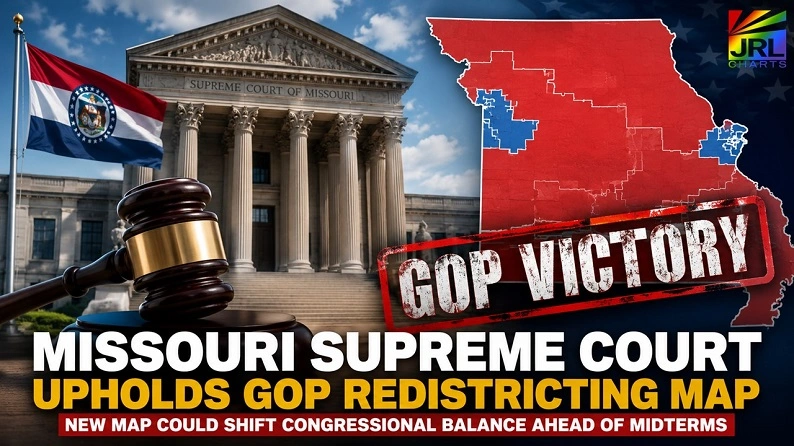
WASHINGTON, D.C. — (May 12, 2026) — The Missouri Supreme Court has upheld a Republican-backed congressional redistricting plan, delivering a significant legal victory that could reshape the state’s political balance heading into the upcoming midterm elections.
In a pair of rulings, the court determined that the newly drawn map complies with the Missouri Constitution, allowing it to move forward despite ongoing legal and political challenges. The updated district lines are expected to shift Missouri’s congressional delegation toward a stronger Republican advantage, potentially moving from a 6–2 split to a 7–1 alignment.
Related LGBT Business Finance & Politics News on JRL CHARTS:
• Watch: Anti-Trump “Had Enough?” Ad Sparks Political Firestorm in Election 2026
• Virginia Supreme Court Sparks National Alarm Over GOP Court Power & Minority Vote Dilution
• Project 2025 Already 50% Complete: Inside Trump’s Plan Reshaping America
• U.S. Banking Rule Ends ‘Reputational Risk’ Barrier, Expands Access for Legal Businesses
• LGBTQ Corporate Participation Plunges 65% in 2026 as DEI Retreat Reshapes Business Landscape
Court Rejects Constitutional Challenges
Opponents of the map argued that the redistricting plan violated constitutional requirements related to district structure, including concerns over how communities are grouped. However, the court sided with lower court decisions, concluding that the map meets the legal standards outlined under state law.
The ruling also rejected an effort to block the map through a referendum process. Plaintiffs had sought to pause implementation while election officials reviewed a petition to place the issue before voters. The court determined that the filing of such a petition does not automatically halt the map’s rollout.
Midterm Impact and Political Stakes
The decision significantly narrows the window for legal challenges to prevent the new district boundaries from being used in upcoming elections. With primary deadlines approaching, timing now plays a critical role in whether any further action could alter the map before ballots are finalized.
Election officials have indicated that a determination on the referendum petition could come later this summer. If validated, state law may require additional procedural steps; however, the proximity to election timelines could complicate any potential changes.
Part of a Broader National Trend
Missouri’s ruling comes amid a series of high-profile redistricting battles across the United States, where courts continue to play a central role in shaping electoral maps. Recent legal developments in multiple states have underscored how judicial decisions can influence representation at both state and federal levels.
Political operatives and advocacy groups on both sides are closely monitoring these rulings, recognizing their potential to impact congressional control and policy direction beyond individual states.
What Comes Next
While legal challenges may continue, the Missouri Supreme Court’s decision marks a pivotal moment in the state’s redistricting process. With election timelines advancing, the focus now shifts to how the new map will influence candidate strategy, voter turnout, and overall electoral dynamics in the months ahead.
Stay with JRL CHARTS LGBT Politics News for in-depth coverage on redistricting battles, election strategy, and the legal decisions shaping the future of U.S. politics.
His reporting focuses on federal court rulings, legislative developments, international human rights issues, and government actions impacting LGBTQ communities worldwide.
With nearly two decades of experience, Goldberg is recognized for his balanced analysis, investigative insight, and commitment to accurate, fact-based journalism that informs readers on the political forces shaping equality and justice.
- Supreme Court Blocks Trump’s Transgender Prison Care Ban in Major Legal Setback - October 21, 2026
- UNC Settles 18 Trump Administration Probes as Race and DEI Rules Face New Scrutiny - October 19, 2026
- Catholic Relief Services Loses Major LGBTQ Benefits Battle in Federal Appeals Court - October 19, 2026