By: Paul Goldberg – Senior Correspondent | LGBT Business Finance News
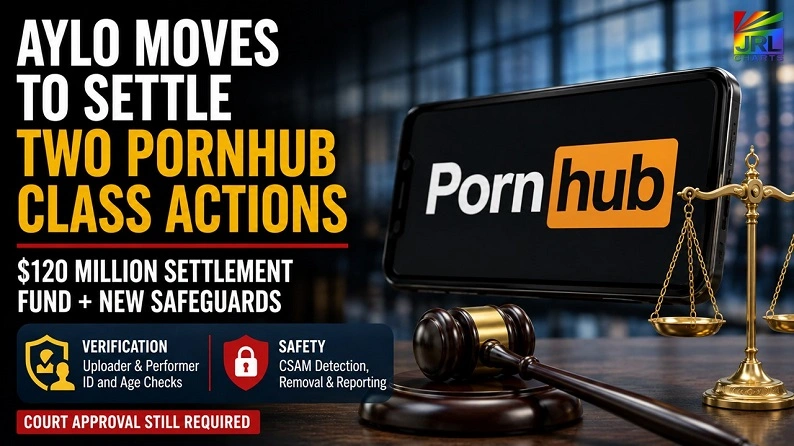
LAS VEGAS, NV — (August 16, 2026) — Aylo, the technology and media company formerly known as MindGeek and owner of Pornhub, is moving toward resolving two long-running class-action lawsuits involving allegations that material depicting minors was made available on websites operated by the company’s former corporate structure.
The proposed resolution represents a potentially significant legal and financial development for Aylo as its current ownership continues confronting litigation originating before and around its 2023 acquisition and corporate rebranding.
Under the reported settlement framework, Aylo would establish a $120 million settlement fund paid over six years while agreeing to maintain or implement extensive safeguards involving uploader verification, performer age and identity documentation, content reporting, removal requests and systems designed to detect suspected child sexual abuse material, commonly known as CSAM.
Trending Gay News Coverage on JRL CHARTS:
• Oliver Blanc Scores BelAmiOnline Model of the Week Spotlight
• Pornhub Data Breach Triggers 3 Class-Action Lawsuits as Adult Industry Faces Major Privacy Reckoning
• Helix Studios Introduces Leo West Opposite Gage Miller in “Miller Goes West”
• Hentaied Men’s ‘A True God’ Captures JRL CHARTS’ Attention with a Dark Supernatural Twist
• xHamster Pays $120K to Settle Texas Age Verification Lawsuit
• Nico Scooby Makes MEN.com Debut in ‘Burger Gooners’ Series
• Get the Latest in Gay News Entertainment News
Importantly, the proposed agreement does not constitute an admission of wrongdoing by Aylo or the defendants, and the underlying allegations remain disputed.
Two Major MindGeek-Era Class Actions Move Toward Resolution
The litigation involves two separate federal class actions.
The California case, Jane Doe v. MindGeek USA Incorporated et al., was filed in the U.S. District Court for the Central District of California in February 2021.
A second case, Doe #1 et al. v. MG Freesites LTD et al., was filed that same month in the U.S. District Court for the Northern District of Alabama.
Both cases concern allegations involving material depicting people who were minors when images or videos containing them were made available through websites operated by the defendants.
The defendants have disputed allegations of wrongdoing, and class certification does not represent a judicial determination that the allegations are true.
Litigation Followed Intense Scrutiny of Pornhub
The lawsuits emerged during a period of extraordinary scrutiny surrounding Pornhub and the content-moderation practices of its then-parent company, MindGeek.
A major catalyst was Nicholas Kristof’s December 2020 New York Times opinion column, commonly referred to as “The Children of Pornhub.”
The column alleged serious deficiencies involving content uploaded to Pornhub and triggered widespread political, financial and public scrutiny of the platform.
Anti-pornography and advocacy organizations subsequently used the controversy to press payment processors, lawmakers and regulators for stronger oversight of online adult platforms.
The fallout became a defining moment for MindGeek and the broader online adult industry, accelerating changes involving uploader verification, performer identification and content moderation.
Courts Certified Broad Classes
The litigation continued for years as the parties contested the allegations and numerous procedural and legal issues.
In the Alabama action, the federal court certified a class covering people who were under age 18 when they appeared in qualifying videos or images made available for viewing on websites owned or operated by the defendants beginning February 12, 2011.
The California litigation similarly advanced as a class action involving people who allegedly appeared as minors in material available through covered MindGeek-operated websites.
Those certifications moved the cases beyond individual plaintiffs and dramatically increased their potential legal and financial significance.
Aylo Reportedly Agrees to $120 Million Settlement Fund
Following mediation, the parties moved toward a negotiated resolution.
Under the proposed settlement framework, Aylo would pay $120 million into a settlement fund over six years.
The agreement also reportedly includes a series of operational requirements addressing the systems used to verify uploaders and people appearing in content.
Other provisions concern procedures for identifying and removing suspected or confirmed CSAM, handling content-removal requests, processing withdrawal-of-consent requests and improving mechanisms through which content can be flagged for review.
Those requirements make the proposed settlement more than a financial resolution.
If approved, it would also establish continuing operational obligations surrounding trust and safety on Aylo-operated platforms.
Aylo Does Not Admit Wrongdoing
A crucial distinction in reporting the settlement is that Aylo is not admitting liability or wrongdoing by agreeing to resolve the litigation.
Settlement agreements routinely allow companies to resolve expensive and uncertain litigation without conceding the plaintiffs’ allegations.
The proposed agreement also does not concede the defendants’ position regarding protections potentially available under Section 230 of the Communications Decency Act, one of the most consequential federal statutes governing liability for online platforms hosting third-party material.
The settlement therefore could resolve the class claims without requiring a final judicial determination on some of the major liability questions raised during the litigation.
Today’s Aylo Is Under Different Ownership
Another important distinction is the corporate transformation that occurred while these cases were pending.
Canadian private equity firm Ethical Capital Partners acquired MindGeek in March 2023, taking control of a portfolio that included Pornhub and numerous other digital properties.
Several months later, MindGeek formally rebranded as Aylo.
The company characterized the name change as a fresh start centered in part on trust, safety and greater corporate transparency.
That means Aylo’s current ownership inherited substantial legal and reputational issues associated with the previous MindGeek era while simultaneously attempting to change the company’s compliance infrastructure and public positioning.
The proposed class-action settlement may become one of the most consequential examples of that inherited legal exposure being resolved under the company’s current ownership.
Pornhub Says Verification Standards Have Changed Dramatically
Aylo and Pornhub have implemented extensive changes to uploader and performer verification since the events underlying the lawsuits.
Among the most significant has been the expansion of identity and consent documentation requirements for people appearing in uploaded content.
Aylo has stated that it progressively expanded those requirements across new and existing accounts and eventually applied them to legacy material.
The company established a June 30, 2025 deadline for models to provide required consent records for performers appearing in legacy content.
Material that failed to satisfy those requirements was deactivated, according to Aylo.
The result, the company says, is a platform where model-uploaded content must have identity and consent documentation for performers on file.
Those changes do not determine liability for historical allegations in the class actions. They do, however, provide important context for understanding why many of the safeguards contemplated by the proposed settlement overlap with systems Aylo says it has already implemented.
$120 Million Settlement Carries Broader Business Implications
For the adult digital-media sector, the proposed agreement extends well beyond Pornhub.
Major online platforms increasingly operate in an environment where identity verification, consent documentation, content moderation and regulatory compliance are becoming fundamental business infrastructure rather than secondary trust-and-safety functions.
Payment processors, financial institutions, regulators, lawmakers and technology providers are also placing greater emphasis on how platforms verify users and individuals appearing in uploaded material.
That makes compliance a financial issue as much as a legal one.
For a company operating platforms at Pornhub’s scale, verification technology, moderation teams, reporting infrastructure and regulatory compliance can represent substantial continuing operating costs.
At the same time, failures in those areas can expose companies to litigation, payment-processing problems, regulatory scrutiny and significant reputational damage.
Court Approval Remains Necessary
The proposed settlement does not immediately end the litigation.
Federal class-action settlements generally require judicial review before becoming final.
The court must first determine whether preliminary approval is appropriate, after which class members must receive an opportunity to review the agreement and exercise applicable rights, including submitting objections.
A final approval hearing would follow before the settlement could become binding.
Until that process is completed, the agreement remains proposed rather than final.
For Aylo, however, reaching a negotiated framework potentially marks an important step toward resolving two of the most prominent pieces of litigation inherited from the MindGeek era.
And for the broader digital adult industry, the proposed $120 million settlement underscores a business reality that has become increasingly difficult for large platforms to ignore: trust, safety, performer verification and documented consent are now central components of corporate risk management.
The claims described in this report are allegations made in civil litigation. Settlement of a lawsuit does not constitute an admission of liability or wrongdoing unless expressly stated otherwise.
His reporting focuses on federal court rulings, legislative developments, international human rights issues, and government actions impacting LGBTQ communities worldwide.
With nearly two decades of experience, Goldberg is recognized for his balanced analysis, investigative insight, and commitment to accurate, fact-based journalism that informs readers on the political forces shaping equality and justice.
- GameStop Hit With Federal Lawsuit After Gay Employee Reports Threats — Then Gets Fired - October 16, 2026
- Meta Paid 29 Anti-LGBTQ Accounts as 2026 Midterm Misinformation Spreads - October 14, 2026
- Orbán’s Anti-LGBTQ Legacy Crumbles as Hungary Votes 139–51 for Change - October 13, 2026