By Paul Goldberg — Senior Correspondent | LGBT Business Finance News
MOUNTAIN VIEW, CA — (November 2, 2026) — Google built one of the world’s most profitable digital businesses by helping billions of people find information. Now, the artificial intelligence revolution is forcing its parent company, Alphabet Inc. (NASDAQ: GOOGL), to confront a potentially disruptive question: What happens when search engines start delivering answers instead of sending users to websites?
As generative AI platforms including OpenAI’s ChatGPT reshape consumer expectations, Google is accelerating its transformation through AI Overviews, AI Mode, and its Gemini artificial intelligence ecosystem.
Trending International LGBTQ News on JRL CHARTS:
• Breaking Military News involving LGBTQ Service Members and Security
• LGBT Politics Europe – Updates on Hate Crimes, Judicial Rulings
• Stay Up to Date on the Happenings in LGBT Politics Asia
• You Won’t Believe What Is Breaking Now on LGBTQ News
But Wall Street’s concern extends beyond technological competition. Investors are questioning whether Google’s AI-powered search strategy can protect the advertising revenue that remains central to Alphabet’s financial performance.
Alphabet’s $63.35 Billion Search Business Faces a New Reality
Alphabet’s third-quarter 2026 financial results illustrate the extraordinary scale of the business at stake.
The company reported $127.6 billion in quarterly revenue, an increase of 25% year over year.
Google Search and related revenue reached $63.35 billion, representing 12% annual growth, while Google Cloud revenue surged 103% to approximately $30.7 billion.
Despite those gains, Alphabet’s results revealed growing pressure on the economics of AI-powered search.
Google Search revenue growth slowed from 19% in the first quarter to 17% in the second quarter and 12% in the third quarter of 2026.
Company executives identified lower monetization within AI Mode as one factor affecting search revenue growth.
The challenge is becoming increasingly clear: Google must encourage consumers to embrace AI search while developing advertising formats capable of generating comparable financial returns.
Google’s AI Overviews Create a New Threat for Digital Publishers
Traditional Google Search helped build an enormous digital advertising ecosystem by directing users to news organizations, retailers, businesses, and independent websites.
AI Overviews change that relationship by presenting generated summaries directly within search results.
For consumers, the technology can provide faster answers. For publishers, however, it raises concerns about declining referral traffic and fewer opportunities to generate advertising revenue.
Research published by the Pew Research Center found that users encountering AI-generated summaries clicked traditional search links during just 8% of visits, compared with 15% of visits without AI summaries.
The findings highlight a growing economic concern for digital publishers whose business models depend on search referrals, reader engagement, and display advertising.
Importantly, the research demonstrates an association between AI summaries and lower click activity, rather than establishing that every publisher is experiencing identical traffic losses.
ChatGPT and Gemini Are Reshaping the Search Competition
Google’s transformation is also being driven by a changing competitive environment.
ChatGPT helped popularize conversational AI as an alternative way to research questions, summarize information, and explore complex subjects.
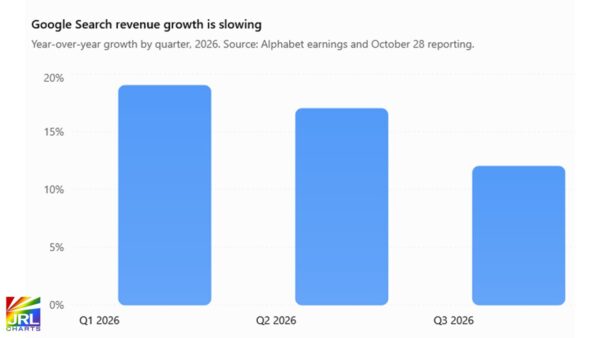
Google Search revenue growth decelerated across the first three quarters of 2026, declining from 19% to 12% year over year. Chart: JRL CHARTS LGBT Business Finance News | Source: Alphabet quarterly earnings.
Google has responded by integrating Gemini-powered experiences across its search products, combining AI Overviews, AI Mode, and traditional search results.
During Alphabet’s October 28 earnings presentation, Chief Executive Officer Sundar Pichai reported that AI investments were contributing to increased search usage, including commercial queries.
Pichai also disclosed that the Gemini application had reached one billion users.
The company maintains that artificial intelligence is expanding the ways consumers interact with search rather than simply replacing conventional search behavior.
Nevertheless, the transition presents a difficult business equation: More AI usage does not automatically guarantee higher advertising revenue per interaction.
Wall Street Confronts the Cost of Google’s AI Transformation
Alphabet’s artificial intelligence strategy extends far beyond search.
The company is investing heavily in computing infrastructure, data centers, specialized processors, and cloud services to support growing demand for AI technology.
Although Google Cloud more than doubled its quarterly revenue, investors remain focused on the financial consequences of massive infrastructure spending and the profitability of AI-powered products.
Reuters reported that Alphabet shares declined sharply in after-hours trading following the October 28 earnings release as investors reacted to advertising performance, cash-flow pressure, and rising AI investment requirements.
These concerns demonstrate how artificial intelligence is changing the investment case for one of the world’s largest technology companies.
Google must simultaneously defend its existing advertising business, compete in advanced AI development, and establish sustainable revenue opportunities across its expanding AI ecosystem.
The Bigger Question: Can Google Protect the Open Web?
Beyond Wall Street, Google’s search transformation raises a broader question about the future of digital publishing.
If AI-generated answers increasingly satisfy consumer searches without requiring visits to original sources, publishers may face additional pressure on advertising revenue and audience development.
That creates a complicated relationship between technology platforms and the independent websites that produce much of the information used across the digital ecosystem.
For Google, maintaining a healthy publishing environment could prove important to the long-term value of its search products.
For advertisers, media companies, and investors, the transition is likely to influence digital marketing strategies, search visibility, and the economics of online content distribution.
The central question is no longer whether artificial intelligence will change Google Search. It already has. The financial challenge is whether Alphabet can make its next generation of search as commercially successful as the business it is transforming.
Image Credit
JRL CHARTS LGBT Business Finance News | Original AI-generated editorial illustration.
JRL CHARTS LGBT Business Finance News continues delivering independent coverage of Wall Street, artificial intelligence, corporate earnings, and the technology companies transforming the global digital economy.

His reporting focuses on federal court rulings, legislative developments, international human rights issues, and government actions impacting LGBTQ communities worldwide.
With nearly two decades of experience, Goldberg is recognized for his balanced analysis, investigative insight, and commitment to accurate, fact-based journalism that informs readers on the political forces shaping equality and justice.
- Google’s AI Gamble: Can Gemini Save Search Without Destroying Its Cash Machine? - November 2, 2026
- Exxon, Chevron Cash In as $130 Billion Oil Boom Threatens Trump’s Midterms - November 1, 2026
- Cedars-Sinai Takes Aim at LGBTQ Smoking Crisis With The Quit Alliance - October 30, 2026