By: Paul Goldberg – Senior Correspondent | LGBT Business Finance News
LAS VEGAS, NV — (September 23, 2026) — A worldwide funding pullback is pushing hundreds of LGBTQ and intersex organizations toward a financial breaking point, with a new international survey finding that more than one-third of affected groups believe they could be forced to close within the next 12 months.
Outright International’s new Breaking Point report surveyed 229 LGBTIQ organizations across 94 countries between late February and late April 2026. Of those organizations, 203 — nearly 89% of respondents — reported losing funding since January 2025.
Trending LGBTQ Business and Politics News on JRL CHARTS:
• Leaked White House Talking Points Reveal GOP Defense of Trump Media Ban
• UNT Deletes LGBTQ History Page After Texas Lawmaker Attack — But the Archive Isn’t Gone
• SC Holds Back Grants From Only Two Arts Groups — Both Are LGBTQ+
• Michigan Church Targets LGBTQ Acceptance in California With Massive 248-Page Complaint
• Review More in LGBTQ Business and Politics News on JRL CHARTS
The financial damage extends far beyond modest reductions in grant income.
Among the affected organizations, Outright found that nearly half lost more than half of their total budgets. Only 3% described themselves as financially stable, while 36% said they were likely or very likely to shut down completely within the coming year.
The findings offer a stark picture of what happens when international funding disappears from organizations that often operate with limited reserves, narrow donor bases and few alternative sources of capital.
U.S. Funding Retreat Accounts for Much of the Loss
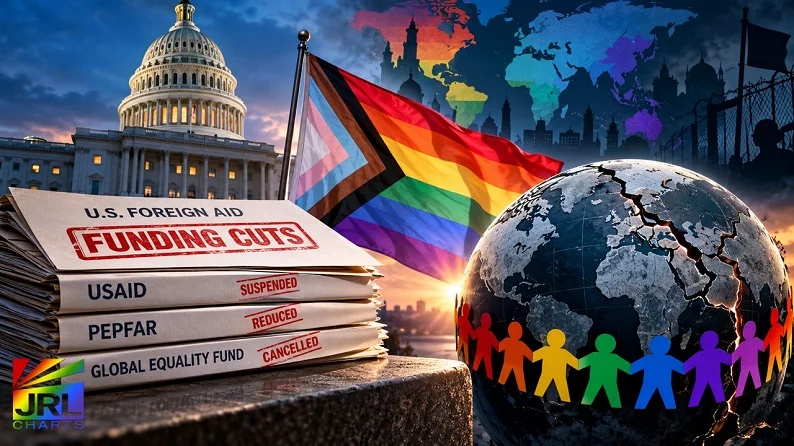
The funding collapse coincided with a major shift in U.S. foreign assistance following President Donald Trump’s return to office in January 2025.
Trump issued an executive order freezing nearly all foreign assistance pending a review of whether programs aligned with his administration’s foreign policy. Secretary of State Marco Rubio subsequently said in March 2025 that 83% of USAID programs had been terminated, with remaining programs slated for administration through the State Department.
Outright found that more than half of the affected organizations identified a U.S. government-linked funding source — including USAID, the State Department or the President’s Emergency Plan for AIDS Relief — among funders that reduced, suspended or withdrew support. But the report also says the contraction was broader than Washington, citing pullbacks or shifts among corporate, institutional and philanthropic donors as well.
That distinction matters: the current financial crisis cannot be attributed exclusively to a single government funding stream.
Outright also reports that global funding for LGBTIQ organizations had already begun declining before the change in U.S. policy, meaning the 2025 cuts struck a sector that was already facing increasing financial pressure.
Financial Damage Hits High-Risk Countries Hardest
Perhaps the report’s most consequential finding is where the financial damage has been concentrated.
According to Outright’s country-level analysis, organizations operating under the harshest social and institutional conditions were roughly two to three times more likely to have been affected by funding terminations than organizations in countries at the opposite end of the measures studied. Health Policy Watch highlighted the same disparity in its analysis of the report.
That creates an especially difficult financing problem.
In countries where LGBTQ people face criminalization, discrimination or limited institutional protection, community organizations may have fewer opportunities to replace international grants with government funding, domestic philanthropy or conventional fundraising.
The consequences are therefore appearing not only on organizational balance sheets but also in services.
Outright documents reductions involving shelters, legal assistance, health programs, emergency relocation, advocacy and other community services.
Offices Close, Staff Disappear and Services Shrink
The report provides examples across several regions of how those financial losses are translating into operations.
In Iraq, funding cuts led IraQueer to discontinue safety and security training for activists and LGBTQ organizations. An intersex-led organization in West Africa reported that it could no longer maintain its office or continue paying staff.
In Ecuador, an organization that had operated a community center for roughly a decade closed the facility in February 2026.
An LGBTQ-led refugee organization in Uganda reported losing funding previously used for emergency relocation of people facing immediate threats, while an organization in Ukraine said reduced resources forced it to cut specialist compensation and reduce the amount of assistance it could provide.
The Tonga Leitis Association also reported reducing activities, with the organization warning that the funding contraction was weakening infrastructure supporting HIV prevention.
These examples illustrate a larger financial vulnerability: for organizations whose budgets primarily support staff and direct services, a 25%, 50% or larger revenue loss cannot necessarily be absorbed through ordinary cost-cutting.
Eventually, services themselves become the expense that gets eliminated.
HIV Programs Are Part of the Financial Fallout
The funding shock also intersects with HIV prevention and treatment infrastructure.
Health Policy Watch reported that HIV services, mental-health programs and harm-reduction initiatives serving LGBTQ communities have been significantly affected during the funding contraction.
Earlier research cited by Human Rights Watch documented similar consequences.
Following the January 2025 U.S. aid freeze, Outright initially suspended 120 grants across 42 countries. Those grants ranged from approximately $9,000 to $180,000 and supported programs including health care, legal assistance and economic livelihoods.
Human Rights Watch reported that its earlier research with Outright found organizations laying off employees, shutting programs and curtailing medical, legal and emergency services after funding disappeared.
A Funding Model Faces a Longer-Term Test
The Breaking Point report ultimately raises a financial question extending beyond the immediate effects of the 2025 cuts: how sustainable is an international LGBTQ nonprofit sector when significant portions of its infrastructure depend on a relatively concentrated group of institutional donors?
The latest survey does not represent every LGBTQ organization worldwide, and Outright explicitly cautions readers to distinguish between its 229 survey respondents, the 203 organizations reporting funding losses and its separate country-level analysis.
But within that surveyed population, the deterioration is substantial.
Nearly half of affected organizations have lost more than half their budgets. Only 3% describe their organizations as stable. And more than one in three say closure could come within the next year.
Those figures turn what began as a foreign-aid policy shift into a broader business and financial problem for the global LGBTQ nonprofit sector: how to replace lost institutional capital before reduced staffing, shuttered facilities and suspended programs become permanent.
JRL CHARTS – LGBT Business Finance News continues tracking the funding, policy and economic forces reshaping LGBTQ organizations and businesses worldwide.
His reporting focuses on federal court rulings, legislative developments, international human rights issues, and government actions impacting LGBTQ communities worldwide.
With nearly two decades of experience, Goldberg is recognized for his balanced analysis, investigative insight, and commitment to accurate, fact-based journalism that informs readers on the political forces shaping equality and justice.
- Japan Faces a $101.5 Billion LGBTQ Equality Problem, Economic Study Warns - October 12, 2026
- Alito Says Gay Marriage Is Safe — But Didn’t They Say That About Roe v. Wade? - October 12, 2026
- Feds Raid Ilhan Omar’s Home — She Fires Back at Trump: ‘I Will Not Be Silenced’ - October 12, 2026