By Paul Goldberg – Senior Correspondent | LGBT Business Finance News
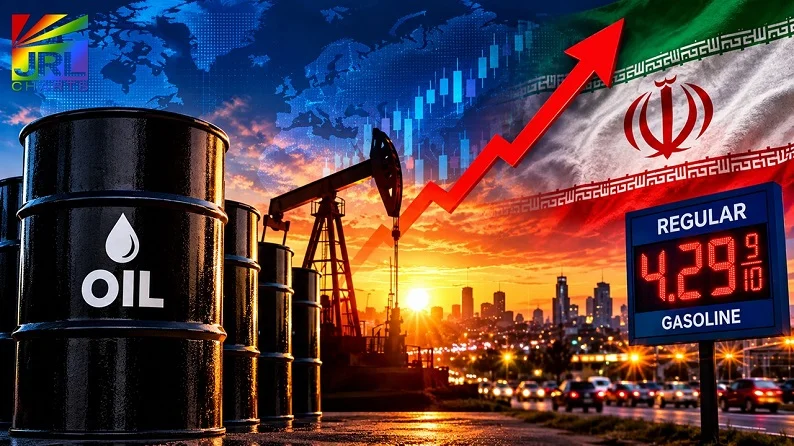
WASHINGTON, D.C. — (October 23, 2026) — Global oil prices surged to their highest levels in months Friday as the continuing war involving Iran intensified concerns over energy supplies, international shipping and inflation across the United States.
International benchmark Brent crude climbed as high as $117.14 per barrel, while U.S. benchmark West Texas Intermediate (WTI) traded near $102, placing renewed pressure on businesses and consumers already confronting elevated energy costs.
The latest increase comes as the conflict approaches its eighth month, with instability surrounding the strategically important Strait of Hormuz continuing to influence global energy markets.
Trending LGBTQ Business and Politics News on JRL CHARTS:
• Wall Street Hammered as AI Stocks Tumble & Oil Prices Surge — LGBTQ Businesses Brace for Fallout
• Bank of America Faces Historic $1.2B Reckoning as Q3 Profits Plunge 17%
• GameStop Hit With Federal Lawsuit After Gay Employee Reports Threats — Then Gets Fired
• Meta Paid 29 Anti-LGBTQ Accounts as 2026 Midterm Misinformation Spreads
• LGBTQ Voters Are Fired Up for the 2026 Midterms — HRC Survey Reveals 87% Plan to Vote
• Review More in LGBTQ Business and Politics News on JRL CHARTS
Iran War Pushes Global Energy Markets Higher
The Strait of Hormuz remains one of the world’s most important oil transportation corridors, connecting Persian Gulf producers with international markets.
Although commercial vessels continue traveling through the waterway, military threats and shipping risks have increased uncertainty surrounding the movement of crude oil.
Those concerns can translate into higher insurance premiums, transportation expenses and fuel costs, creating financial consequences far beyond the Middle East.
For American businesses dependent on transportation, manufacturing and imported merchandise, sustained increases in energy prices could complicate operating budgets and supply-chain planning.
U.S. Gas Prices Remain Above $4 as Inflation Concerns Grow
American motorists are already feeling the financial consequences.
According to AAA, the national average price of regular gasoline reached approximately $4.29 per gallon on Friday, compared with $3.07 a year earlier.
Although gasoline prices have declined roughly 18 cents over the past month, they remain substantially higher than October 2025 levels.
Higher crude oil prices could limit further relief at the pump, particularly if geopolitical instability continues to disrupt global energy markets.
The financial consequences extend beyond gasoline purchases. Diesel fuel, freight transportation and distribution costs can influence the prices businesses pay to move products across the country.
What Higher Oil Prices Mean for LGBTQ-Owned Businesses and Retailers
For LGBTQ-owned small businesses, independent retailers and companies serving specialized consumer markets, rising energy expenses represent another potential challenge in an already competitive economy.
Higher transportation and shipping costs can reduce profit margins, particularly for smaller businesses that lack the purchasing power of major national retail chains.
Adult retail operators, pleasure-products distributors, apparel companies and other specialty wholesalers could face additional pressure if suppliers and transportation providers pass along increased expenses.
Businesses may be forced to absorb those costs, renegotiate purchasing arrangements or adjust retail prices.
At the same time, higher household fuel expenses can reduce discretionary spending, potentially affecting consumer demand for fashion, entertainment and specialty retail merchandise.
These are broader economic risks rather than evidence that LGBTQ-owned businesses are experiencing disproportionate impacts.
Energy Prices Add Economic Uncertainty Ahead of 2026 Midterms
The renewed oil-price surge arrives less than two weeks before the November 3 U.S. midterm elections, placing inflation, gasoline prices and household affordability firmly within the national economic conversation.
Energy costs are particularly significant because their effects can spread throughout transportation, manufacturing, agriculture and retail distribution.
While the direction of oil prices remains uncertain, continued instability in the Middle East could keep energy markets volatile and complicate efforts to bring down consumer prices.
For business owners, the immediate concern is whether elevated energy costs will become a prolonged operating expense rather than a temporary market disruption.
JRL CHARTS LGBT Business Finance News continues monitoring global energy markets, U.S. inflation and economic developments affecting LGBTQ-owned businesses, independent retailers and the broader business community.
His reporting focuses on federal court rulings, legislative developments, international human rights issues, and government actions impacting LGBTQ communities worldwide.
With nearly two decades of experience, Goldberg is recognized for his balanced analysis, investigative insight, and commitment to accurate, fact-based journalism that informs readers on the political forces shaping equality and justice.
- Oil Prices Explode to $117 a Barrel as Iran War Sends Shockwaves Through U.S. Economy - October 23, 2026
- Lindsey Graham Accused of Paying 3 Male Escorts — One Claims He Was 17 - October 22, 2026
- LGBTQ Nonprofit Makes $3 Million Move to Transform Downtown Buffalo - October 21, 2026