By Paul Goldberg – Senior Correspondent | LGBT Business Finance News
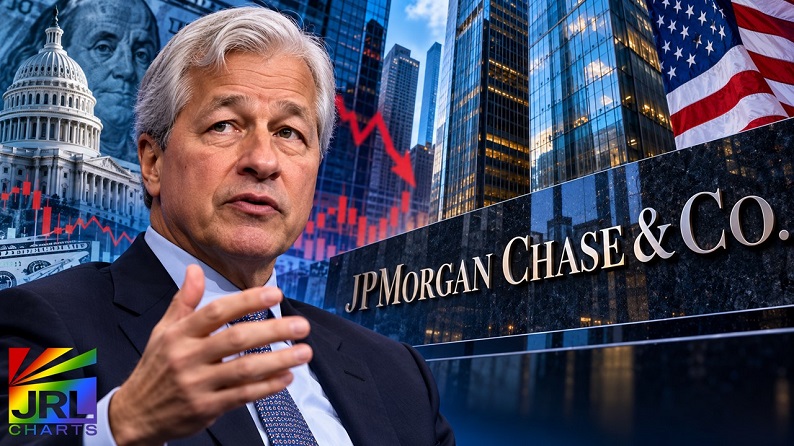
NEW YORK, NY — (October 25, 2026) — JPMorgan Chase (JPM) CEO Jamie Dimon is raising concerns about five major economic pressures that could challenge American businesses, financial markets, and consumers, even as the nation’s largest bank reports billions in quarterly profits.
The warning comes as corporate investment and consumer spending continue supporting the U.S. economy, creating an increasingly complicated financial picture: strong business activity on the surface, with potentially disruptive economic forces developing underneath.
Trending LGBTQ Business and Politics News on JRL CHARTS:
• Oil Prices Explode to $117 a Barrel as Iran War Sends Shockwaves Through U.S. Economy
• LGBTQ Nonprofit Makes $3 Million Move to Transform Downtown Buffalo
• Sportsheets Scores Major WIPO Victory Against Copycat Website
• UNC Settles 18 Trump Administration Probes as Race and DEI Rules Face New Scrutiny
• Breaking Now on LGBT Business Finance News
In JPMorgan Chase’s October 13 third-quarter earnings report, Dimon identified five areas of concern: large government deficits, persistent inflation, elevated asset valuations, rising interest rates, and geopolitical instability.
His warning carries considerable weight. JPMorgan Chase reported $15.3 billion in third-quarter net income, $50.2 billion in reported revenue, and approximately $5.1 trillion in assets as of September 30, 2026.
Despite that financial strength, the bank’s leadership is maintaining a cautious outlook.
“These forces may be manageable, but we remain prepared for a wide range of outcomes,” Dimon stated in the company’s earnings release.
For business owners, investors, retailers, and financial institutions, that approach underscores an important distinction: a resilient economy is not necessarily an economy without risk.
1. America’s Growing Fiscal Deficits Raise Long-Term Concerns
One of Dimon’s central concerns involves the federal government’s continued reliance on deficit spending.
Large fiscal deficits can create economic challenges when government borrowing requirements remain elevated over extended periods.
Increased borrowing may contribute to upward pressure on Treasury Yields, influence financial market expectations, and raise financing costs throughout the broader economy.
For American businesses, those pressures can eventually affect commercial lending, equipment financing, real estate development, and capital investment.
Small and medium-sized companies may be especially sensitive because they often have fewer financing alternatives than major corporations.
The concern is not that government deficits automatically produce an economic crisis. Rather, persistent borrowing needs can reduce financial flexibility when policymakers confront unexpected economic shocks.
2. Sticky Inflation Continues to Threaten Business Profit Margins
Inflation remains another significant concern for JPMorgan’s leadership.
Even when the overall pace of price increases moderates, businesses and consumers can continue experiencing the financial consequences of higher accumulated costs.
For retailers and wholesalers, those pressures can appear through increased supplier pricing, transportation expenses, insurance premiums, labor costs, and commercial rents.
Businesses must then decide whether to absorb additional expenses or pass them along to customers.
Neither option is particularly attractive.
Absorbing costs can compress operating margins, while raising prices can discourage spending among price-sensitive consumers.
The challenge becomes more complicated when inflation affects essential operating expenses that businesses cannot easily reduce.
For independent retailers, distributors, and specialty product suppliers, disciplined inventory purchasing and careful expense management become increasingly important in such an environment.
3. Elevated Stock Market Valuations Create Financial Vulnerability
Dimon’s third warning concerns elevated asset prices.
When stocks and other financial assets trade at valuations that depend heavily on future earnings growth, markets can become more vulnerable to disappointing economic developments.
The rapid expansion of artificial intelligence infrastructure has introduced another dimension to the discussion.
Technology companies are investing heavily in data centers, computing equipment, and the infrastructure needed to support AI services.
Those investments could generate substantial long-term economic benefits.
However, questions remain about how quickly future revenue and profitability will justify the scale of spending.
If investor expectations move significantly ahead of actual business performance, market corrections can become more severe.
That does not mean an AI-related market collapse is inevitable.
It does mean that investors and corporate executives should distinguish between genuine technological progress and the financial assumptions embedded in market valuations.
For businesses with retirement investments, corporate reserves, or exposure to publicly traded companies, sudden market volatility can have consequences extending beyond Wall Street.
4. Rising Interest Rates Could Reshape Borrowing and Investment
Interest rates represent another major economic pressure point.
Higher borrowing costs can influence everything from residential mortgages and commercial real estate financing to business credit lines and consumer credit cards.
For companies planning expansion, the cost of financing can determine whether a project moves forward.
A business considering a new distribution center, warehouse, retail location, or technology upgrade must evaluate expected returns against the expense of borrowing.
Higher interest rates can make otherwise attractive investments less financially viable.
Consumers may also reduce discretionary spending when debt payments consume a larger share of household income.
That creates a potential ripple effect for retailers and other businesses dependent on consumer purchases.
Importantly, Dimon’s warning about rising rates should not be interpreted as a prediction that the Federal Reserve will necessarily increase its benchmark interest rate.
Market borrowing costs can move independently of central bank policy, particularly when bond investors reassess inflation expectations, fiscal conditions, or financial risks.
5. Geopolitical Instability Threatens Global Trade and Supply Chains
The fifth warning extends beyond America’s borders.
Geopolitical conflicts, trade tensions, and disruptions to international commerce can influence domestic economic conditions even when the underlying events occur thousands of miles away.
Energy markets are particularly sensitive to geopolitical instability.
Disruptions involving major oil-producing regions or important shipping routes can increase transportation costs and introduce new inflationary pressures.
International manufacturers, importers, wholesalers, and distributors may face additional challenges when shipping costs rise or delivery schedules become unpredictable.
For companies dependent on overseas manufacturing, geopolitical uncertainty can complicate inventory planning and supplier relationships.
The effects can spread through multiple industries, including electronics, apparel, consumer products, industrial equipment, and specialty retail.
Businesses with concentrated supplier networks may face greater exposure than companies able to obtain merchandise from several regions.
JPMorgan’s $15.3 Billion Quarter Reveals a Different Side of the Story
While Dimon’s warnings have attracted attention, JPMorgan Chase’s latest financial results demonstrate that economic risks can coexist with strong corporate performance.
The banking giant reported third-quarter net income of $15.3 billion, compared with $14.4 billion during the corresponding period in 2025.
The company also reported approximately $1.5 trillion in cash and marketable securities and a standardized Common Equity Tier 1 capital ratio of 13.9%.
Those figures provide context for the bank’s emphasis on financial resilience.
JPMorgan’s approach includes maintaining substantial financial resources, monitoring economic risks, and making capital allocation decisions with multiple potential economic outcomes in mind.
The bank also reported reducing share repurchases during the quarter, while emphasizing investment in its businesses and support for clients.
For investors, this illustrates how a major financial institution can continue generating substantial profits while remaining cautious about future conditions.
What Jamie Dimon’s Warning Means for American Businesses
The broader significance of Dimon’s comments extends beyond the banking industry.
Independent retailers, distributors, manufacturers, and service companies operate within the same economic environment that influences major financial institutions.
Although smaller businesses cannot replicate JPMorgan’s balance sheet, they can apply several of the underlying risk-management principles.
Maintaining adequate liquidity, reviewing financing arrangements, controlling operating expenses, and avoiding excessive dependence on a single revenue source can improve financial flexibility.
Business owners may also benefit from evaluating supplier concentration, monitoring inventory turnover, and considering how changes in consumer demand could affect cash flow.
For companies serving specialized markets, including LGBTQ-owned enterprises and businesses operating within the broader adult retail and pleasure products industries, these considerations are particularly relevant when expansion depends on imported merchandise, commercial credit, and discretionary consumer spending.
The objective is not to stop investing or expanding.
It is to ensure that growth decisions remain sustainable under less favorable economic conditions.
The Bigger Economic Question: Can Growth Continue Despite the Risks?
Dimon’s warnings do not amount to a declaration that the United States is entering a recession.
In fact, his comments acknowledge the strength of current business investment and consumer spending.
The concern is that several economic pressures could intensify simultaneously, creating challenges that are more difficult to manage than any single risk in isolation.
Persistent inflation could keep borrowing costs elevated. Geopolitical disruptions could increase energy prices. Higher financing costs could weaken investment activity, while expensive financial assets could become vulnerable to changing expectations.
Alternatively, these pressures could remain manageable while the economy continues expanding.
That uncertainty is precisely why JPMorgan is preparing for multiple possible outcomes rather than relying on a single economic forecast.
For American businesses and investors, the message is straightforward: financial strength today should not eliminate the need for preparation tomorrow.
JRL CHARTS LGBT Business Finance News continues tracking major developments in banking, corporate finance, economic policy, and global business markets, delivering financial news and analysis relevant to business owners, industry professionals, and investors.

His reporting focuses on federal court rulings, legislative developments, international human rights issues, and government actions impacting LGBTQ communities worldwide.
With nearly two decades of experience, Goldberg is recognized for his balanced analysis, investigative insight, and commitment to accurate, fact-based journalism that informs readers on the political forces shaping equality and justice.
- Jamie Dimon Sounds the Alarm: 5 Economic Threats That Could Shake America - October 25, 2026
- Cape Town Pride 2027 Goes BIG With 24 Days of LGBTQ Celebrations! - October 24, 2026
- LGBTQ Rights on the Line in 7 States as 2026 Midterm Elections Near - October 24, 2026