By: Paul Goldberg – Senior Correspondent | Breaking Military News
WASHINGTON, D.C. — (September 30, 2026) — The Pentagon is preparing for a sweeping transformation that reaches from autonomous weapons and hardened military bases to the number of generals commanding America’s forces — and even the place of religion inside the Department of Defense.
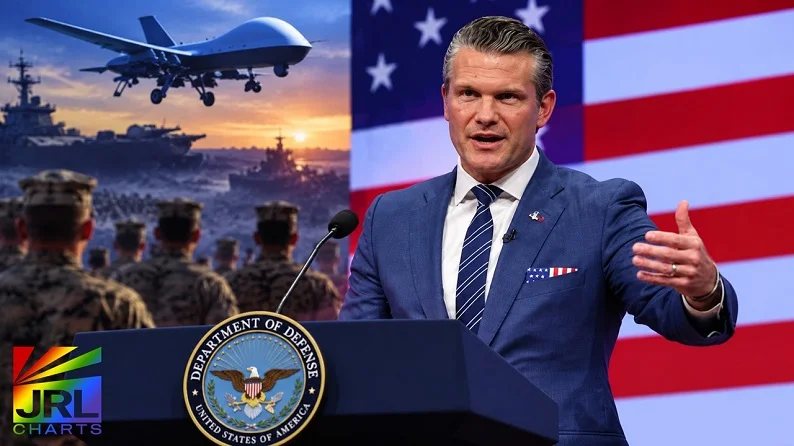
Defense Secretary Pete Hegseth used his September 30 “State of the Force” address at Marine Corps Base Quantico in Virginia to unveil six major initiatives that could reshape how the United States military fights, powers its installations, develops future weapons and trains its next generation of officers.
Trending LGBT Breaking Military News Coverage on JRL CHARTS:
• Navy Weighs Scrapping USS Doris Miller Name for Trump in Historic Carrier Shakeup
• VA Loses Again as Judge Blocks Third Attempt to Cancel AFGE Contract
• Did the Pentagon Force Scouting America to Change Its Transgender Policy?
• VA Restructures LGBTQ+ Veteran Programs Under New Federal Policy Changes
• Breaking Military News involving LGBTQ Service Members and Security
Among them are a new four-star Autonomous Warfare Command, a massive future military base, a nationwide “Fortress America” resilience program, a new military-college initiative and Project Meridian — an effort involving Elon Musk, Palmer Luckey and former House Speaker Newt Gingrich that will examine what warfare could look like decades from now.
Hegseth also defended plans to shrink the ranks of America’s generals and admirals by 20 percent.
But another announcement carries implications far beyond weapons and military infrastructure.
Hegseth is establishing an Office of Religious Affairs with a direct line to the Defense secretary, placing religious support closer to the Pentagon’s senior leadership at a time when his promotion of Christian worship and rhetoric inside the department has already generated controversy.
Together, the announcements provide one of the clearest pictures yet of the military Hegseth wants to build.
Pentagon Creates a Four-Star Autonomous Warfare Command
At the center of Hegseth’s technological overhaul is the creation of the Autonomous Warfare Command, or AUTOWARCOM.
The Pentagon intends to establish the organization as a four-star functional combatant command designed to accelerate the development and deployment of autonomous and robotic capabilities throughout the armed forces.
The target date for the command to become operational is October 1, 2027.
Unlike geographic combatant commands organized around particular regions of the world, AUTOWARCOM is being organized around a military capability: autonomous warfare.
That gives the concept potentially enormous reach across the joint force.
The command is expected to receive dedicated manpower, budget and acquisition authorities while establishing career pathways for officers and enlisted personnel specializing in autonomous warfare.
The Pentagon also wants emerging systems tested against realistic opposition and under difficult battlefield conditions rather than waiting for traditional procurement cycles to determine what works.
Recent wars have demonstrated why.
Cheap drones, electronic warfare and rapidly changing autonomous technologies have allowed forces to adapt battlefield tactics at speeds that conventional military acquisition systems have struggled to match.
Hegseth’s answer is to institutionalize that ability to adapt.
Project Meridian Looks Beyond Today’s Battlefield
While AUTOWARCOM concentrates on putting autonomous technology into the current force, Project Meridian is supposed to look considerably further into the future.
Hegseth selected SpaceX and xAI chief Elon Musk, Anduril co-founder Palmer Luckey and former House Speaker Newt Gingrich to help lead the effort under Pentagon research and engineering leadership.
Project Meridian is not being presented as another military strategy review.
Instead, its mission is to examine emerging technologies, future battlefields and capabilities that American forces could require decades from now.
The Pentagon has given the project 120 days to produce its findings.
Hegseth argued that forecasting future conflict should not be confined to people already working inside the Pentagon, saying outside technologists and innovators could challenge institutional assumptions about warfare.
The involvement of technology executives whose industries intersect with national-security procurement could also invite questions about how the Pentagon handles potential conflicts of interest as the initiative develops.
Governors Are Being Invited to Compete for a Massive New Base
Hegseth also opened what could become a significant competition among states.
Governors and state military officials are being invited to pitch their states as the location for what Hegseth called the “next great American” military base.
The proposed installation could eventually accommodate approximately 15,000 to 25,000 troops.
And this isn’t being envisioned as a conventional military installation.
Pentagon plans call for potentially hundreds of thousands of acres, independent power generation, advanced air defenses, autonomous systems, modern training facilities and extensive housing and services for military families.
The Defense Department has assigned Assistant Secretary of Defense for Energy, Installations and Environment Dale R. Marks to oversee the effort to identify and evaluate potential sites.
A project of that scale would likely require extensive planning, funding, environmental review and congressional involvement before construction.
But if it moves forward as described, states could be competing for one of America’s most consequential new pieces of domestic military infrastructure in decades.
‘Fortress America’ Would Prepare Bases to Survive an Attack on the Grid
Hegseth’s next initiative concentrates on a vulnerability much closer to home.
The Pentagon calls it Fortress America.
Its objective is to make major U.S. military installations capable of continuing operations even if civilian infrastructure is disrupted by cyberattack, sabotage or another major emergency.
That includes reducing reliance on the commercial electrical grid through independent power generation.
The strategic concern is straightforward.
A technologically advanced military cannot project power effectively if aircraft are grounded, communications fail or command centers lose electricity because an adversary successfully attacks domestic infrastructure.
Fortress America extends beyond electricity.
The initiative also calls for stronger defenses against cyber intrusions, sabotage and drones while improving domestic supply chains and strategic reserves for materials and supplies including semiconductors, rare-earth minerals, specialty metals, fuel, medicine and munitions.
The Pentagon is effectively treating the resilience of American military installations as another battlefield.
Hegseth Says the Military Will Have 20 Percent Fewer Generals and Admirals
Technology isn’t the only part of the Pentagon Hegseth intends to restructure.
He also defended his campaign to reduce the number of America’s generals and admirals.
Hegseth said the overall reduction will reach approximately 20 percent compared with the beginning of the Trump administration.
That combines an earlier reduction with another round of cuts he has ordered.
Generals and admirals account for less than 1 percent of the military, but they occupy many of its most powerful operational and institutional positions.
Hegseth argues that reducing their numbers will eliminate unnecessary bureaucracy and push authority closer to the troops carrying out military operations.
Critics have raised a different concern.
Hegseth has already fired, removed or pushed out numerous senior military leaders, producing questions from lawmakers about whether some personnel decisions are being driven by ideology or politics rather than military performance.
Hegseth rejected that criticism during his Quantico address, characterizing the reductions as accountability.
How the cuts ultimately affect command structures will depend not simply on the number of generals removed, but which positions disappear, which commands are consolidated and who assumes their responsibilities.
Then Hegseth Put Faith Closer to the Pentagon’s Center
Perhaps the most culturally consequential announcement had nothing to do with drones, electricity or military bases.
Hegseth announced the creation of a new Office of Religious Affairs.
The office will have a direct line to the Defense secretary and is intended to advocate for military chaplains, religious-support infrastructure, budgets and the free exercise of religion throughout the armed forces.
Religious support itself is not new to the American military.
The armed services have longstanding chaplain programs, and service members have constitutional and statutory protections for religious exercise. Military chaplains serve personnel from numerous faith traditions as well as troops who hold no religious belief.
What makes Hegseth’s announcement noteworthy is the organizational elevation of religious affairs — and the context in which it is happening.
Hegseth has repeatedly incorporated his Christian faith into his public leadership of the Pentagon and has hosted monthly Christian worship services there.
The Pentagon maintains that attendance at those services is voluntary.
Critics, however, have questioned whether religious events associated directly with the Defense secretary can create perceived pressure inside an institution built around rank and command authority.
Those concerns have intensified during 2026.
More Than 200 Complaints Reported Across 50-Plus Military Installations
Earlier this year, the Military Religious Freedom Foundation said it received more than 200 complaints involving more than 50 military installations and every branch of the armed forces following allegations that some commanders had connected the war with Iran to Christian biblical prophecy.
One complaint described by Military.com came from a noncommissioned officer who identified as Christian and said they were writing on behalf of 15 troops, including Christians, a Muslim and a Jewish service member.
The complaint alleged that a commander characterized the conflict as part of a divine plan involving biblical prophecy and the return of Jesus Christ.
Those allegations require an important qualification.
The 200-plus figure represents complaints reported by the Military Religious Freedom Foundation. It does not mean the Pentagon has independently substantiated 200 cases of religious coercion or misconduct.
The allegations nevertheless became serious enough politically that more than two dozen Democratic members of Congress requested a Defense Department inspector-general investigation into reports that military personnel were invoking apocalyptic Christian theology when discussing U.S. military operations against Iran.
The Pentagon’s Christian worship services have generated separate scrutiny.
Americans United for Separation of Church and State filed litigation seeking records concerning the organization, financing and administration of the services, including records relating to complaints from Pentagon personnel.
Those disputes remain allegations and legal challenges rather than judicial findings that Hegseth’s religious activities violate the Constitution.
But they provide essential context for understanding why establishing a Religious Affairs office reporting directly to him is receiving attention beyond ordinary questions about military chaplaincy.
Religious Freedom or Government Endorsement?
The underlying constitutional issue is more complicated than whether religion belongs in the military.
Service members do not surrender their religious freedom when they put on a uniform.
The Defense Department therefore has obligations to accommodate religious practices when military requirements permit, while chaplains provide support in environments where troops may have little or no access to civilian religious communities.
At the same time, commanders exercise extraordinary authority over the people serving beneath them.
That makes the distinction between accommodating a service member’s religion and using government authority to promote a particular religion especially important inside the armed forces.
Hegseth says his changes are intended to strengthen religious liberty and provide chaplains with the institutional support they need.
Critics argue that his own Christian rhetoric and Pentagon worship services raise questions about whether the department is maintaining sufficient separation between supporting religious exercise and appearing to endorse a particular religious worldview.
The newly created Office of Religious Affairs will now operate directly inside that debate.
Five Universities Join a New Officer Pipeline
Hegseth also announced America’s Corps of Cadets, an initiative intended to expand the military’s officer-development pipeline.
Its first five participating universities are Louisiana State University, Liberty University, Tuskegee University, Mississippi State University and Hillsdale College.
The Pentagon says participating institutions will be expected to maintain elevated standards involving cadet discipline, tactical instruction and military organization.
Implementation is expected to begin quickly.
The program arrives alongside Hegseth’s broader criticism of diversity, equity and inclusion initiatives in higher education and his effort to reshape what he describes as the military’s “warrior ethos.”
How the new initiative will interact with existing ROTC programs, senior military colleges and the service academies should become clearer as implementation proceeds.
This Is More Than Another Pentagon Modernization Plan
Viewed separately, Hegseth’s announcements cover very different subjects.
Viewed together, they reveal something much larger.
AUTOWARCOM seeks to institutionalize autonomous and robotic warfare.
Project Meridian looks toward battlefields and technologies that may not yet exist.
Fortress America aims to keep domestic bases operating even when civilian infrastructure fails.
The proposed new military base would incorporate those resilience concepts from its foundation.
America’s Corps of Cadets attempts to influence the future officer pipeline.
The reduction in generals and admirals restructures the military’s senior leadership.
And the Office of Religious Affairs elevates another component of Hegseth’s vision for military culture directly toward the secretary’s office.
Not every initiative will necessarily emerge exactly as announced.
New commands, massive construction projects and organizational restructuring can require congressional authorization, appropriations, regulatory reviews and years of implementation.
But Hegseth has now provided an unusually detailed blueprint for where he wants the Pentagon to go.
It’s a military built around autonomous warfare and faster technological adaptation; bases hardened against attacks at home; fewer senior officers; a different pipeline for developing future leaders — and a significantly more prominent institutional role for religious affairs.
The technology may determine how America’s military fights its next war.
The personnel and cultural changes could determine what kind of military is doing the fighting.
JRL CHARTS – Breaking Military News continues tracking the Pentagon, U.S. defense strategy and the technologies reshaping America’s armed forces.

His reporting focuses on federal court rulings, legislative developments, international human rights issues, and government actions impacting LGBTQ communities worldwide.
With nearly two decades of experience, Goldberg is recognized for his balanced analysis, investigative insight, and commitment to accurate, fact-based journalism that informs readers on the political forces shaping equality and justice.