By: Paul Goldberg – Senior Correspondent | Breaking Military News
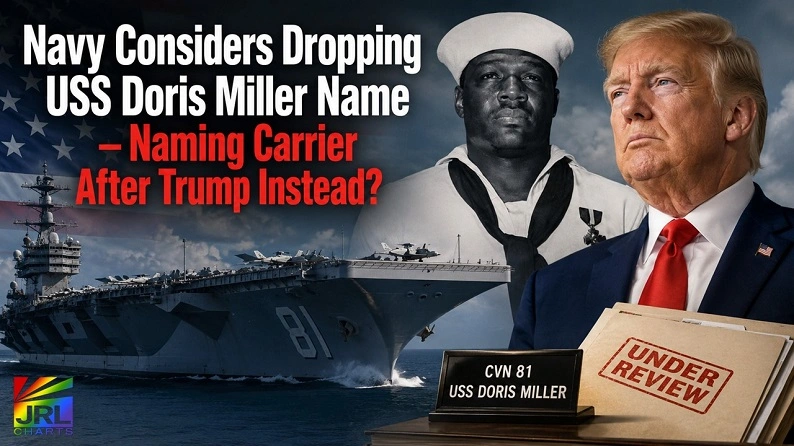
WASHINGTON, D.C. — (August 20, 2026) — The U.S. Navy is reportedly considering removing the name of legendary Black World War II hero Doris “Dorie” Miller from a future Gerald R. Ford-class aircraft carrier — with President Donald Trump potentially replacing him as the ship’s namesake.
The extraordinary possibility was first reported Thursday by CNN, citing two sources familiar with internal Navy discussions.
No final decision has been publicly announced by the Department of Defense or Navy.
Trending LGBT Breaking Military News Coverage on JRL CHARTS:
• VA Loses Again as Judge Blocks Third Attempt to Cancel AFGE Contract
• Hegseth’s $37.5 Billion Iran War Admission Sparks Online Firestorm
• Third Missing U.S. Service Member Confirmed Dead After Iran’s Jordan Base Attack
• Did the Pentagon Force Scouting America to Change Its Transgender Policy?
• VA Restructures LGBTQ+ Veteran Programs Under New Federal Policy Changes
• Breaking Military News involving LGBTQ Service Members and Security
If approved, however, the move would reverse a historic decision made during Trump’s own first administration and potentially result in the unprecedented naming of an aircraft carrier for a sitting president.
USS Doris Miller Made Navy History
The Navy officially announced in January 2020 that the future CVN-81 would be named USS Doris Miller in honor of the decorated sailor whose actions during the Japanese attack on Pearl Harbor became one of the most celebrated stories of Black military service during World War II.
The significance extended far beyond another ship naming.
CVN-81 was slated to become the first aircraft carrier in U.S. Navy history named for an African American and the first carrier named in honor of a sailor for heroic actions performed while serving in the enlisted ranks.
Then-Acting Secretary of the Navy Thomas Modly announced the name during a Martin Luther King Jr. Day ceremony at Joint Base Pearl Harbor-Hickam in Hawaii.
The Navy said at the time that honoring Miller recognized the contributions of enlisted sailors “of every race, religion and background.”
Six years later, that historic designation could be in jeopardy.
Could CVN-81 Become a Trump Aircraft Carrier?
According to CNN’s August 20 report, efforts to reconsider the USS Doris Miller name have reportedly been underway since earlier in 2026.
Acting Secretary of the Navy Hung Cao has reportedly examined changes to Navy ship-naming guidance, including clarification of whether ships can be named for presidents.
The possibility immediately raises an extraordinary question: Could CVN-81 ultimately become the USS Donald J. Trump?
Such a decision would be remarkable not simply because of whose name it would carry, but because Trump remains in office.
American aircraft carriers have carried the names of presidents including USS Dwight D. Eisenhower, USS Theodore Roosevelt, USS Abraham Lincoln, USS George Washington, USS Ronald Reagan and USS George H.W. Bush.
Naming one for a sitting commander in chief would take that presidential tradition into largely uncharted territory.
For now, Trump replacing Miller remains a reported possibility rather than an official Navy decision.
A Defense Department spokesperson told CNN there was nothing to announce at this time.
Who Was Doris “Dorie” Miller?
What makes the potential change particularly consequential is the extraordinary story behind the existing name.
Doris Miller was born in Waco, Texas, in 1919 and enlisted in the Navy in September 1939.
At a time when racial segregation severely restricted opportunities available to Black sailors, Miller served as a mess attendant aboard the battleship USS West Virginia.
Then came December 7, 1941.
When Japanese aircraft attacked Pearl Harbor, Miller’s normal duties became irrelevant amid the devastation unfolding around him.
After discovering that his battle station had been destroyed, Miller helped carry wounded sailors to safety and assisted his mortally wounded commanding officer.
He then took control of a .50-caliber anti-aircraft machine gun and fired at attacking Japanese aircraft despite not having been formally trained to operate the weapon.
Miller later recalled that he had learned by watching other sailors use the guns.
His actions transformed him into one of the most prominent Black American military heroes of World War II.
Doris Miller Became First Black Recipient of the Navy Cross
Miller’s heroism earned him the Navy Cross, presented by Pacific Fleet commander Adm. Chester W. Nimitz in May 1942.
The decoration is one of the nation’s highest awards for military valor.
Miller became the first Black American to receive the Navy Cross.
His service continued after Pearl Harbor.
Miller later served aboard the escort carrier USS Liscome Bay, which was struck by a Japanese submarine torpedo during operations in the Gilbert Islands on November 24, 1943.
The resulting explosion sank the carrier within minutes.
Miller was among the hundreds of sailors killed.
He was just 24 years old.
Navy Could Pursue Medal of Honor for Miller
CNN reports that the Navy is considering another way of honoring Miller if his name is removed from CVN-81.
According to the report, officials are considering naming another warship for Miller while also recommending that he receive the Medal of Honor, America’s highest military decoration.
Such a move would significantly elevate the formal recognition of Miller’s actions at Pearl Harbor.
Miller’s great-nephew told CNN that the family had not been informed about plans to change the carrier’s name but viewed the possibility of a Medal of Honor for Miller positively.
The Navy has already honored Miller at sea before.
The Knox-class frigate USS Miller (FF-1091), commissioned in 1973, carried his name until its decommissioning in 1991.
But CVN-81 represented something considerably larger: placing an enlisted Black sailor’s name on one of the most powerful and prestigious warships ever constructed.
Trump Administration Already Targeting Changes to CVN-81
The naming controversy isn’t the only major development surrounding the future carrier.
Trump recently ordered the Pentagon to develop a plan for replacing the Ford-class electromagnetic aircraft launch system with traditional steam-powered catapults on CVN-81.
That directive could potentially produce substantial engineering, scheduling and cost implications because the carrier is already under construction.
Combined with the newly reported naming discussions, CVN-81 has suddenly emerged as one of the most politically scrutinized ships in America’s future fleet.
A Historic Navy Decision Now Hangs in the Balance
When the Navy announced USS Doris Miller in 2020, officials deliberately unveiled the name during a Martin Luther King Jr. Day ceremony honoring African Americans of the Greatest Generation.
The symbolism was unmistakable.
A Black enlisted sailor who served in a segregated Navy, rushed toward danger during Pearl Harbor and became a national war hero would have his name carried around the world aboard an American nuclear-powered aircraft carrier.
Now that distinction may be reconsidered.
Whether CVN-81 ultimately sails as USS Doris Miller, carries Donald Trump’s name or receives another designation altogether remains undecided.
But removing Miller’s name would reverse one of the most historically significant ship-naming decisions the Navy has made in modern times — and almost certainly ignite a national debate over military tradition, presidential power, race and how America chooses to honor its war heroes.
JRL CHARTS Breaking Military News will continue tracking developments surrounding CVN-81, the future USS Doris Miller and any official Navy decision regarding the reported proposal to rename the historic Ford-class aircraft carrier.

His reporting focuses on federal court rulings, legislative developments, international human rights issues, and government actions impacting LGBTQ communities worldwide.
With nearly two decades of experience, Goldberg is recognized for his balanced analysis, investigative insight, and commitment to accurate, fact-based journalism that informs readers on the political forces shaping equality and justice.