By Paul Goldberg — Senior Correspondent | LGBT Business Finance News
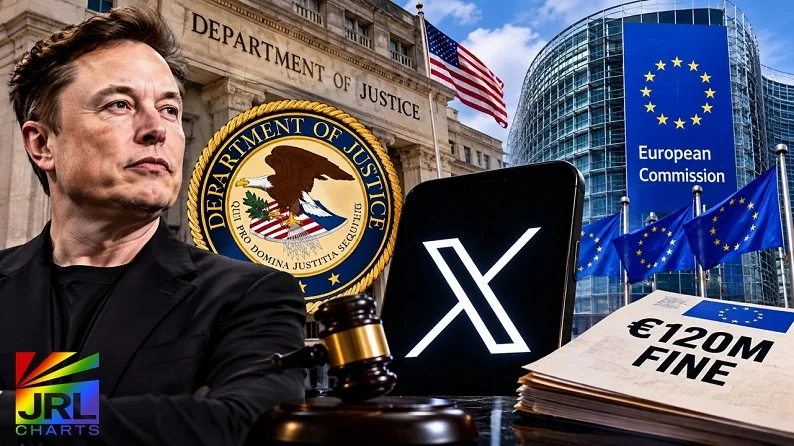
WASHINGTON, D.C. — (September 26, 2026) — Elon Musk and X have gained a powerful new participant in their legal battle with Brussels: the United States government.
The U.S. Department of Justice filed an application September 24 seeking permission to intervene in support of X Internet, X Holdings and Musk in their challenges to a €120 million fine imposed by the European Commission under the European Union’s Digital Services Act.
The move puts Washington directly into a pending European court fight between one of America’s most prominent technology companies — along with its billionaire owner — and the EU’s executive arm.
Related LGBT Politics Europe News on JRL CHARTS:
• Hungary’s New Government Moves to Scrap Orbán-Era Anti-LGBTQ Adoption Restrictions
• Russia Hits Booking.com With 6 Million Ruble Fine Under Sweeping LGBT Laws
• Ukraine Porn Legalization Push Could Open the Door for Gay Adult Industry
• Paris Homophobic Attack Leaves LGBTQ Rights Leader Pierre Picavet Seriously Injured
• Suspect in Berlin Pride Terror Attack Shot Dead During Police Operation
• Catch Up with the Latest Headlines in LGBT Politics Europe
The European Commission imposed the €120 million penalty on X on December 5, 2025, in what Brussels described as its first non-compliance decision under the DSA.
The Commission found that X violated transparency requirements involving its blue-check verification system, advertising repository and access to public data for researchers. X disputes the decision and is asking the EU General Court to annul it.
Musk has filed a separate challenge.
Now Washington wants a seat at the table.
DOJ Says Brussels Went Too Far
The Justice Department isn’t merely observing the dispute. Its filing asks the General Court to permit the United States to intervene in support of the challenges seeking annulment of the Commission’s decision.
Assistant Attorney General Brett A. Shumate framed the case as a question of how far European regulators can reach when enforcing EU law against American companies and their owners.
“The European Commission inappropriately attempted to expand its regulatory authority to reach American companies not present or operating within its jurisdiction,” Shumate said.
DOJ said it has “significant concerns” about the Commission’s approach to determining who can be treated as a provider of digital services under the DSA.
The department also objected to the Commission’s decision to extend its analysis beyond X to Musk personally and other companies within his corporate holdings.
According to DOJ, allowing that approach to stand could have consequences for other U.S.-based companies whose digital platforms operate in Europe.
That argument transforms what began as an EU enforcement dispute with X into a broader transatlantic fight over jurisdiction, corporate liability and the ability of foreign regulators to reach American parent companies and shareholders.
🚨 United States Files Request to Intervene in Case Brought by X Corp. and Elon Musk Seeking to Annul Decision by European Commission
“The European Commission inappropriately attempted to expand its regulatory authority to reach American companies not present or operating within…
— DOJ Civil Division (@DOJCivil) September 24, 2026
What Brussels Actually Fined X For
The European Commission presents the case very differently.
Brussels says X violated specific transparency obligations imposed on very large online platforms under the DSA.
The Commission identified three principal violations: what it called the deceptive design of X’s blue-check system, deficiencies in the platform’s advertising repository and inadequate access to public data for qualified researchers.
Under X’s current system, users can pay for a blue check rather than receiving one solely after an identity-verification process. The Commission argues that presenting those accounts as “verified” can mislead users about who is actually behind them.
Brussels also said X’s advertising database lacked required information and imposed barriers that made independent scrutiny more difficult.
X subsequently committed to changes involving its advertising repository and researcher access. The Commission accepted an action plan addressing those areas in July 2026, but the €120 million penalty and the court challenges remain separate matters.
Washington Is Now More Than a Political Spectator
The intervention request gives the dispute significance beyond another disagreement between Musk and European regulators.
The United States government is formally seeking to participate in litigation supporting challenges brought by Musk and American companies against an enforcement decision by the European Commission.
That does not mean Washington automatically becomes a party to the proceedings. The General Court must decide whether to permit the intervention.
But the request demonstrates how far the dispute has moved beyond X itself.
The Trump administration has repeatedly criticized European technology regulation and argued that EU rules can burden American companies and restrict speech. European officials reject that characterization, maintaining that the DSA applies according to a platform’s activities in the European market rather than the nationality of its owner.
Those competing positions now sit at the center of an actual court fight.
The Bigger Fight Over the Digital Services Act
The X dispute is also part of a much broader political battle over the DSA.
Supporters describe the law as a regulatory framework intended to make large online platforms more transparent and accountable while requiring them to address illegal content and systemic risks.
Critics — including Republican members of the U.S. House Judiciary Committee — argue that its content-moderation requirements and potentially large penalties can pressure technology companies to restrict lawful political speech beyond Europe’s borders.
A February 2026 report from House Judiciary Committee Republicans accused the European Commission of using the DSA and related mechanisms to exert international influence over platform moderation policies.
Those are the committee’s conclusions, not uncontested findings. European officials reject the characterization of the DSA as a censorship regime and maintain that the law protects users while establishing transparency and accountability requirements for platforms operating within the EU.
The disagreement nevertheless illustrates why the X litigation has become about considerably more than €120 million.
X Still Faces Separate EU Scrutiny Over Grok
The legal challenge also comes while X remains under separate European scrutiny.
In January, the Commission opened another formal DSA investigation examining whether X properly assessed and mitigated risks associated with Grok’s deployment on the platform.
Among the issues under investigation are manipulated sexually explicit images and other potentially illegal material generated through the AI system.
That proceeding has not established that X violated the DSA. The Commission has said its investigation will determine whether the company complied with its obligations.
A €120 Million Fine Becomes a Transatlantic Test
What began with a European regulatory penalty has now developed into a confrontation involving X, Elon Musk, the European Commission and the United States government.
X wants the €120 million decision overturned.
Brussels maintains that companies operating large platforms within the European market must follow European transparency rules.
And Washington is asking Europe’s General Court to let it argue that the Commission crossed jurisdictional boundaries when it extended liability beyond the European X entity and into Musk’s broader American corporate structure.
Whether the court accepts that argument remains unresolved.
But Washington’s decision to formally enter the dispute ensures that the case will be watched for something much larger than Musk’s fine: where European regulatory authority ends, how far American corporate protections extend, and what happens when the world’s largest technology companies become the center of a legal confrontation between two major political and economic powers.
JRL CHARTS — LGBT Business Finance News continues tracking the widening U.S.-EU battle over Big Tech regulation, digital speech and the growing power struggle over who gets to set the rules for global platforms.
His reporting focuses on federal court rulings, legislative developments, international human rights issues, and government actions impacting LGBTQ communities worldwide.
With nearly two decades of experience, Goldberg is recognized for his balanced analysis, investigative insight, and commitment to accurate, fact-based journalism that informs readers on the political forces shaping equality and justice.
- GameStop Hit With Federal Lawsuit After Gay Employee Reports Threats — Then Gets Fired - October 16, 2026
- Meta Paid 29 Anti-LGBTQ Accounts as 2026 Midterm Misinformation Spreads - October 14, 2026
- Orbán’s Anti-LGBTQ Legacy Crumbles as Hungary Votes 139–51 for Change - October 13, 2026