By Paul Goldberg – Senior Correspondent | JRL CHARTS LGBTQ News
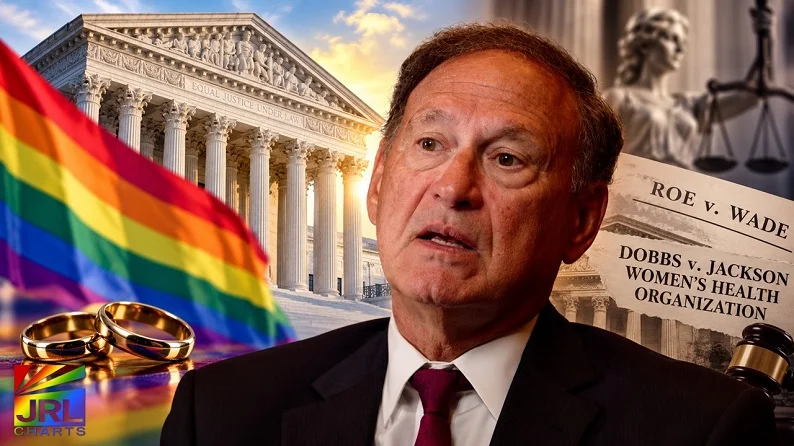
WASHINGTON, D.C. — (October 12, 2026) — Supreme Court Justice Samuel Alito says he sees little realistic possibility that the nation’s highest court will overturn marriage equality, despite his longstanding opposition to the constitutional ruling that legalized same-sex marriage nationwide.
But his remarks, delivered during an extended CBS News interview with chief legal correspondent Jan Crawford, raise a question that has followed the Supreme Court since its historic reversal of Roe v. Wade in 2022: How much reassurance can Americans take from predictions that an established constitutional right will survive?
Trending LGBTQ Business and Politics News on JRL CHARTS:
• Feds Raid Ilhan Omar’s Home — She Fires Back at Trump: ‘I Will Not Be Silenced’
• LGBTQ Voters Are Fired Up for the 2026 Midterms — HRC Survey Reveals 87% Plan to Vote
• Pete Buttigieg Hits 6 States for Democrats as the 2028 Question Gets Louder
• LGBTQ Students Lose a Major Federal Title IX Protection as Trump Administration Acts
• America Granted Them Protection — Then Deported LGBTQ Migrants Somewhere Else
• Review More in LGBTQ Business and Politics News on JRL CHARTS
Alito Says Same-Sex Marriage Is Different From Roe
While promoting his new book, So Ordered: An Originalist’s View of the Constitution, the Court, and Our Country, Alito addressed concerns that the Court could eventually reconsider Obergefell v. Hodges, its landmark 2015 marriage equality decision.
Alito, who dissented in Obergefell, argued that the ruling has created substantial legal and personal commitments that distinguish it from the abortion precedent overturned in Dobbs v. Jackson Women’s Health Organization.
He pointed to married same-sex couples who have built families, signed contracts and organized their lives around the legal recognition of their relationships.
In his view, those concrete commitments make overturning marriage equality considerably less realistic.
However, Alito stopped short of explicitly stating how he would vote if a future challenge to Obergefell reached the Supreme Court.
Watch – Supreme Court Justice Samuel Alito on CBS News
The Roe v. Wade Reversal Still Looms Large
For Americans concerned about the future of marriage equality, the comparison with Roe v. Wade remains significant.
Before the Supreme Court overturned Roe in June 2022, several conservative justices had discussed its status as established precedent during their confirmation hearings. Those statements did not amount to binding promises that they would never vote to reconsider it.
Alito ultimately authored the majority opinion in Dobbs, which eliminated the federal constitutional right to abortion recognized under Roe.
The distinction matters: Alito’s current assessment of marriage equality may reflect his understanding of legal precedent, but it does not guarantee the outcome of a future Supreme Court case.
Justice Clarence Thomas added to those concerns in 2022 when he separately urged the Court to reconsider several substantive due process precedents, including Obergefell.
The Dobbs majority, however, expressly distinguished abortion from other constitutional rights and stated that its ruling should not be understood as deciding those other questions.
Why Marriage Equality Is Also a Financial Issue
Beyond constitutional law, marriage equality carries substantial financial and business consequences.
For married same-sex couples, legal recognition affects federal taxation, inheritance, retirement benefits, health insurance, estate planning and family financial protections.
The 2022 Respect for Marriage Act provides an additional federal statutory safeguard by requiring recognition of marriages validly performed under applicable law. However, it does not independently require every state to issue same-sex marriage licenses if Obergefell were overturned.
That distinction illustrates why the constitutional ruling remains important even with additional legislative protections in place.
A Prediction, Not a Supreme Court Guarantee
Alito’s latest comments offer an explanation for why he considers marriage equality more secure than the former abortion precedent.
Yet his continuing disagreement with Obergefell, the Court’s willingness to overturn Roe, and Thomas’s separate call to revisit other constitutional decisions demonstrate why the legal debate has not disappeared.
For millions of Americans whose marriages carry personal, legal and financial significance, the future of marriage equality ultimately depends on constitutional law, federal protections and decisions the Supreme Court has yet to make.
JRL CHARTS LGBT Business Finance News will continue following Supreme Court developments affecting LGBTQ civil rights, marriage equality and the financial protections of American families.

His reporting focuses on federal court rulings, legislative developments, international human rights issues, and government actions impacting LGBTQ communities worldwide.
With nearly two decades of experience, Goldberg is recognized for his balanced analysis, investigative insight, and commitment to accurate, fact-based journalism that informs readers on the political forces shaping equality and justice.
- Alito Says Gay Marriage Is Safe — But Didn’t They Say That About Roe v. Wade? - October 12, 2026
- Feds Raid Ilhan Omar’s Home — She Fires Back at Trump: ‘I Will Not Be Silenced’ - October 12, 2026
- Taipei Gay Bar Raid Sparks Outrage as Police Face LGBTQ Backlash - October 11, 2026