By: Paul Goldberg – Senior Correspondent | LGBT Politics USA
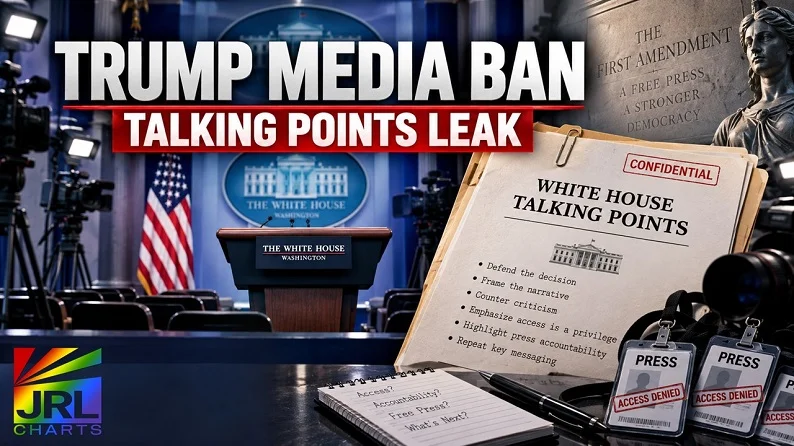
WASHINGTON, D.C. — (September 22, 2026) — The escalating Trump White House media ban has taken another turn after internal talking points circulated by the White House to House Republicans revealed how the administration is urging allies to defend President Donald Trump’s decision to bar CNN, MS NOW and Politico from the White House.
MS NOW congressional reporter Mychael Schnell obtained the talking points, which were subsequently reported by Mediaite after being discussed on air by MS NOW anchor Alicia Menendez.
Trending LGBTQ Politics & Business News on JRL CHARTS:
• UNT Deletes LGBTQ History Page After Texas Lawmaker Attack — But the Archive Isn’t Gone
• SC Holds Back Grants From Only Two Arts Groups — Both Are LGBTQ+
• Michigan Church Targets LGBTQ Acceptance in California With Massive 248-Page Complaint
• Southlake City Council Unanimously Rejects Permit for LGBTQ Pride Festival
• Texas A&M Slashes LGBTQ, Race and Climate Courses From Core Curriculum
• Review More in LGBTQ Business and Politics News on JRL CHARTS
The document provides a detailed look at the arguments the White House is distributing to congressional Republicans as the administration faces mounting scrutiny — and now a federal lawsuit — over its decision to revoke access for reporters from the three news organizations.
The White House isn’t disputing that the talking points are authentic.
White House Communications Director Steven Cheung responded directly to Schnell’s reporting on X, claiming the administration intentionally allowed the document to become public.
“Thanks for taking the bait we purposefully put out there and publishing our talking points for the world to see.”
Thanks for taking the bait we purposefully put out there and publishing our talking points for the world to see. https://t.co/JXI9anG3W7
— Steven Cheung (@StevenCheung47) September 22, 2026
White House Lays Out Defense of Trump Media Ban
The talking points begin with a statement from Trump defending the administration’s action as an attack on what he calls “FAKE NEWS,” rather than an assault on press freedom.
The document then lays out several arguments for congressional Republicans to use when discussing the controversy.
Among them, the White House argues that the First Amendment protects a news organization’s right to publish but does not automatically entitle individual outlets or journalists to a White House hard pass, a briefing-room seat or membership in the presidential press pool.
The administration also contends that no member of the public or press possesses a freestanding constitutional right to enter the White House complex.
Another section argues that publishing false information from within the White House can violate professional standards and disrupt White House operations.
Those arguments are now particularly significant because CNN, MS NOW and Politico have taken the administration to federal court.
CNN, MS NOW and Politico Challenge Ban in Federal Court
CNN, MS NOW and Politico filed suit Monday in Washington, D.C., alleging that the White House retaliated against the organizations because President Trump objected to their reporting.
Their reporters were denied access to the White House grounds Saturday after their hard passes were deactivated. The organizations say they received no advance notice or opportunity to contest the decision, which forms part of their Fifth Amendment due-process claim.
The lawsuit also raises a different First Amendment question from the one emphasized in the leaked White House talking points.
The organizations are not arguing simply that every journalist possesses an unrestricted constitutional right to enter the White House.
Instead, they contend that once the government establishes press access, it cannot selectively revoke that access as retaliation for reporting or editorial viewpoints protected by the First Amendment.
The White House disputes that characterization and argues that the organizations remain capable of covering the administration from outside the White House complex.
Trump’s Own Explanation Could Become Important
When Trump originally announced the ban Friday, he accused CNN, MS NOW and Politico of publishing what he characterized as false reporting.
Asked later why he was imposing the restrictions at that particular moment, Trump said there was “no reason” tied to a single event and described his decision as resulting from the cumulative effect of coverage during the previous two years.
That history could become relevant as the courts consider whether the administration exercised permissible control over White House access or engaged in unconstitutional viewpoint discrimination.
Reuters reported Tuesday that four legal experts it interviewed said Trump’s publicly stated rationale could present significant problems for the administration because courts have distinguished between regulating access and conditioning government-provided press access on favorable coverage.
The White House, meanwhile, maintains that it has broad discretion over who receives access to presidential spaces and that the First Amendment does not guarantee particular reporters a place inside them.
Previous Court Decisions Complicate the Fight
The legal landscape isn’t entirely one-sided.
Presidents have considerable discretion over access to highly restricted locations such as the Oval Office and Air Force One.
A federal appeals court ruled in 2025 that the Trump administration likely possessed authority to exclude the Associated Press from certain limited-access presidential spaces, although the court distinguished those areas from broader White House press facilities. Final litigation in that dispute remained pending as of Reuters’ latest report.
There is also precedent involving Trump and CNN itself.
During Trump’s first administration, the White House revoked CNN correspondent Jim Acosta’s press credential following a contentious 2018 press conference. U.S. District Judge Timothy Kelly ordered the credential temporarily restored.
Kelly is now presiding over the new CNN, MS NOW and Politico case.
Major Networks Respond to White House Ban
The controversy has expanded beyond the three organizations directly affected.
ABC, CBS, Fox News and NBC joined CNN in suspending participation in the traditional White House television pool after CNN was removed from a scheduled pool assignment.
The television pool allows participating networks to rotate responsibility for providing video coverage of presidential events to the wider press corps.
That collective action means the dispute is no longer limited to three news organizations fighting over their individual credentials.
It has developed into a larger confrontation over the rules governing access between the White House and the organizations responsible for independently covering the presidency.
Leaked Talking Points Put White House Strategy on Paper
That is what makes Schnell’s newly obtained document significant.
The talking points put the administration’s political defense of the Trump White House media ban into a single document at almost exactly the same time its legal defense is being tested in federal court.
House Republicans receiving the document are being given a straightforward argument: news organizations retain their right to publish, but that right does not automatically guarantee physical access to the White House.
CNN, MS NOW and Politico are presenting a different constitutional argument: once the government establishes a system granting journalists access, it cannot selectively punish particular organizations because officials object to their reporting.
Neither the leaked document nor the pending lawsuit itself resolves that constitutional dispute. That question is now before the federal courts.
U.S. District Judge Timothy Kelly has scheduled a Wednesday hearing on the news organizations’ request for a temporary restraining order that would block the ban while the litigation proceeds.
And that turns what began as another clash between Trump and the press into a potentially consequential test of where presidential authority over White House access ends and constitutional protections against government retaliation begin.
JRL CHARTS LGBT Politics USA will continue tracking the Trump White House Media Ban, the federal First Amendment challenge and the growing dispute over press access as new developments emerge.
His reporting focuses on federal court rulings, legislative developments, international human rights issues, and government actions impacting LGBTQ communities worldwide.
With nearly two decades of experience, Goldberg is recognized for his balanced analysis, investigative insight, and commitment to accurate, fact-based journalism that informs readers on the political forces shaping equality and justice.
- Japan Faces a $101.5 Billion LGBTQ Equality Problem, Economic Study Warns - October 12, 2026
- Alito Says Gay Marriage Is Safe — But Didn’t They Say That About Roe v. Wade? - October 12, 2026
- Feds Raid Ilhan Omar’s Home — She Fires Back at Trump: ‘I Will Not Be Silenced’ - October 12, 2026