By: Paul Goldberg – Senior Correspondent | LGBT Politics USA
WASHINGTON, D.C. — (September 21, 2026) — President Donald Trump’s decision to ban CNN, MS NOW and Politico from the White House has escalated into a much larger confrontation with the American press — and the consequences became immediately visible, but barely audible, Monday.
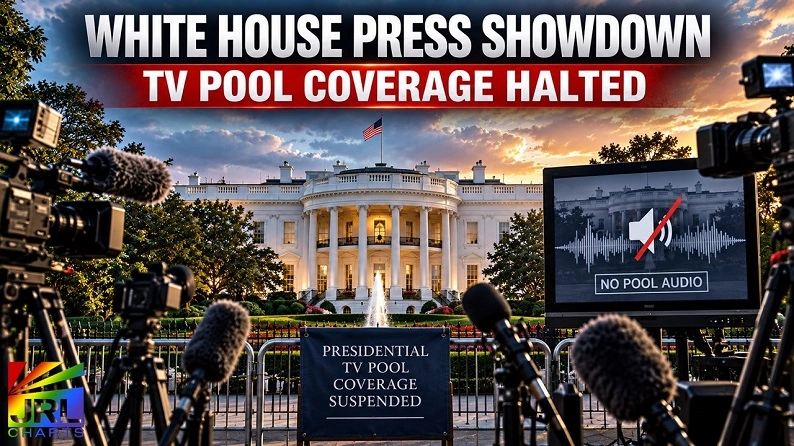
Major television networks that normally rotate responsibility for providing independent pooled video and audio of presidential events suspended TV-pool coverage of Trump after CNN was prevented from taking its scheduled turn.
Trending LGBTQ Politics & Business News on JRL CHARTS:
• Trump Unveils ‘AI Force’ and New ‘AI Czar’ — Then Asks America to Rename Artificial Intelligence
• Trump Plays King, Bans CNN, Politico and MS NOW From White House
• SC Holds Back Grants From Only Two Arts Groups — Both Are LGBTQ+
• Michigan Church Targets LGBTQ Acceptance in California With Massive 248-Page Complaint
• Southlake City Council Unanimously Rejects Permit for LGBTQ Pride Festival
• Texas A&M Slashes LGBTQ, Race and Climate Courses From Core Curriculum
• Review More in LGBTQ Business and Politics News on JRL CHARTS
ABC News, CBS News, CNN, Fox News and NBC News joined together in the extraordinary action, putting normally competing — and politically diverse — television organizations on the same side of an escalating White House press-access dispute.
The result became strikingly apparent during Trump’s ribbon-cutting ceremony for the new South Lawn helipad.
The White House could provide its own video of the president, meaning viewers could see Trump speaking — but could barely hear what he was saying.
Without the normal television pool crew and its audio equipment, Trump’s remarks were overwhelmed by the sound of the nearby presidential helicopter. The Associated Press reported that whatever Trump said during the ceremony was impossible to hear over the aircraft noise.
For an administration attempting to restrict access by news organizations it considers hostile, the first major consequence was therefore an unusual one: the dispute interfered with the distribution of the president’s own message.
Fox, ABC, CBS and NBC Refuse to Replace CNN in Presidential TV Pool
CNN is one of five television networks — alongside ABC, CBS, NBC and Fox News — that rotate responsibility for providing pooled television coverage of presidential events.
When CNN was barred from fulfilling its scheduled pool assignment Monday, the other networks declined to replace it.
Bryan Boughton, Fox News’ Washington bureau chief and current chair of the White House television pool, informed the press corps that the pool would no longer cover events designated for presidential pool coverage.
Other pooled operations, including congressional and selected Washington coverage, were expected to continue normally.
The five television networks subsequently issued a joint statement defending independent coverage of the presidency.
“The public has a vital interest in receiving accurate, independent information about its government.”
They added:
“No administration should restrict a news organization because it objects to its reporting.”
The involvement of Fox News is particularly notable because the network has frequently featured commentators and programming supportive of Trump. In this dispute, however, Fox joined its television-pool competitors in opposing the exclusion of CNN.
CNN, MS NOW and Politico Take Trump to Federal Court
The television networks’ action came as CNN, MS NOW and Politico filed a federal lawsuit Monday seeking restoration of their White House access.
Trump announced Friday that the three organizations would be barred, accusing them of publishing “FAKE NEWS.”
The organizations argue that the administration retaliated against them because of their journalism and therefore violated their First Amendment protections. Their complaint also raises Fifth Amendment due-process claims.
In their lawsuit, the three organizations described the ban as something that:
“could not be a more direct assault on the First Amendment nor a more blatant violation of our most fundamental constitutional principles.”
A federal court hearing on their effort to regain access is expected this week.
The case adds another chapter to Trump’s long-running battles over White House press access. During his first administration, CNN correspondent Jim Acosta and Playboy reporter Brian Karem separately regained White House access after litigation challenging restrictions imposed on them.
Cable News Network, Inc. v. Trump
Case No. 1:26-cv-03287
U.S. District Court for the District of Columbia
Filed: September 21, 2026
Judge: Timothy J. Kelly
Even Trump-Friendly Media Figures Question the Ban
Criticism has not been confined to outlets typically viewed as hostile to Trump.
Former Trump White House press secretary Sean Spicer questioned the strategy while maintaining that he understood Trump’s objections to some news coverage.
“I don’t disagree with the president’s concern about some of these outlets, I just think there’s more effective ways to do this,”
Spicer told The Hill.
He also questioned the timing, arguing that the controversy overshadowed a White House announcement on prescription drug costs.
“And the other thing is the timing of this. On Friday he was having an amazing announcement on prescription drugs that gets to the affordability issue head on, and this obviously just stepped all over that,” Spicer said.
Right-leaning CNBC host Joe Kernen also challenged the administration’s approach while interviewing Treasury Secretary Scott Bessent.
“I just don’t think this is something we do in this country,”
Kernen said.
“You can’t control the press. The press is going to press, the media is going to media.”
Fox News commentator Brit Hume questioned what the president could gain from excluding the organizations, writing that:
“if he thinks this will lead to more favorable coverage, I think he’s dreaming.”
Those objections differ in their reasoning, but illustrate that opposition to the White House action has extended beyond Democratic politicians and media organizations generally critical of Trump.
White House Defends Decision to Block the Three Outlets
Trump has rejected accusations that his action constitutes an attack on press freedom.
In a Monday Truth Social post, the president insisted he is:
“not instituting an assault on the Free Press, something which I cherish,”
and characterized his action instead as:
“an assault on the FAKE NEWS”
which he called a:
“threat to our National Security, and must be stopped, NOW!”
A White House official similarly defended the restrictions, telling The Hill:
“Fake News has no place demanding a spot in the President’s Oval Office.”
The official added:
“The lies they smear are a disservice to the American public and tear at the very fabric of our Democracy. They’re completely capable of reporting from directly outside.”
The administration’s position is therefore that the outlets remain able to report on the presidency without being granted access to White House grounds. The plaintiffs contend that removing their credentials specifically because the administration objects to their reporting constitutes unconstitutional retaliation.
That disagreement is now before the federal courts.
White House Press Fight Suddenly Becomes an Audio Problem
Then came Monday’s South Lawn ceremony.
Trump appeared before cameras to inaugurate the White House’s newly constructed helipad. But with CNN unable to perform its scheduled pool duties and the other networks refusing to substitute for it, the normal independent television-pool operation wasn’t there.
The White House supplied video.
Usable pool audio was another matter.
Trump could be seen speaking during the ceremony, but the roar of the helicopter overwhelmed his remarks.
The problem was noticeable even at Newsmax.
As the right-leaning network attempted to cover the ceremony, anchor Bianca de la Garza acknowledged the consequences of the missing pool operation:
“So maybe this is one example of it backfiring just a little bit,”
She then summarized the problem facing viewers:
“Obviously the ramifications are right here … you can’t hear the president.”
Newsmax ultimately had the same basic technical problem confronting everyone else relying on the available feed: video of the president was available, but his remarks were drowned out.
The episode offered an unusually immediate demonstration of what the White House television pool actually does.
The pool isn’t simply a group of reporters standing inside the White House. Its rotating television crews capture professional independent video and audio and distribute that material broadly to news organizations that could not practically place separate camera crews alongside the president at every restricted event.
By Monday afternoon, a fight that began with Trump barring three news organizations had therefore expanded into a federal constitutional lawsuit, a rare unified response from competing television networks and a disruption of the independent audio and video infrastructure normally used to document presidential activities.
For the moment, Americans can still see White House-provided footage of the president.
Monday demonstrated something else:
Without the independent television pool, seeing the president and hearing what the president is saying can become two very different things.
Stay with JRL CHARTS LGBT Politics USA for continuing coverage of the White House media-access fight, the federal court challenge and its implications for press freedom in the United States.

His reporting focuses on federal court rulings, legislative developments, international human rights issues, and government actions impacting LGBTQ communities worldwide.
With nearly two decades of experience, Goldberg is recognized for his balanced analysis, investigative insight, and commitment to accurate, fact-based journalism that informs readers on the political forces shaping equality and justice.
- Japan Faces a $101.5 Billion LGBTQ Equality Problem, Economic Study Warns - October 12, 2026
- Alito Says Gay Marriage Is Safe — But Didn’t They Say That About Roe v. Wade? - October 12, 2026
- Feds Raid Ilhan Omar’s Home — She Fires Back at Trump: ‘I Will Not Be Silenced’ - October 12, 2026