By: Paul Goldberg – Senior Correspondent | LGBT Politics USA
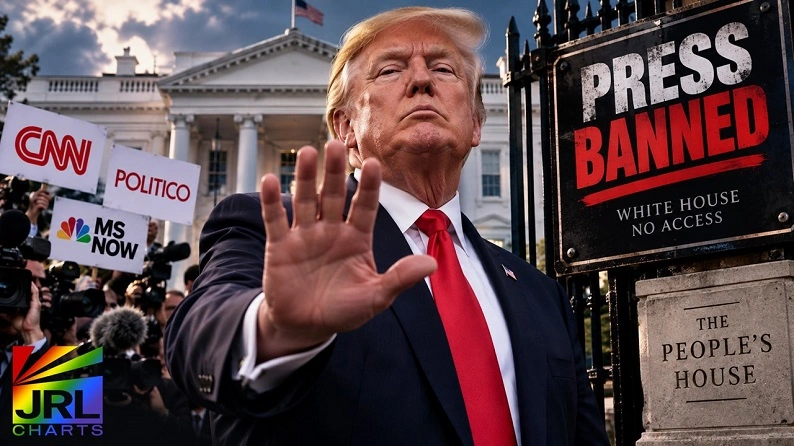
WASHINGTON, D.C. — (September 19, 2026) — President Donald Trump has followed through on his threat to ban CNN, Politico and MS NOW from the White House, escalating his long-running battle with the American press into a new First Amendment confrontation.
Reporters from all three news organizations were denied access to the White House grounds Saturday morning, one day after Trump announced that the outlets were being banned “effective immediately.”
Trending LGBTQ Politics & Business News on JRL CHARTS:
• Trump Media Ban Backfires as Networks Halt White House Coverage — Leaving Him Without Pool Audio
• SC Holds Back Grants From Only Two Arts Groups — Both Are LGBTQ+
• Michigan Church Targets LGBTQ Acceptance in California With Massive 248-Page Complaint
• Southlake City Council Unanimously Rejects Permit for LGBTQ Pride Festival
• America’s Job Market Just Got Worse — And Higher Interest Rates Could Be Next
• Review More in LGBTQ Business and Politics News on JRL CHARTS
Politico editor-in-chief Jonathan Greenberger said reporter Cheyenne Haslett attempted to enter the White House Saturday only to have the Secret Service deny her entry and confiscate the pass that had allowed her access to the complex.
CNN and MS NOW reporters also found their White House credentials deactivated Saturday.
But Trump’s own comments from the Oval Office on Friday may now become a central part of the controversy surrounding the ban.
When reporters pressed Trump to explain exactly what his order meant, the president himself referred to it as “the ban on the free press.”
Trump said he did not want the three organizations in his office or at the White House and that the prohibition would extend “as far as you can.”
In another striking exchange, Trump complained about news organizations publishing what he characterized as purposely negative stories.
“If they want to write them, that’s fine,” Trump said, before beginning to say that he did not have to allow them into “my—” and then correcting himself: “into the People’s House.”
The moment came as reporters repeatedly questioned whether excluding news organizations because of their coverage could withstand scrutiny under the First Amendment.
President Trump said he is banning CNN, MS NOW and Politico from the White House over their coverage of his administration. He said the ban would take effect immediately, and he said he planned to ban other outlets in the future.
🎥 Read more: https://t.co/dz7GExFd1W pic.twitter.com/rh5pkAwkt0
— The Wall Street Journal (@WSJ) September 18, 2026
Trump just explained why he’s illegally banning CNN, Politico and MSNOW from the White House:
“because they never write a good story.” pic.twitter.com/XAZMlG40hr
— Ed Krassenstein (@EdKrassen) September 18, 2026
President Trump suggested more news outlets could be barred from the White House after announcing bans on CNN, MS NOW and Politico reporters. Trump accused the three outlets of reporting “Fake News” as he announced the restrictions Friday. pic.twitter.com/0zvARldMyv
— New York Post (@nypost) September 18, 2026
Q: You posted that you intend to ban CNN, Politico, and MS NOW from the White House. Every president takes an oath to uphold the Constitution, which includes the 1st Amendment. How do you justify—
Trump: Because they’re fake news. pic.twitter.com/mHfeGeRROz
— Molly Ploofkins (@Mollyploofkins) September 18, 2026
Trump was specifically reminded that his administration’s previous attempt to revoke CNN White House correspondent Jim Acosta’s credentials during his first term did not survive the resulting court fight.
Trump appeared undeterred by the possibility of another legal defeat.
“I think it’s good to point it out, whether it survives or doesn’t,” Trump said, later adding that the outcome could depend on which judge hears a challenge.
That history could become particularly important if CNN, Politico or MS NOW takes the administration to court.
Trump has maintained that the outlets are being excluded because he considers their reporting dishonest and “fake news.” CNN and Politico have rejected those accusations and said they would defend their constitutional rights.
The White House Correspondents’ Association has also condemned the action, arguing that the First Amendment protects the ability of journalists to cover the presidency regardless of whether an administration approves of their reporting.
Trump, meanwhile, has indicated that CNN, Politico and MS NOW may not be the last organizations targeted, warning that additional news outlets could face similar treatment.
What began Friday as a presidential declaration on social media has therefore become something far more consequential: an actual restriction on journalists attempting to enter the White House — and potentially the opening round of another major court battle over presidential power, press access and the First Amendment.
Stay with JRL CHARTS LGBT Politics USA as we track the legal and constitutional fallout from President Trump’s White House media ban and what it could mean for press access moving forward.
His reporting focuses on federal court rulings, legislative developments, international human rights issues, and government actions impacting LGBTQ communities worldwide.
With nearly two decades of experience, Goldberg is recognized for his balanced analysis, investigative insight, and commitment to accurate, fact-based journalism that informs readers on the political forces shaping equality and justice.