By: Paul Goldberg – Senior Correspondent | LGBT Politics USA
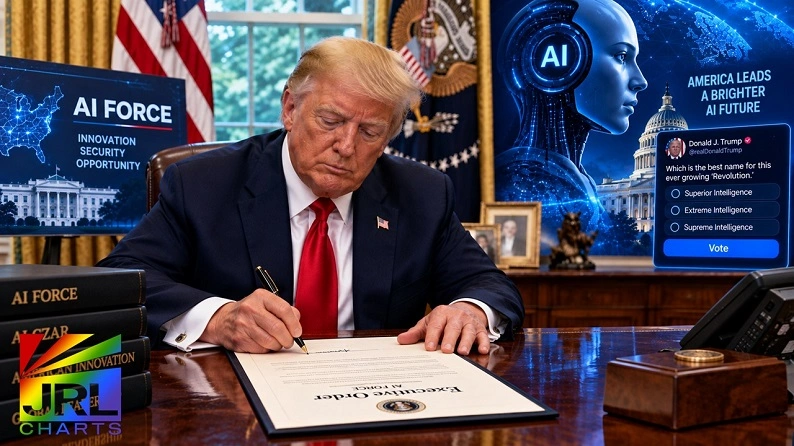
WASHINGTON, D.C. — (September 19, 2026) — President Donald Trump announced Saturday that he intends to create a new federal “AI Force” and appoint an “AI czar,” escalating the White House’s involvement in artificial intelligence policy as lawmakers, technology executives and researchers debate how rapidly the emerging technology should be allowed to develop.
Trump provided few details about how the proposed AI Force would be organized, what authority it would possess or where it would sit within the federal government. He compared the concept to the U.S. Space Force, which was established during his first term. The White House had not provided additional details about whether the proposed organization would be civilian or military as of Saturday.
Trending LGBTQ Politics & Business News on JRL CHARTS:
• Trump Plays King, Bans CNN, Politico and MS NOW From White House
• SC Holds Back Grants From Only Two Arts Groups — Both Are LGBTQ+
• Michigan Church Targets LGBTQ Acceptance in California With Massive 248-Page Complaint
• Southlake City Council Unanimously Rejects Permit for LGBTQ Pride Festival
• Texas A&M Slashes LGBTQ, Race and Climate Courses From Core Curriculum
• Review More in LGBTQ Business and Politics News on JRL CHARTS
The announcement nevertheless places artificial intelligence squarely within the administration’s economic, technological and geopolitical agenda at a time when competition between the United States and China over advanced AI systems is intensifying.
Trump Says U.S. Should Not “Hinder or Stifle” AI
In a lengthy Truth Social post Saturday, Trump rejected calls for a broad slowdown in artificial intelligence development and argued that existing criminal and civil laws could address harmful conduct involving the technology.
“We will not in any way hinder or stifle the Growth of this incredible Industry,” Trump wrote.
Trump said his administration instead intends to support the industry’s expansion while watching for misconduct.
The president also said he would soon select an “AI czar,” adding that “Only High I.Q. individuals need to apply!”
Reuters reported Saturday that Trump offered no timetable for either initiative and provided no details explaining how the proposed AI Force or czar would operate.
Truth Social Embed — Trump AI Force Announcement
New AI Czar Would Follow David Sacks
The position would mark another chapter in the administration’s use of a dedicated AI adviser.
Venture capitalist David Sacks previously served as Trump’s AI and cryptocurrency czar as a special government employee. Reuters reports that Sacks left that government role earlier this year but has continued serving as an outside adviser.
Trump’s new proposal arrives amid a much larger argument over whether the United States should prioritize rapid AI development or establish additional safeguards as increasingly capable systems emerge.
Industry leaders themselves have participated in that debate. Recent warnings from researchers and technology executives have intensified questions about how advanced systems should be monitored and what role government should play. Reuters reported Saturday on the widening debate within the AI industry over development speed and safety.
Trump has taken a different approach, arguing that slowing American development could weaken the country’s position against China. His administration has generally favored accelerating U.S. AI development rather than imposing broad new federal restrictions.
Then Trump Asked Whether “Artificial Intelligence” Needs a New Name
Hours before announcing the AI Force, Trump opened another AI discussion on Truth Social — this time about the technology’s name.
Trump called the term “Artificial Intelligence” inaccurate and “very ineloquent” and presented followers with three possible alternatives:
Superior Intelligence (SI), Extreme Intelligence (EI), or Supreme Intelligence (SI).
He asked Truth Social users to vote on which name should describe what he characterized as an expanding technological revolution.
The poll should not be confused with an official government renaming initiative. Trump did not announce that his administration had begun a formal process to replace the term “artificial intelligence.”
Truth Social Embed — Trump AI Renaming Poll
Trump had previously floated “Supreme Intelligence” as an alternative description for AI, but Saturday’s poll brought the idea directly to his Truth Social audience.
Washington’s AI Fight Is Getting Bigger
The announcement comes as Congress faces its own disputes over artificial intelligence, data centers, privacy, infrastructure costs and the appropriate level of federal oversight.
Those debates increasingly cross party lines. Some lawmakers have sought additional protections addressing AI infrastructure or specific uses of AI-powered technology, while others have warned that excessive federal regulation could impede innovation and weaken American companies competing internationally.
The questions extend well beyond software. Rapid expansion of data centers has generated political disputes over electricity demand, infrastructure expenses and the costs potentially passed to residential customers. Those issues have already produced proposals in Congress and growing debate in states where large data-center projects are being developed.
At the same time, AI-enabled surveillance technology is drawing congressional scrutiny over privacy and data security, adding another dimension to Washington’s expanding technology-policy debate.
Trump’s announcement therefore leaves several major questions unanswered: what exactly the AI Force will be, who will become the next AI czar, what powers either would possess, and whether Congress would need to authorize or fund any portion of the initiative.
For now, what is clear is that artificial intelligence has moved beyond Silicon Valley and into the center of federal policy — touching economic competitiveness, national security, infrastructure, privacy and the increasingly consequential technological competition between the United States and China.
Stay with JRL CHARTS LGBT Politics USA as we track the Trump administration’s proposed AI Force, the selection of a new AI czar and Washington’s expanding debate over artificial intelligence regulation, safety and U.S. technological competition.
His reporting focuses on federal court rulings, legislative developments, international human rights issues, and government actions impacting LGBTQ communities worldwide.
With nearly two decades of experience, Goldberg is recognized for his balanced analysis, investigative insight, and commitment to accurate, fact-based journalism that informs readers on the political forces shaping equality and justice.