By: Paul Goldberg – Senior Correspondent | LGBT Politics International
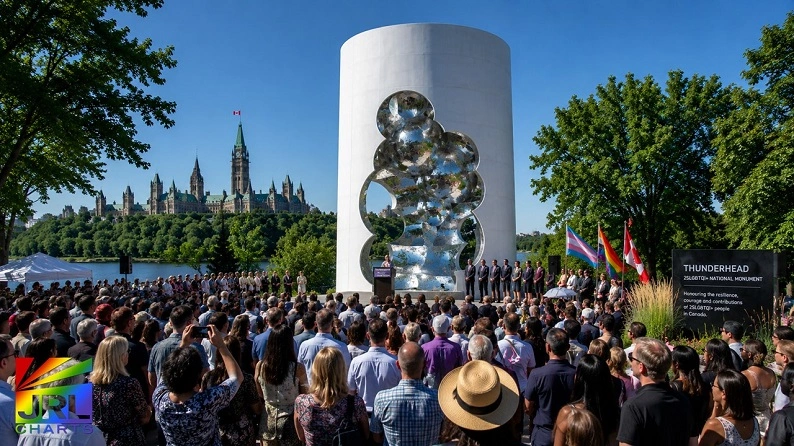
OTTAWA, Canada — (August 25, 2026) — Canada has formally opened Thunderhead, its first national monument dedicated to 2SLGBTQI+ communities, creating a permanent memorial to generations who endured discrimination and government-sanctioned persecution.
The landmark officially opened in Ottawa on August 21, bringing together survivors of the notorious LGBT Purge, Indigenous partners, LGBTQ community leaders, families, government representatives and allies.
Governor General Louise Arbour and Women and Gender Equality Minister Rechie Valdez were among those participating in the ceremony.
Now Trending on LGBTQ Politics News on JRL CHARTS:
• LGBTQ Lawmakers Expand Their Power Across California Legislature for 2027
• Torrey Pines High School Hit With Federal Lawsuit Over Pro-Trump ‘LGBT’ Poster
• AIPAC Spent $30 Million Trying to Stop Abdul El-Sayed — Now Mike Rogers Doesn’t Want Its Help
• Log Cabin Republicans Drop the ‘T’ as Group Refocuses on LGB Advocacy
• Review More in LGBTQ Politics News Exclusively on JRL CHARTS
Standing 11 metres high, Thunderhead commemorates LGBTQ Canadians who faced discrimination under government policies, with particular attention paid to members of the Canadian Armed Forces, Royal Canadian Mounted Police and federal public service whose careers were destroyed or disrupted because of their sexual orientation or gender identity.
Thunderhead Confronts Canada’s LGBT Purge History
For decades beginning in the 1950s, Canada’s federal government systematically investigated and targeted employees and military personnel suspected of being gay, lesbian or otherwise part of sexual and gender minorities.
Thousands experienced surveillance, interrogation, harassment and career-ending discrimination during what became known as the LGBT Purge.
Those policies continued into the 1990s, leaving behind a legacy that Canada has increasingly been forced to confront.
Former Prime Minister Justin Trudeau issued a formal apology in 2017 to LGBTQ Canadians harmed by federal legislation, programs and policies. That reckoning was followed by the settlement of a class-action lawsuit brought by LGBT Purge survivors against the federal government.
Money stemming from that settlement ultimately helped make Thunderhead possible.
The monument is therefore more than a government-funded memorial. Its creation is directly connected to the legal battle fought by survivors of the very discrimination it now commemorates.
Powerful Symbolism Built Into Thunderhead
Located at 201 Wellington Street along the Ottawa River, Thunderhead was created by a Winnipeg-based Canadian design team led by Public City Architecture, working with Elder Albert McLeod and artists Shawna Dempsey and Lorri Millan.
The monument takes its name and visual inspiration from a thunderhead cloud — a symbol associated with energy, transformation and renewal.
At its center, a massive column appears to have been broken apart from within by the formation of a thundercloud, symbolizing LGBTQ communities breaking through barriers in their fight for justice and equality.
Thousands of mirrored tiles line portions of the sculpture, reflecting both the diversity of Canada’s 2SLGBTQI+ communities and the memory of people whose lives were lost too soon.
The surrounding landscape extends that storytelling beyond the monument itself. A healing circle and medicinal garden recognize Two-Spirit and Indigiqueer experiences, while a sugar maple honors those who served Canada.
Thunderhead stands on the traditional and unceded territory of the Anishinabe Algonquin Nation.
A National Memorial — and a Warning From History
Governor General Louise Arbour used the opening ceremony to emphasize the courage of those who challenged discrimination and injustice.
The monument now transforms one of the darkest chapters in Canada’s treatment of LGBTQ citizens into a permanent public record — one designed not only to remember what happened, but to educate future generations about how institutional discrimination can become government policy.
Thunderhead also arrives at a time when LGBTQ rights remain the subject of intense political battles in Canada and around the world.
For LGBT Purge survivors, the monument represents something that would have been nearly unimaginable during the decades when LGBTQ Canadians could lose their careers simply because of who they were.
Their experiences now occupy a permanent place in Canada’s national landscape.
Stay with JRL CHARTS LGBT Politics International for continuing coverage of LGBTQ civil rights, government policy and political developments shaping communities across Canada and around the world.

His reporting focuses on federal court rulings, legislative developments, international human rights issues, and government actions impacting LGBTQ communities worldwide.
With nearly two decades of experience, Goldberg is recognized for his balanced analysis, investigative insight, and commitment to accurate, fact-based journalism that informs readers on the political forces shaping equality and justice.