By: Paul Goldberg – Senior Correspondent | Breaking Military News
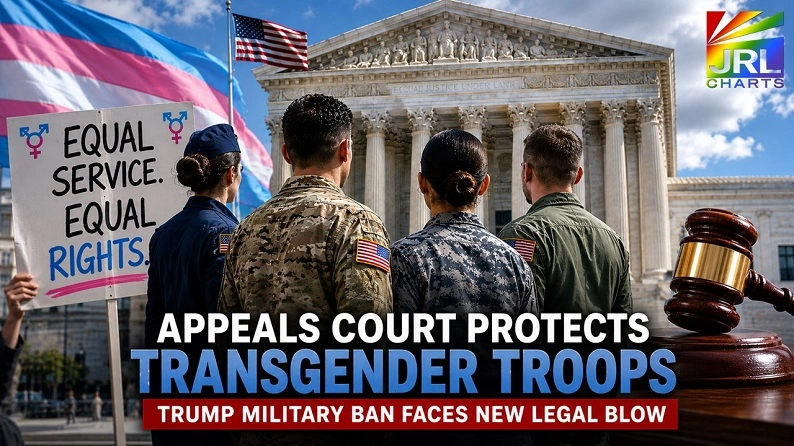
WASHINGTON, D.C. — (June 2, 2026) — A divided federal appeals court delivered a significant setback to the Trump administration’s effort to remove transgender Americans from military service, ruling that current transgender service members challenging the policy may remain in uniform while the legal battle continues.
The decision from the federal appeals court comes amid growing national debate over military readiness, executive authority, and LGBTQ rights in the armed forces. While the ruling protects active-duty transgender plaintiffs already serving, the court simultaneously allowed the administration to continue enforcing restrictions on new transgender recruits and officer candidates pending further litigation.
Trending Breaking Military News on JRL CHARTS:
Supreme Court Allows Trump to Implement Transgender Military Ban
Legal battle continues as transgender service members face an uncertain future.
US Strikes Southern Iran as Tehran Rushes to Qatar for Emergency Talks
Military tensions escalate as diplomatic efforts intensify across the Middle East.
Watch: Pentagon Releases 40+ Minutes of UAP Videos in Unprecedented Transparency
Newly released footage fuels renewed debate over unidentified aerial phenomena.
U.S. Military Draft System Update: Automatic Registration Planned
Defense officials explore modernization efforts for Selective Service enrollment.
Court Finds Evidence of Unconstitutional Bias
In a 2-1 ruling, the appeals panel concluded that Defense Secretary Pete Hegseth’s policy targeting transgender military personnel was likely motivated by unconstitutional animus rather than legitimate military concerns.
Writing for the majority, Judge Robert Wilkins stated that administration officials failed to demonstrate why decorated transgender service members should be removed from military service after years of honorable performance.
The court noted that the plaintiffs collectively represent more than 130 years of military service and have earned dozens of commendations while meeting all military standards and readiness requirements.
Judges Robert Wilkins and Judith Rogers rejected administration arguments that the policy was primarily designed to strengthen military readiness, concluding that those explanations appeared to have been developed after the fact and did not adequately justify the restrictions.
Existing Service Members Protected
The ruling specifically protects the transgender service members who brought the lawsuit, preventing the administration from removing them while the case proceeds through the courts.
However, the court declined to extend those protections broadly across the entire military.
The majority emphasized that recent Supreme Court concerns regarding nationwide injunctions influenced the narrow scope of the decision. As a result, the ruling applies only to the plaintiffs involved in the case rather than every transgender service member nationwide.
New Recruits Still Face Restrictions
The panel was divided over whether transgender Americans seeking to enlist or obtain military commissions should also receive protection.
Judge Wilkins joined Judge Justin Walker in allowing the administration to continue enforcing restrictions against new transgender applicants while litigation remains ongoing.
Judge Judith Rogers disagreed with that approach, arguing that transgender individuals seeking to join the military should also receive legal protection if they are parties to the lawsuit.
The split highlights the ongoing judicial disagreement over how far courts should go when reviewing military personnel policies issued by the executive branch.
Trump-Appointed Judge Defends Military Deference
In a separate opinion, Judge Justin Walker argued that courts should defer heavily to military leadership when evaluating policies related to force readiness and personnel decisions.
Walker warned that judicial interference in military decision-making could weaken the armed forces’ ability to perform their mission and maintain operational effectiveness.
His opinion reflects a long-standing legal principle that federal courts generally grant broad authority to military leaders and the executive branch in matters of national defense.
Why Transgender Troops May Not Find Rescue at the Supreme Court
The legal fight over transgender military service may ultimately return to the U.S. Supreme Court, where many LGBTQ rights advocates see a conservative majority that has grown increasingly skeptical of expansive civil rights protections for LGBTQ Americans.
While the Supreme Court has issued landmark LGBTQ victories in the past — including marriage equality in Obergefell v. Hodges and workplace protections in Bostock v. Clayton County — its more recent record has moved sharply in favor of religious-liberty, free-speech, and executive-power arguments used to limit LGBTQ protections.
That shift is especially important for transgender service members.
In 2025, the Supreme Court allowed the Trump administration’s transgender military restrictions to take effect while legal challenges continued, offering no detailed explanation for the order. That silence left lower courts with little guidance while giving the administration temporary power to enforce a policy targeting transgender Americans in uniform.
The Court also upheld Tennessee’s ban on gender-affirming medical care for minors in United States v. Skrmetti, a major defeat for transgender rights advocates who had argued that the law violated constitutional equal protection principles.
For that reason, many legal observers do not expect the current Supreme Court to “rescue” transgender soldiers if the Trump administration asks the justices to intervene again. The Court’s conservative majority has repeatedly shown a willingness to narrow anti-discrimination protections when those protections collide with claims involving religion, speech, state authority, or executive control over government policy.
That does not guarantee how the justices will rule in this military case. But the recent pattern is clear: transgender plaintiffs face a far more difficult path at the Supreme Court than they do in some lower federal courts.
For active-duty transgender service members who have already met military standards, earned commendations, deployed, served honorably, and built careers in uniform, the legal uncertainty is more than symbolic. It places their military futures in the hands of a Supreme Court that many LGBTQ advocates no longer view as a reliable backstop against government discrimination.
Follow JRL CHARTS Breaking Military News for continuing coverage of U.S. military policy, Pentagon developments, national security issues, and LGBTQ service member rights.
© 2026 JRL CHARTS Network. Editorial Illustration. All Rights Reserved.
His reporting focuses on federal court rulings, legislative developments, international human rights issues, and government actions impacting LGBTQ communities worldwide.
With nearly two decades of experience, Goldberg is recognized for his balanced analysis, investigative insight, and commitment to accurate, fact-based journalism that informs readers on the political forces shaping equality and justice.