By Paul Goldberg — Senior Correspondent | LGBT Business Finance News
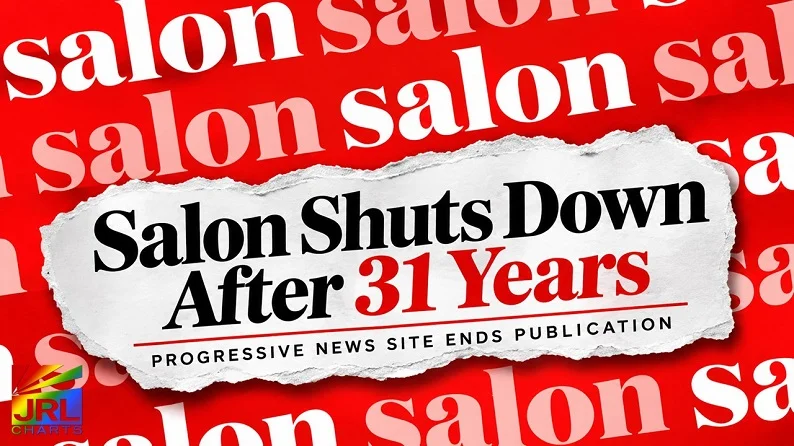
LAS VEGAS, NV — (November 5, 2026) — In a stunning development for the American digital publishing industry, pioneering progressive news outlet Salon.com announced Thursday that it is ceasing publication after 31 years, bringing an end to one of the internet’s most recognizable independent journalism brands.
The announcement, published under the headline Goodbye from Salon, confirmed that the publication’s longstanding business model could no longer support its operations. The closure marks another significant moment in the financial transformation of digital journalism, where established editorial reputations do not necessarily guarantee long-term commercial survival.
Trending LGBTQ News Coverage on JRL CHARTS:
• Breaking Military News involving LGBTQ Service Members and Security
• LGBT Politics Europe – Updates on Hate Crimes, Judicial Rulings
• Stay Up to Date on the Happenings in LGBT Politics Asia
• You Won’t Believe What Is Breaking Now on LGBTQ News
Founded in November 1995, Salon helped establish the internet as a serious platform for political commentary, investigative reporting, cultural criticism and independent journalism. Its departure raises fundamental questions about the economics of online publishing and the future of editorial organizations operating outside traditional media conglomerates.
Salon’s 31-Year Publishing Legacy Comes to an End
Salon emerged during the earliest years of commercial internet publishing, when newspapers and magazines were still determining how digital distribution would transform the news business.
The publication distinguished itself through progressive political analysis, provocative opinion writing, cultural commentary and a willingness to challenge conventional media narratives.
Over three decades, its newsroom became associated with several prominent American journalists, including CNN anchor Jake Tapper, former editor-in-chief Joan Walsh, investigative journalist Glenn Greenwald and political writer Rebecca Traister.
Its influence extended beyond individual articles. Salon helped demonstrate that internet-native publications could develop distinctive editorial identities and attract national audiences without originating as traditional print newspapers.
But that pioneering position ultimately proved insufficient to protect the organization from the economic realities confronting independent digital publishers.
Financial Pressures Bring Down a Digital Media Pioneer
Salon’s farewell announcement directly attributed the decision to the changing economics of independent digital journalism.
The company stated that its publishing model was no longer financially sustainable, although it did not publicly disclose detailed financial statements, revenue losses, operating deficits or specific restructuring alternatives in its farewell message.
That distinction matters.
While the closure clearly reflects financial sustainability concerns, Salon has not established that any single factor — including advertising revenue, declining search referrals, artificial intelligence or subscription performance — independently caused its shutdown.
Nevertheless, its departure comes as publishers across the digital media economy confront several structural challenges.
Advertising competition: Independent news organizations compete for marketing budgets against technology platforms, social networks, streaming services and increasingly sophisticated retail advertising networks.
Audience acquisition costs: Publishers must continually invest in editorial production, search visibility, newsletters and audience development while maintaining sufficient advertising or subscription revenue.
Platform dependence: Changes in search engines, recommendation systems and social media distribution can alter referral traffic, complicating revenue forecasts and advertising inventory planning.
Artificial intelligence: AI-generated search summaries and automated content discovery introduce additional uncertainty over how audiences reach original reporting and how publishers monetize that work.
These pressures do not affect every publisher equally, but together they illustrate the increasingly complex financial environment facing independent newsrooms.
What Salon’s Closure Means for Independent Digital Journalism
For the wider media industry, Salon’s closure represents more than the loss of a progressive political publication.
It demonstrates the fundamental difference between building an influential editorial brand and operating a financially sustainable publishing enterprise.
A publication may maintain a recognizable name, substantial archives, experienced journalists and loyal readers while struggling to generate enough recurring revenue to support its newsroom.
The implications extend to specialized publishers serving business communities, professional audiences and niche consumer markets.
Unlike broad-interest news outlets, business-to-business publishers may have opportunities to develop direct relationships with manufacturers, distributors, retailers and industry advertisers.
Those relationships can support specialized sponsorship programs, newsletter advertising, display campaigns and other commercial products.
However, diversification is not a guarantee of survival. Publishers must still balance operating expenses, editorial independence, audience engagement and advertiser retention.
For media executives, Salon’s departure reinforces a critical business principle: audience recognition and editorial influence must ultimately be supported by a viable revenue model.
The Search and AI Economy Adds Another Layer of Uncertainty
Salon’s announcement also arrives during a period of rapid technological change in online information distribution.
Google Search, Google Discover, social media feeds and emerging AI-powered answer engines increasingly influence how readers encounter journalism.
For publishers, the financial challenge involves converting that visibility into direct audience relationships and sustainable revenue.
Search referrals can generate valuable traffic, but publishers do not control the algorithms determining how frequently their stories appear.
Likewise, artificial intelligence introduces new questions about content attribution, licensing, original reporting and the economic value of publisher-produced information.
These developments make direct readership, email subscriptions, recognizable editorial brands and diversified commercial relationships increasingly important considerations in publishing strategy.
Salon’s closure should not be attributed specifically to AI without supporting evidence. Nevertheless, its announcement underscores the urgency of the industry’s broader debate over digital journalism’s financial future.
Salon’s Official Statement — November 5, 2026
“It’s difficult to find the right words for the end of something that has meant so much to so many people. Salon was never just a website. It was an idea about what journalism could be, born at a moment when the internet was still a largely unexplored frontier.
When Salon launched in November 1995, the web was a very different place. A small group of journalists set out to create something original: a publication with a strong voice, a curiosity about the world and a belief that the internet could bring journalism and readers together in new ways. They helped pioneer a form of journalism that would come to define an entirely new era of publishing.
Over three decades, Salon has brought together politics, culture, criticism and ideas in a way that was distinctly our own. Our journalism examined power and politics, questioned assumptions, surfaced stories that deserved attention and made room for perspectives that were too often overlooked. Our writers and editors helped shape conversations about the forces changing our lives. The work was never simply about keeping up with the news. It was about making sense of it.
The history of Salon is also the history of the people who made it. We are profoundly grateful to the journalists, editors, photographers, producers, designers, business teams and countless other colleagues who brought this publication to life across its many chapters. To the founders who imagined it, the staff members who built it, the contributors who gave them their voices and the alumni who carried its spirit into the world: Thank you. Salon’s legacy belongs to all of you.
We also want to thank our readers. You came to Salon for the journalism, the dialogue, the essays, the criticism, the unexpected discoveries and the sense that there was a place on the internet where ideas mattered. You read, shared, challenged, subscribed, wrote to us and kept coming back. Your engagement made Salon a publication and a community, and it gave our work meaning. We are so grateful for the time you spent with us.
The business realities of independent digital journalism have changed profoundly over the years. After careful consideration, we have reached the difficult decision that our publishing model is no longer sustainable. We know this news will be deeply disappointing to many of you, and we share that sadness.
Thirty-one years is a remarkable run, but what matters most is what happened during those years: the journalism, the ideas, the voices, the conversations and the community that grew around them. Salon helped demonstrate what digital journalism could be and could become. We hope that legacy will continue to matter long after today.
Thank you for being part of our story. It has been an extraordinary privilege.”
A Defining Moment for the Future of Online News
The disappearance of a pioneering publication like Salon serves as a reminder that longevity alone cannot guarantee survival in the digital economy.
For journalists, the closure represents the loss of an influential editorial institution that helped shape online political and cultural reporting.
For publishers, advertisers and investors, it raises another difficult question: how can independent journalism preserve its editorial mission while developing the financial stability necessary to survive?
The answer will differ across publications, but sustainable revenue, operational discipline, trusted reporting and meaningful audience relationships remain essential.
Salon helped define the first generation of internet journalism. Its closure now becomes part of the story of how that industry is changing.
As the digital publishing industry confronts mounting financial and technological pressures, JRL CHARTS | LGBT Business Finance News will continue examining the business decisions, advertising trends and economic forces shaping the future of independent media.
JRL CHARTS | LGBT Business Finance News — Delivering independent reporting and financial analysis on the media companies, technology platforms and business forces shaping the global digital economy.

His reporting focuses on federal court rulings, legislative developments, international human rights issues, and government actions impacting LGBTQ communities worldwide.
With nearly two decades of experience, Goldberg is recognized for his balanced analysis, investigative insight, and commitment to accurate, fact-based journalism that informs readers on the political forces shaping equality and justice.
- Salon Shuts Down After 31 Years as Digital Journalism Faces Financial Reckoning - November 5, 2026
- Democrats’ 2026 Blue Tsunami Rewrites History: Gay Leaders Win, Black Governors Break Barriers and Statehouses Flip - November 4, 2026
- Texas Age Verification Battle Explodes Again as Fifth Circuit Reopens Section 230 Showdown - November 2, 2026