By Paul Goldberg – Senior Correspondent | LGBT Business Finance News
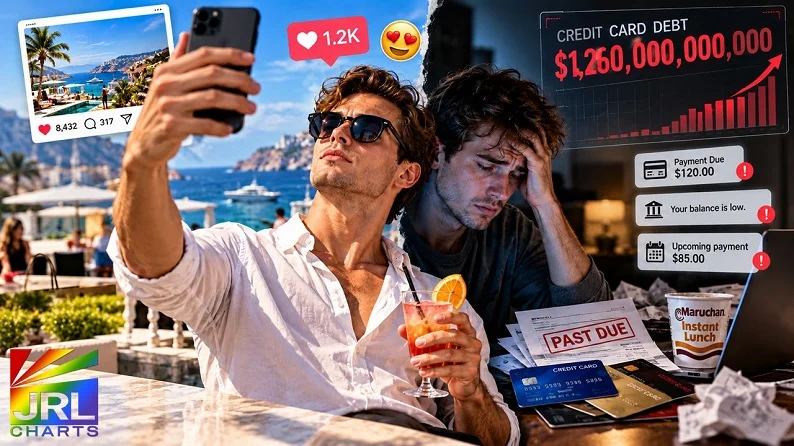
America increasingly operates as two economies at once.
LAS VEGAS, NV — (September 27, 2026) — There is the economy visible on social media — designer clothing, expensive restaurants, luxury apartments, international vacations and meticulously photographed $7 coffees.
Then there is the economy sitting quietly behind the screen: credit-card balances, installment payments, rising living costs and millions of consumers trying to maintain the appearance of prosperity while their finances tell a considerably more complicated story.
Trending LGBTQ Business and Politics News on JRL CHARTS:
• America Granted Them Protection — Then Deported LGBTQ Migrants Somewhere Else
• Brent Crude Explodes Past $107 — So Why Is Cable News Barely Talking About It?
• UNT Deletes LGBTQ History Page After Texas Lawmaker Attack — But the Archive Isn’t Gone
• SC Holds Back Grants From Only Two Arts Groups — Both Are LGBTQ+
• Michigan Church Targets LGBTQ Acceptance in California With Massive 248-Page Complaint
• Review More in LGBTQ Business and Politics News on JRL CHARTS
New research from financial-services company Empower puts numbers behind that contradiction. Its September survey of 1,000 Americans found that 41% don’t consider themselves financially “well-off,” while 24% of Gen Z respondents said they have felt pressure to showcase wealth on social media.
That disconnect is helping create what might be called America’s “fake-rich economy” — a consumer culture in which appearing financially successful can become nearly as important as actually being financially secure.
Social Media Turns Consumption Into Performance
For previous generations, keeping up with the Joneses generally meant comparing yourself with neighbors, coworkers or friends.
Social media dramatically expanded the neighborhood.
Consumers can now compare their clothes, vacations, restaurants, homes and lifestyles with thousands of carefully curated images every day. Ordinary purchases become content, while luxury purchases can become evidence of personal success.
Empower found that 42% of Americans shop to treat themselves at least monthly, while 21% do so at least weekly. Gen Z also reported dining out for roughly 26% of its meals.
None of those behaviors necessarily indicates financial distress. But when consumption becomes tied to social status, spending can increasingly become performative rather than practical.
And the broader household numbers show why the distinction matters.
Behind the Lifestyle Is $1.26 Trillion In Credit Card Debt
The latest Federal Reserve Bank of New York household-credit report provides a much less glamorous picture.
American household debt stood at approximately $18.77 trillion during the second quarter of 2026. Credit-card balances increased another $21 billion during the quarter to $1.263 trillion, while auto-loan balances climbed to approximately $1.713 trillion.
Those figures don’t mean Americans collectively are financially collapsing. In fact, aggregate household debt edged down slightly during the quarter, and overall delinquency improved modestly. But the New York Fed said new delinquencies for credit cards and auto loans remained elevated.
Federal Reserve’s separate household-finance study offers another reality check.
Although 73% of adults said they were doing okay financially or living comfortably, 16% reported not paying all their bills during the previous month. Just 63% said they could cover an unexpected $400 expense entirely with cash, savings or a credit card they would pay off with the next statement.
Meanwhile, 58% said price changes during the previous year had made their financial situation worse.
In other words, America isn’t universally broke — but financial comfort is far from universal.
Buy Now, Pay Later Changed The Psychology of Price
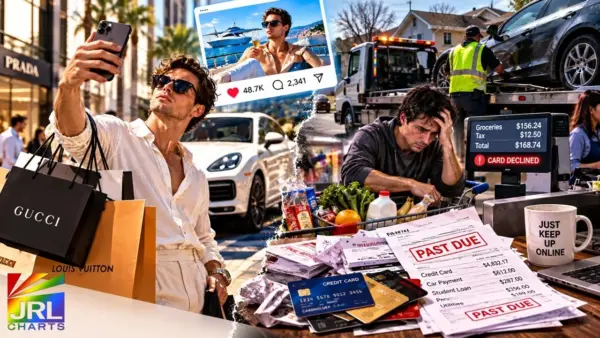
The “fake rich” economy puts luxury shopping and social-media status on one side—and car payments, grocery bills, credit-card debt and financial stress on the other. | JRL CHARTS
The rise of buy-now-pay-later financing has added another layer.
Instead of asking whether a consumer wants to spend $120, the purchase can be reframed as four much smaller payments.
The Consumer Financial Protection Bureau has documented the rapid expansion of these short-term installment products since 2019. Its research has also examined consumers using multiple buy-now-pay-later providers alongside other forms of unsecured debt.
For retailers, installment financing can reduce the psychological impact of the sticker price.
For consumers, however, breaking one large expense into several smaller payments doesn’t change the underlying mathematics: tomorrow’s income is still being committed to today’s purchase.
Even Frugality Became Something To Sell
Social media eventually produced its own reaction to excessive influencer consumption: “de-influencing.”
The premise sounds refreshingly simple. Creators tell audiences which viral products aren’t worth buying. But even anti-consumption can become commerce when creators recommend cheaper alternatives through affiliate links.
The message evolves from “don’t buy this” into “buy this instead.”
The aesthetic changes. The transaction survives.
The Vacation Ends. The Statement Doesn’t
Few categories demonstrate the divide between physical and digital wealth better than travel.
Online, a vacation can exist indefinitely as a sequence of beaches, hotel rooms, restaurants and airport lounges.
Financially, however, the experience can continue long after the traveler comes home if it was financed with revolving debt.
The same applies to clothing, automobiles, electronics and dining. Social media compresses the reward into an image visible immediately while separating that image from the months — or potentially years — required to pay for it.
That separation may be one of the defining characteristics of the modern status economy.
The Real Flex May Be Financial Security
There is an interesting counterpoint buried inside Empower’s research.
Despite all the attention surrounding conspicuous consumption, 73% of Americans said they would be willing to reduce everyday spending to save toward longer-term goals.
That suggests Americans haven’t abandoned financial restraint.
Instead, many consumers appear caught between two competing incentives: building actual financial security and displaying visible signs of prosperity.
Social media rewards the second one immediately.
A healthy savings account doesn’t photograph particularly well. Paying off a credit card rarely goes viral. An emergency fund doesn’t arrive in designer packaging.
But those invisible financial decisions ultimately determine whether the lifestyle appearing on the screen belongs to the person posting it — or to the lenders financing it.
America’s fake-rich economy therefore isn’t simply a story about irresponsible spending. It’s about a consumer system increasingly capable of separating the appearance of wealth from the ownership of wealth.
The photo disappears from the feed.
The balance remains.
JRL CHARTS LGBT Business Finance News tracks the money, markets and consumer trends reshaping how Americans work, spend and build wealth.
His reporting focuses on federal court rulings, legislative developments, international human rights issues, and government actions impacting LGBTQ communities worldwide.
With nearly two decades of experience, Goldberg is recognized for his balanced analysis, investigative insight, and commitment to accurate, fact-based journalism that informs readers on the political forces shaping equality and justice.
- GameStop Hit With Federal Lawsuit After Gay Employee Reports Threats — Then Gets Fired - October 16, 2026
- Meta Paid 29 Anti-LGBTQ Accounts as 2026 Midterm Misinformation Spreads - October 14, 2026
- Orbán’s Anti-LGBTQ Legacy Crumbles as Hungary Votes 139–51 for Change - October 13, 2026