By: Paul Goldberg – Senior Correspondent | LGBT Politics USA
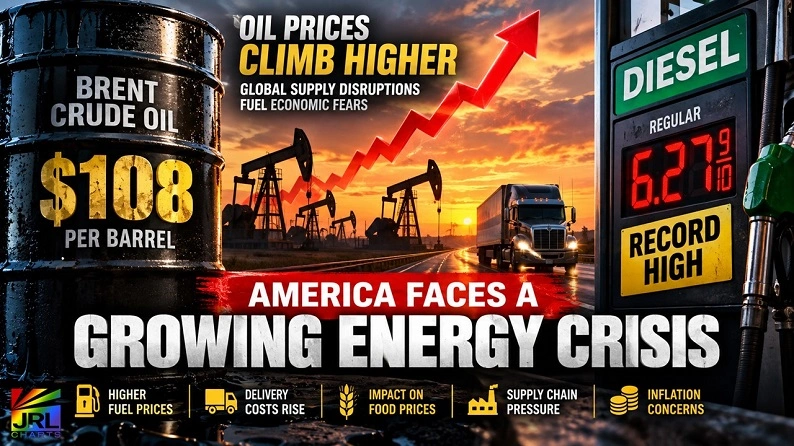
WASHINGTON, D.C. — (September 15, 2026) — Brent crude oil surged beyond $109 per barrel Tuesday, extending a remarkable run above the psychologically important $100 threshold and escalating an energy shock that threatens to work its way through virtually every corner of the American economy.
Yet turn on much of America’s political television coverage and viewers could easily miss the magnitude of what is occurring.
Now Trending on LGBT Business and Politics News on JRL CHARTS:
• DOJ Appeals to Save Trump’s $1.8B Fund After Blanche Swore to Congress It Was ‘Dead’
• Maria Bartiromo OUT at Fox News in Shocking Effective-Immediately Exit
• America’s Job Market Just Got Worse — And Higher Interest Rates Could Be Next
• Wall Street Shrugs, But LGBT Businesses Could Feel the Pain as Bond Yields Surge
• HRC Launches $15M Campaign to Defend LGBTQ+ Rights in 2026 Midterms
• Review More in LGBT Business and Politics News on JRL CHARTS
The oil story is being reported. But the more important question is whether a sustained surge in crude oil, record diesel costs and mounting disruption to global energy supplies is receiving attention proportional to its potential effect on American households and businesses.
Because this isn’t simply a story about what motorists pay at the gas pump.
It’s a transportation story. A farming story. A food-price story. A manufacturing story. An inflation story. And ultimately, a household-budget story.
Brent Crude Breaks Through $109
Brent crude climbed to $109.20 per barrel Tuesday afternoon, while West Texas Intermediate surged to $106.46, according to Reuters. The latest jump followed another wave of concerns about Middle Eastern oil infrastructure and supply routes.
Brent initially crossed $100 on September 9 for the first time since July 24. At that point it was trading around $100.80. The benchmark has subsequently remained above the century mark while experiencing extraordinary intraday swings.
The escalation has been breathtaking.
Reuters reported Tuesday that Saudi Arabia had suspended oil loadings at its Yanbu Red Sea port, while Libya halted production at three oil fields. Saudi Arabia’s critical East-West Pipeline also remained offline following an attack by Iran-backed Houthi forces.
Those developments come amid continuing instability surrounding the Strait of Hormuz and other critical Middle Eastern energy and shipping routes.
And traders are beginning to contemplate something considerably worse.
Reuters reports that Goldman Sachs sees the possibility of Brent exceeding $120 per barrel if depressed Gulf production persists.
The Bigger Alarm May Be Diesel
For American consumers, crude oil is only the beginning.
Diesel is the fuel that quietly keeps enormous portions of the U.S. economy moving: tractor-trailers hauling goods, agricultural machinery working farms, construction equipment, delivery networks and numerous industrial operations.
And diesel prices are flashing extraordinary warning signs.
The Wall Street Journal reported Tuesday that the national diesel average has reached a record $6.27 per gallon, compared with approximately $3.69 a year earlier. California diesel has reportedly climbed to an average $8.21 per gallon.
Those costs don’t remain confined to truck stops.
When transporting groceries becomes more expensive, transportation costs can eventually reach retailers and consumers. When farmers pay more to operate machinery and move crops, agricultural production becomes more expensive. When construction equipment becomes more expensive to operate, businesses have another cost to absorb or pass along.
Farmers Face Oil, Diesel — and Fertilizer Pressure
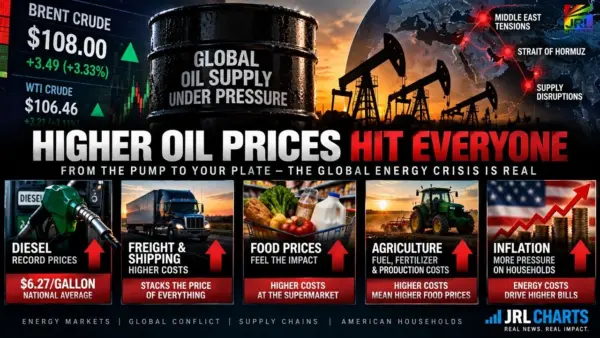
From the fuel pump to the supermarket, surging oil and diesel prices threaten to raise freight, agricultural and household costs as the 2026 energy crisis intensifies. | JRL CHARTS
Agriculture may become one of the most important transmission points between the energy crisis and American household budgets.
Farm-industry reporting has already highlighted how oil above $100 threatens farmers through higher diesel, fertilizer and freight costs.
That matters because energy is embedded throughout modern food production.
The price of oil doesn’t determine the supermarket price of a loaf of bread by itself. But sustained increases in fuel, transportation, fertilizer and other agricultural inputs can create another layer of cost pressure throughout the food supply chain.
And that comes while policymakers are already confronting persistent inflation concerns.
The Media Is Reporting Oil — But Is It Treating It Like the Economic Story It Has Become?
This is where an important distinction needs to be made.
Major news organizations haven’t completely ignored the oil shock.
CNN discussed Brent reaching $108 last week and explicitly connected higher crude with gasoline, diesel and consumer costs. Fox has reported on supply disruptions and record diesel prices. Newsmax has published stories about Brent approaching $110 and remaining above $100.
The question isn’t whether these organizations have published or broadcast anything about oil.
The question is one of prominence.
When a commodity fundamental to transportation, agriculture, manufacturing and global trade remains above $100 per barrel—and diesel reaches historic levels—should that story be competing for considerably more sustained attention than the daily cycle of political controversies, personality disputes and partisan theater?
Americans don’t purchase barrels of Brent crude.
But they purchase nearly everything that energy helps produce, manufacture or transport.
This Could Become an Inflation Story Very Quickly
That’s why the implications extend far beyond energy markets.
Higher transportation and production costs can contribute to inflationary pressure just as policymakers attempt to contain it. Oil prices can also influence financial markets, consumer confidence and expectations about monetary policy.
Tuesday’s market reaction demonstrates that investors understand the danger.
The question facing Washington—and American consumers—is how long the disruption lasts.
If damaged infrastructure returns quickly, shipping conditions improve and Middle Eastern supply normalizes, crude prices could retreat substantially.
But if disruptions persist, $100 oil may prove less a temporary spike than the beginning of a considerably more expensive period for the global economy.
And with Brent already moving beyond $109 per barrel, Americans deserve sustained reporting about what those numbers could eventually mean at the truck stop, grocery store, farm, warehouse and household budget.
Because while political controversy generates clicks and television ratings, energy prices generate bills.
JRL CHARTS LGBT Business Finance News will continue tracking the global oil shock, diesel prices and their impact on American consumers, businesses and inflation as this rapidly developing economic story unfolds.

His reporting focuses on federal court rulings, legislative developments, international human rights issues, and government actions impacting LGBTQ communities worldwide.
With nearly two decades of experience, Goldberg is recognized for his balanced analysis, investigative insight, and commitment to accurate, fact-based journalism that informs readers on the political forces shaping equality and justice.
- Federal Watchdog Drops $78 Million Bombshell on Trump’s Healthcare Funding Cuts - October 7, 2026
- NYC Puts $8.9 Million Behind Trans Youth Care After Major Hospitals Back Away - October 6, 2026
- Bronx Anti-LGBTQ Attack Leads to Arrest — But Police Say a Second Suspect Is Still Out There - October 5, 2026