By: Paul Goldberg – Senior Correspondent | Breaking Military News
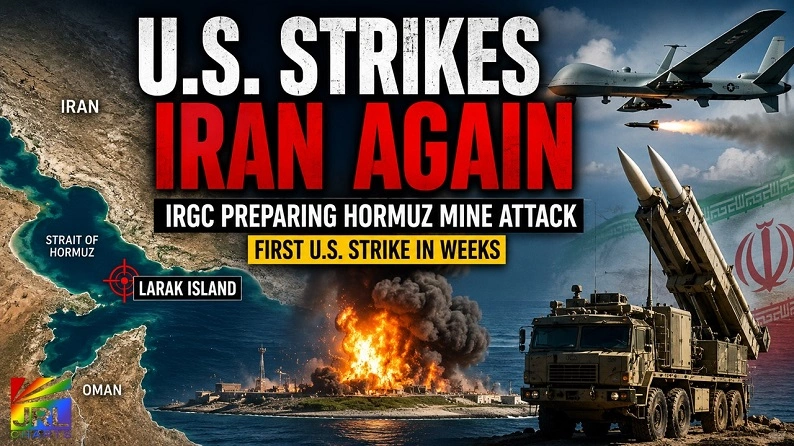
WASHINGTON, D.C. — (August 30, 2026) — U.S. forces launched new strikes against Iran on Sunday, targeting two Iranian military launchers on Larak Island after American officials said Islamic Revolutionary Guard Corps forces were preparing rockets capable of deploying sea mines into the strategically critical Strait of Hormuz.
The operation marks the first known U.S. military strike against Iran since late July, ending a roughly month-long pause in direct American attacks.
A U.S. official confirmed that American forces struck two launchers positioned on Larak Island after observing activity by Iran’s Islamic Revolutionary Guard Corps.
Trending LGBT Breaking Military News Coverage on JRL CHARTS:
• Pentagon Backs Off — For Now — in Explosive Stars and Stripes Press Freedom Fight
• Navy Weighs Scrapping USS Doris Miller Name for Trump in Historic Carrier Shakeup
• VA Loses Again as Judge Blocks Third Attempt to Cancel AFGE Contract
• Did the Pentagon Force Scouting America to Change Its Transgender Policy?
• VA Restructures LGBTQ+ Veteran Programs Under New Federal Policy Changes
• Breaking Military News involving LGBTQ Service Members and Security
The official said IRGC forces had been preparing rockets carrying sea mines intended for deployment into the Strait of Hormuz.
The attack comes just days after the United States announced that mines had been cleared from the main international shipping lane through the Strait of Hormuz. President Donald Trump subsequently warned Iran that renewed attempts to place mines in international waters would trigger a U.S. response.
U.S. Moves to Protect Strait of Hormuz
The Strait of Hormuz remains one of the world’s most strategically important maritime corridors, making any attempt to deploy additional mines a direct threat to international shipping and global energy markets.
A U.S. official told Axios that American forces were closely monitoring the region and remained prepared to protect the flow of commercial traffic through the waterway.
Sunday’s military action demonstrates that Washington remains willing to use force to prevent Iran from restoring its mine threat even as the Trump administration has increasingly emphasized economic sanctions and financial pressure against Tehran.
Before the current conflict, roughly one-fifth of the world’s consumed oil passed through the Strait of Hormuz. The war and Iranian blockade have dramatically disrupted that traffic, although U.S. officials say shipping through the waterway has begun increasing following mine-clearing operations.
IRGC Reports Casualties and Threatens Retaliation
Iran’s Revolutionary Guard acknowledged the attack Sunday and said several Iranian military personnel and civilians were killed or wounded.
The IRGC did not immediately provide a precise casualty count.
Iranian state and semi-official media reported explosions around Larak Island, while Tasnim reported that the attack was carried out by a U.S. drone.
The Revolutionary Guard quickly threatened retaliation, declaring that the strike would bring a response and punishment against those responsible. Iranian officials have also warned that consequences could extend to both military and economic fronts.
That threat raises the possibility that Sunday’s limited strike could reignite a broader exchange between Washington and Tehran after several weeks of reduced direct military action.
Hormuz Remains the Critical Flashpoint
The renewed confrontation comes as Washington and Tehran continue to make competing claims over control of the Strait of Hormuz.
U.S. officials maintain that American military operations have restored increasing commercial traffic through portions of the waterway. Iran, meanwhile, has continued threatening shipping and asserting its ability to disrupt passage through the strait.
Despite improved tanker traffic, maritime conditions remain far from their prewar levels. Recent attacks and threats against vessels demonstrate that the Strait of Hormuz remains one of the most dangerous flashpoints in the conflict.
The latest U.S. strike is particularly significant because Washington says it acted before the alleged Iranian mine deployment could take place, effectively treating preparations to threaten international shipping as sufficient grounds for military action.
Risk of Iranian Retaliation Returns
Iran has previously responded to American and Israeli military operations with missiles and drones targeting Israel and military installations in neighboring Gulf states that host U.S. forces.
That history places American installations throughout the region back under heightened scrutiny following Tehran’s latest retaliation threat.
For Washington, the immediate objective appears clear: prevent Iran from rebuilding its ability to mine the Strait of Hormuz after the extensive effort to reopen international shipping routes.
For Tehran, however, the U.S. attack provides another potential trigger for retaliation.
Whether Sunday’s operation remains an isolated American strike or marks the beginning of another round of direct U.S.-Iran military exchanges will now depend heavily on how — and where — Iran chooses to respond.
Stay with JRL CHARTS Breaking Military News for continuing coverage of U.S. military operations, Iran, the IRGC and the escalating battle over the Strait of Hormuz.

His reporting focuses on federal court rulings, legislative developments, international human rights issues, and government actions impacting LGBTQ communities worldwide.
With nearly two decades of experience, Goldberg is recognized for his balanced analysis, investigative insight, and commitment to accurate, fact-based journalism that informs readers on the political forces shaping equality and justice.
- Japan Faces a $101.5 Billion LGBTQ Equality Problem, Economic Study Warns - October 12, 2026
- Alito Says Gay Marriage Is Safe — But Didn’t They Say That About Roe v. Wade? - October 12, 2026
- Feds Raid Ilhan Omar’s Home — She Fires Back at Trump: ‘I Will Not Be Silenced’ - October 12, 2026