By: Keith Witchka — Senior Correspondent | LGBT Business Finance News
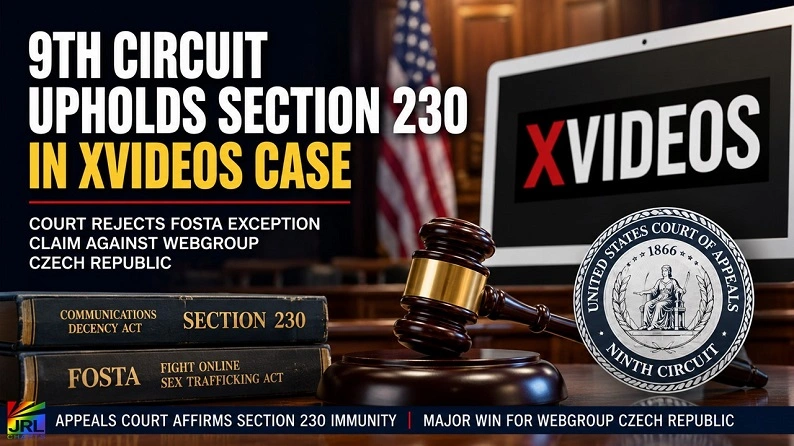
SAN FRANCISCO, CA — (August 18, 2026) — The U.S. Court of Appeals for the 9th Circuit has upheld a lower court ruling protecting WebGroup Czech Republic under Section 230 of the Communications Decency Act, delivering an important appellate victory for the parent company behind major adult platforms including XVideos and XNXX.
At the center of the dispute is whether WebGroup Czech Republic, commonly known as WGCZ, could be held liable over illegal videos depicting the plaintiff when she was a minor that third parties uploaded to platforms operated by the company.
Trending LGBT Business Finance News Coverage on JRL CHARTS:
• JustFor.fans Scores Major WIPO Victory as Panel Orders Rival Domain Transferred
• Aylo Moves to Settle Pornhub Class Actions With $120 Million Fund and New Safeguards
• Adult Creators Finally Get Specialized Insurance Coverage from Essence Protection
• Former Wells Fargo VP Alleges Age, Race and LGBTQ Discrimination After 39-Year Career
• DeKalb County Pushes Adult Stores Out of Commercial Zones in Major Zoning Shift
• Where are the Jobs? America Was Promised Private-Sector Hiring — The Data Tells a Different Story
• Get the Latest in LGBT Business Finance News
The plaintiff, identified in court records as Jane Doe, sought to overcome Section 230 by invoking the federal Allow States and Victims to Fight Online Sex Trafficking Act, commonly known as FOSTA.
But the appeals court concluded that Doe’s allegations did not sufficiently establish the kind of knowing participation in a sex-trafficking venture necessary to trigger FOSTA’s exception to Section 230.
The ruling leaves the liability shield intact in a case carrying potentially significant implications for online platforms that host user-generated content.
Section 230 at Center of XVideos Legal Battle
Section 230 has been one of the most consequential laws governing internet businesses for decades.
Broadly, the law prevents providers of interactive computer services from being treated as the publisher or speaker of information supplied by another content provider.
That distinction became central to Doe’s lawsuit.
Doe alleged that videos depicting abuse she suffered as a minor were uploaded by third parties to adult websites operated by WGCZ and related entities.
Her lawsuit sought to hold the companies legally responsible under several federal and California statutes.
The National Center on Sexual Exploitation, or NCOSE, supported the litigation, with its chief legal officer Dani Pinter serving among the attorneys representing Doe.
FOSTA Exception Becomes Critical to Case
Congress altered portions of the Section 230 landscape in 2018 when it enacted FOSTA.
The legislation created an exception allowing certain civil sex-trafficking claims to proceed despite Section 230 when the conduct underlying a claim amounts to a violation of the federal criminal sex-trafficking statute.
That exception became crucial to Doe’s case.
Under existing Ninth Circuit precedent, however, simply alleging that illegal material appeared on a website is not enough to establish the necessary violation.
For the FOSTA exception to apply, a plaintiff must sufficiently establish that the defendant knowingly benefited from and knowingly assisted, supported or facilitated sex-trafficking activity.
The legal standard requires more than allegations that an online service failed to prevent illegal third-party material from appearing on its platform.
Court Finds Allegations Fall Short of FOSTA Standard
According to the ruling, Doe failed to adequately establish WebGroup’s knowledge of and participation in the sex-trafficking activity necessary to remove the company’s Section 230 protection.
The court focused on the distinction between knowledge that illegal or abusive material exists and actual knowledge of a qualifying sex-trafficking venture.
Doe alleged that she contacted XVideos and XNXX repeatedly beginning in at least 2017 seeking removal of videos depicting her abuse.
But the appeals court said the complaint did not sufficiently allege that those communications informed WebGroup of the circumstances constituting sex trafficking until Doe’s attorney sent a cease-and-desist letter in 2020.
WebGroup subsequently removed the videos.
The distinction proved critical.
Under the FOSTA framework applied by the court, knowledge that unlawful content has appeared on a platform does not automatically establish that the platform knowingly participated in or benefited from the underlying trafficking venture.
What “Actual Knowledge” Means Under FOSTA
The ruling builds on the Ninth Circuit’s earlier interpretation of FOSTA in Does 1-6 v. Reddit, a significant Section 230 case decided in 2022.
That precedent requires plaintiffs attempting to use FOSTA to overcome Section 230 to establish that the website’s own conduct violated the federal criminal trafficking statute.
The standard requires “actual knowledge and a causal relationship between affirmative conduct furthering the sex-trafficking venture and receipt of a benefit.”
That is a considerably higher threshold than merely demonstrating that a platform financially benefited from hosting user-generated content on which illegal material subsequently appeared.
In Doe’s case, the court determined that the allegations did not adequately bridge that gap.
Alleged Traffickers Present Another Legal Problem
The court identified another significant weakness in Doe’s FOSTA argument.
Although the complaint referred to individuals involved as “sex traffickers,” the court concluded that the allegations did not sufficiently establish that the person responsible for uploading the disputed material trafficked Doe within the statutory framework required for the FOSTA exception.
That matters because FOSTA does not operate as a blanket exception to Section 230 for every category of illegal content.
Instead, the exception relevant to this case is tied specifically to conduct satisfying federal sex-trafficking statutes.
Without adequately establishing both the underlying trafficking venture and WebGroup’s knowing participation in that venture, the FOSTA argument could not overcome Section 230.
Case Has Already Made One Trip Through 9th Circuit
The latest ruling represents another chapter in litigation that has already produced significant federal appellate activity.
Doe originally filed the putative class action against numerous foreign and domestic defendants.
The Central District of California initially dismissed claims against foreign defendants on jurisdictional grounds.
Doe appealed.
In 2024, the Ninth Circuit partially reversed that decision, finding that Doe had established a sufficient basis at the pleading stage for U.S. courts to exercise specific personal jurisdiction over WebGroup Czech Republic and NKL Associates.
That decision, reported as Doe v. WebGroup Czech Republic, A.S., 93 F.4th 442, sent portions of the case back to the district court.
The litigation subsequently shifted from whether U.S. courts could exercise jurisdiction over the foreign companies to whether Doe’s substantive claims could survive Section 230 and other statutory requirements.
District Court Finds Platform Tools Protected by Section 230
The district court’s analysis also addressed a particularly important question for internet companies: whether ordinary platform features can transform a service provider into the creator or developer of illegal third-party content.
Doe pointed to features including thumbnails, titles, tags, keywords, search terms, categories and recommendation systems.
The district court was not persuaded that those allegations were sufficient.
It concluded that creating thumbnails from uploaded videos appeared to constitute either a standard publishing function or a neutral tool.
Similar reasoning applied to tags, keywords and categories available to users.
The court also found that recommending content based on a user’s previous viewing activity did not, by itself, establish that the platform knowingly received or distributed illegal material.
That portion of the case potentially reaches far beyond adult entertainment.
Search functions, automated recommendations, tagging systems and user-generated content are fundamental components of social media, video-sharing services, marketplaces and other online businesses.
Second Appeal Reaches Ninth Circuit in 2026
After the district court entered judgment, Doe appealed again.
The new appellate proceeding was docketed as Doe v. WebGroup Czech Republic, A.S., No. 25-2424.
The Ninth Circuit heard oral arguments on July 8, 2026, in Pasadena, California.
The panel consisted of Circuit Judges Johnnie B. Rawlinson and Gabriel P. Sanchez, joined by U.S. District Judge Sidney A. Fitzwater, sitting by designation.
The resulting decision leaves the district court’s Section 230 determination standing and rejects Doe’s attempt to invoke the FOSTA exception on the allegations presented.
Why the XVideos Ruling Matters to Online Businesses
Although the underlying allegations involve adult websites, the legal significance extends considerably further.
Section 230 applies across enormous portions of the modern internet economy.
Social networks, discussion forums, video platforms, online marketplaces and other interactive services routinely depend on legal distinctions between material created by the service itself and content supplied by users.
FOSTA established an important statutory limitation on that immunity in qualifying sex-trafficking cases.
But the WebGroup litigation demonstrates that the exception has boundaries.
A plaintiff attempting to invoke FOSTA must connect the platform’s own conduct to a legally sufficient sex-trafficking venture rather than relying solely on allegations that illegal user-generated material appeared on the service.
For digital businesses, that distinction can determine whether litigation proceeds into potentially expensive discovery and trial or is dismissed under Section 230.
Section 230 Victory Carries Wider Digital-Business Implications
For WebGroup Czech Republic, the decision represents a substantial legal victory after years of litigation.
For the broader technology and digital-media industries, however, the importance lies in what the ruling says about the continuing reach of Section 230.
Congress created FOSTA specifically to ensure that Section 230 could not shield online businesses that themselves engage in conduct violating federal sex-trafficking law.
The Ninth Circuit’s application of that exception nevertheless requires allegations demonstrating actual knowledge and affirmative participation sufficient to satisfy the underlying federal statute.
That leaves a significant legal distinction between knowingly participating in trafficking and operating an online platform on which a third party uploads unlawful material.
As Congress, courts and regulators continue debating the responsibilities of digital platforms, Doe v. WebGroup Czech Republic adds another significant decision to the developing legal boundaries surrounding Section 230, user-generated content and online liability.
Stay with JRL CHARTS LGBT Business Finance News for continuing coverage of litigation, regulation, corporate developments and court decisions shaping the LGBTQ and adult entertainment business sectors.

A veteran member of the JRL CHARTS editorial team, Witchka brings 20 years of experience with the publication covering studios, performers, new releases and developments across the international gay adult entertainment industry.
His reporting combines two decades of industry knowledge with JRL CHARTS’ continuing coverage of the studios, talent and business trends shaping the gay adult entertainment market.
- LatinBoyz Presents Alex & Peter – One Interview Sparks an Unexpected Connection - October 21, 2026
- JFF Create Arrives on Android as JustFor.fans Upgrades Its iPhone App - October 19, 2026
- MEN.com Drops a Bombshell — Viral Star CurvedKing Signs Exclusive Deal - October 19, 2026