By Keith Witchka – Senior Correspondent | LGBT Business Finance News
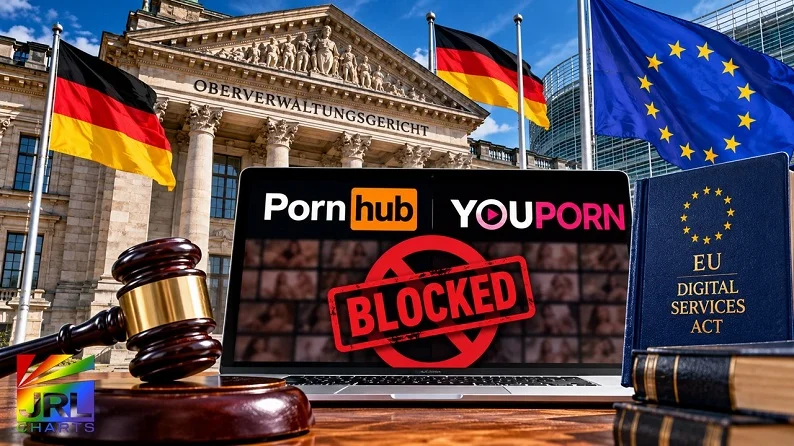
MÜNSTER, GERMANY — October 9, 2026 — Germany’s attempt to force internet providers to block Pornhub and YouPorn has encountered a major legal obstacle after a higher administrative court ruled that the restrictions likely conflict with European Union law.
The Higher Administrative Court of North Rhine-Westphalia rejected emergency appeals from the state’s media regulator, allowing both Aylo-owned platforms to remain outside the disputed network-blocking orders while related legal proceedings continue.
Trending Gay Adult Industry News Coverage on JRL CHARTS:
• OnlyFans and MYM Escape Sweeping French Crackdown After Parliament Showdown
• OnlyGays Launches LGBTQ Creator Search Platform to Take On the Algorithm Problem
• Ukraine Porn Legalization Push Could Open the Door for Gay Adult Industry
• California AB 1705 Could Rewrite Adult Website UGC Rules With $75,000-Per-Violation Liability
• XVideos Scores Major Section 230 Victory as 9th Circuit Rejects FOSTA Challenge
The decision marks an important development in Europe’s expanding debate over online age verification, digital platform regulation, and the authority of individual EU member states to police cross-border internet services.
Why Germany’s Pornhub and YouPorn Blocking Orders Failed
The dispute originated with the State Media Authority of North Rhine-Westphalia, known as LfM, which challenged the platforms’ compliance with German youth-protection requirements.
Regulators initially acted against the Cyprus-based operator in 2020, arguing that the websites lacked effective systems to prevent minors from accessing adult material.
When enforcement against the foreign-based operator proved unsuccessful, the authority escalated its response in April 2024 by directing an internet access provider to block the websites in Germany.
However, the Administrative Court of Düsseldorf suspended those blocking requirements during the underlying litigation. The higher court has now upheld that interim protection.
In its October 9 announcement, the court explained that the blocking orders likely exceeded the regulator’s authority under European law.
EU Digital Services Act Changes the Legal Battlefield
Central to the ruling is the European Union’s Digital Services Act (DSA), which became fully applicable in February 2024.
The court identified two significant legal barriers to Germany’s approach.
First, the EU’s country-of-origin principle generally places responsibility for regulating a cross-border digital service with the member state where its operator is established.
Second, the court concluded that the DSA provides a harmonized framework for online platform obligations concerning the protection of minors, limiting the ability of national regulators to impose overlapping measures.
That does not eliminate age-verification obligations.
Instead, it changes which authorities can investigate potential violations and pursue enforcement.
Cyprus and Brussels Now Hold Key Enforcement Roles
Because YouPorn’s operator is established in Cyprus, the court identified Cypriot authorities as the appropriate supervisory channel under the EU framework.
Pornhub faces a different regulatory arrangement.
Its designation as a Very Large Online Platform (VLOP) places it under direct European Commission supervision for relevant DSA obligations.
The distinction is especially important for multinational digital publishers and platform operators, which must navigate both European-wide requirements and national regulatory disputes.
European Commission Already Investigating Pornhub
The German ruling arrives while the European Commission is pursuing its own investigation into online protections for minors.
On March 26, 2026, the Commission announced preliminary findings involving Pornhub, Stripchat, XNXX, and XVideos.
EU investigators questioned whether the platforms had adequately assessed risks to minors and implemented effective safeguards against underage access.
The Commission also challenged the effectiveness of simple age-confirmation buttons and other limited protective measures.
Those findings are preliminary. The platforms retain the right to respond, and the Commission has not announced a final decision in those proceedings.
If violations are ultimately established, the DSA provides for substantial financial penalties and additional enforcement measures.
What the German Ruling Means for Europe’s Digital Businesses
For online publishers, digital platforms, internet providers, and companies operating across EU borders, the decision highlights a critical regulatory question: Who has the legal authority to enforce online safety obligations?
The ruling does not give adult platforms permission to disregard youth-protection requirements.
Rather, it reinforces the importance of applying those requirements through the appropriate European legal channels.
The court also disclosed that seven additional proceedings involving related regulatory measures remain pending.
For now, the contested German network-blocking orders cannot be enforced against Pornhub and YouPorn under the two interim decisions.
The wider battle over online age verification, cross-border enforcement, and the future of Europe’s digital services market is far from over.
JRL CHARTS LGBT Business Finance News and LGBT Politics Europe will continue tracking the European Union’s digital regulations, court decisions, and their impact on international online businesses.

A veteran member of the JRL CHARTS editorial team, Witchka brings 20 years of experience with the publication covering studios, performers, new releases and developments across the international gay adult entertainment industry.
His reporting combines two decades of industry knowledge with JRL CHARTS’ continuing coverage of the studios, talent and business trends shaping the gay adult entertainment market.