By: Paul Goldberg – Senior Correspondent | LGBT Business Finance News
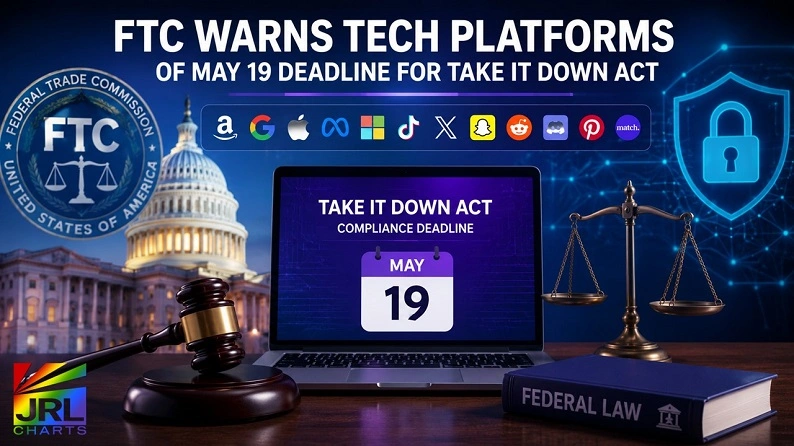
WASHINGTON, D.C. — (May 13,2026) — The Federal Trade Commission (FTC) has issued formal warnings to major online platforms as the May 19 enforcement deadline for the Take It Down Act approaches, signaling a significant shift in how digital content is regulated across the United States.
In a sweeping move, the agency confirmed that compliance notices were sent to a wide range of technology companies, including major social media networks, messaging platforms, and content-sharing services. The directive underscores the urgency for platforms to implement systems capable of responding to legal takedown requests within strict federal timelines.
Related LGBT Business Finance & Politics News on JRL CHARTS:
• Conservative Packed Missouri Supreme Court Hands GOP Gerrymandering Victory
• Watch: Anti-Trump “Had Enough?” Ad Sparks Political Firestorm in Election 2026
• Virginia Supreme Court Sparks National Alarm Over GOP Court Power & Minority Vote Dilution
• Project 2025 Already 50% Complete: Inside Trump’s Plan Reshaping America
• U.S. Banking Rule Ends ‘Reputational Risk’ Barrier, Expands Access for Legal Businesses
New Federal Standard for Content Removal
The Take It Down Act, signed into law last year, establishes a federal prohibition against the distribution of non-consensual intimate imagery (NCII), including AI-generated synthetic content. The legislation introduces a mandatory notice-and-removal framework requiring platforms to act within 48 hours of receiving a valid request.
Beginning May 19, platforms operating within U.S. jurisdiction must comply with these requirements or face regulatory consequences. The law applies broadly to services that host user-generated content, including social media platforms, messaging apps, video-sharing services, and interactive digital communities.
FTC Signals Strict Enforcement Approach
“We stand ready to monitor compliance, investigate violations, and enforce the Take It Down Act,” said FTC Chair Andrew Ferguson. “Protecting the vulnerable—especially children—from this harmful abuse is a top priority for this agency and this administration.”
Under the new rules, failure to meet takedown obligations may be treated as a violation of FTC regulations, with civil penalties reaching up to $53,088 per violation. In more severe cases, unlawful content distribution could also trigger criminal liability under federal law.
Operational Challenges for Digital Platforms
Legal experts emphasize that compliance will require more than policy updates. Platforms must deploy operational systems capable of receiving, reviewing, tracking, and removing flagged content within the mandated timeframe.
“For platforms that host user-generated content, creator content, private messaging, image or video uploads, live chat, AI-generated media, or adult content, this is not just a policy issue,” said attorney Corey Silverstein. “It is an operational issue.”
He added that companies must ensure they can not only remove flagged content quickly but also prevent its reappearance across their platforms.
Industry Groups Highlight Compliance Risks
Industry organizations are also raising awareness about the law’s implications. The Free Speech Coalition noted that liability under the act extends primarily to individuals who knowingly publish prohibited content, while platforms are responsible for maintaining transparent and accessible removal processes.
Platforms must clearly communicate how users can submit takedown requests and ensure that those systems are functional and responsive. Failure to meet these requirements may be classified as an unfair or deceptive business practice under FTC enforcement standards.
What This Means for the Digital Economy
As the May 19 deadline approaches, the Take It Down Act is expected to reshape compliance strategies across the tech sector. Companies operating in content-driven environments—particularly those involving user uploads or AI-generated media—are now under pressure to implement robust moderation systems and legal safeguards.
For businesses, the law represents a broader shift toward accountability in digital publishing, with regulators signaling a more aggressive stance on consumer protection and platform responsibility in the evolving online ecosystem.
Stay with JRL CHARTS for continuing coverage on digital policy, LGBT News, and the evolving impact of age verification laws across the United States.
His reporting focuses on federal court rulings, legislative developments, international human rights issues, and government actions impacting LGBTQ communities worldwide.
With nearly two decades of experience, Goldberg is recognized for his balanced analysis, investigative insight, and commitment to accurate, fact-based journalism that informs readers on the political forces shaping equality and justice.
- Cape Town Pride 2027 Goes BIG With 24 Days of LGBTQ Celebrations! - October 24, 2026
- LGBTQ Rights on the Line in 7 States as 2026 Midterm Elections Near - October 24, 2026
- Gay Dad Cleared After Punching MAGA Influencer Who Targeted His Family - October 24, 2026