By Keith Witchka – Senior Correspondent | Gay Adult Industry News
SACRAMENTO, CA — (September 15, 2026) — California lawmakers have sent Gov. Gavin Newsom legislation that could substantially change how adult websites handle user-generated content, establishing new certification, consent, contact-verification and record-retention requirements while exposing operators and uploaders to potentially significant civil liability.
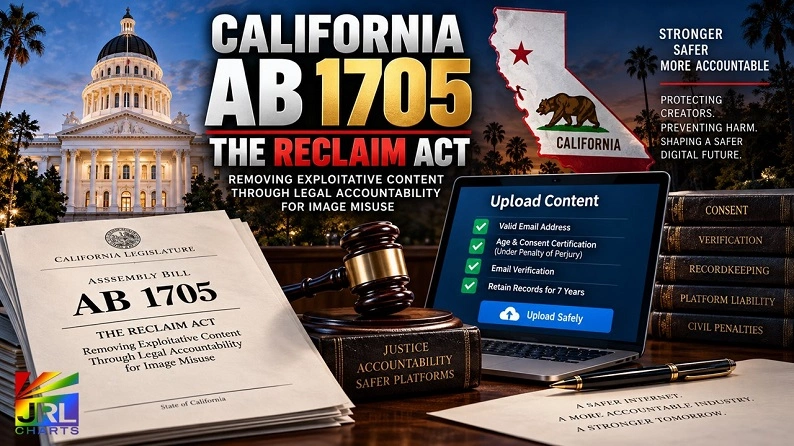
Assembly Bill 1705, officially known as the RECLAIM Act — Removing Exploitative Content Through Legal Accountability for Image Misuse — cleared both chambers without a recorded opposing vote in its final passage: the Senate approved the measure 39-0 on August 20, followed by a 78-0 Assembly concurrence vote on August 24. The enrolled legislation was presented to the governor on August 28.
Trending Gay Adult Industry News Coverage on JRL CHARTS:
• Ukraine Porn Legalization Push Could Open the Door for Gay Adult Industry
• XVideos Scores Major Section 230 Victory as 9th Circuit Rejects FOSTA Challenge
• What Happened to the Gay Adult Webmaster Industry? Inside the Digital Market Shift
• Aylo Moves to Settle Pornhub Class Actions With $120 Million Fund and New Safeguards
• Segpay Wins Dismissal in Florida Age Verification Legal Challenge
Authored by Democratic Assemblymember Rebecca Bauer-Kahan and Republican Assembly member Diane Dixon, AB 1705 specifically targets websites that permit users to upload or provide sexually explicit material for public display. California legislative analysis describes the measure as establishing an enforceable duty of care intended to prevent nonconsensual material and content involving minors from appearing on those platforms.
For adult-industry operators, however, the significance extends beyond content moderation.
The legislation would place compliance obligations directly into the upload process itself.
AB 1705 Would Require Certification Before Adult UGC Is Uploaded
Under the enrolled legislation, users seeking to upload covered material would first have to provide the website operator with contact information including, at minimum, an email address.
They would also have to certify under penalty of perjury that every person depicted was an adult when the material was created, consented to being depicted and consented to the material being uploaded to the website.
Operators would have to verify the uploader’s email address before allowing the upload and retain the certification and associated information in a readily available format for at least seven years.
The legislation adds another enforcement mechanism against uploaders themselves: knowingly supplying false information in the required certification would constitute an infraction punishable by a $1,000 fine.
That provision is particularly important because AB 1705 does not simply establish a general obligation to remove prohibited material after receiving a complaint. It places a compliance checkpoint before covered user-generated material can be uploaded.
The Potential Liability Reaches $75,000 Per Violation
AB 1705 also carries significant potential financial consequences.
A depicted person who suffers harm could bring a civil action when covered material was uploaded or displayed in violation of the proposed requirements. A prevailing plaintiff could recover actual damages or statutory damages of up to $75,000 per violation, whichever is greater, along with punitive damages, reasonable attorney’s fees, costs and other available relief.
Public prosecutors would separately be authorized to pursue civil penalties of $25,000 per violation, as well as injunctive or equitable relief, attorney’s fees and other relief deemed appropriate by a court.
But one provision may attract particular attention from platform operators:
Each full calendar day that material displayed in violation of the chapter remains accessible would constitute a separate violation.
That potentially makes the length of time disputed material remains online an important component of an operator’s exposure.
AB 1705 Is Not Simply California’s Version of Federal 2257
Adult-industry businesses already operate within an extensive federal recordkeeping environment, most notably 18 U.S.C. § 2257 and its associated regulations.
AB 1705, however, addresses additional issues.
The California proposal directly regulates covered website operators and establishes obligations involving uploader certification, consent to depiction, consent to uploading, verified uploader contact information and the continued display of covered material.
The Legislature’s own analysis characterizes AB 1705 as creating liability around platforms’ failure to take reasonable steps to prevent prohibited user-generated material from being uploaded. It also acknowledges that the legislation operates in an area where Section 230 litigation and platform-liability law continue to evolve, while arguing that the bill is structured around an operator’s own statutory obligations rather than simply treating the platform as the publisher of somebody else’s speech.
That distinction could become legally significant if the measure becomes law and subsequently faces court challenges.
What Happens to Adult Content Already Online?
One of the more complicated questions involves material uploaded before any new requirements take effect.
The enrolled text clearly establishes pre-upload requirements for certification and email verification. Those requirements naturally operate at the point an upload occurs.
But AB 1705 separately states that an operator must exercise ordinary care and reasonable diligence to ensure that each instance of covered material displayed on its website does not include a person falling within the legislation’s prohibited categories.
That distinction creates an important issue for platforms maintaining large historical libraries.
The enrolled legislation does not expressly provide a blanket exemption for older catalogs in the provisions reviewed by JRL CHARTS. At the same time, exactly what constitutes sufficient “ordinary care” and “reasonable diligence” for enormous preexisting libraries could ultimately depend on enforcement decisions and judicial interpretation.
Operators therefore should distinguish between what the legislation explicitly requires and questions that remain unresolved rather than assuming every preexisting upload automatically requires a new certification.
Dating-Site Private Messages Receive a Specific Exclusion
Another detail worth noting is what AB 1705 does not cover.
The enrolled legislation contains a specific exclusion for covered material transmitted through an online dating service’s private messaging or direct-communication functionality when it is sent only to user-selected recipients and is not publicly available through a feed, public display or search indexing.
The underlying statutory definition also excludes services solely on the basis that they provide email, direct messaging, cloud storage, file-transfer or file-collaboration functionality.
Those distinctions reinforce the legislation’s focus on platforms making user-supplied adult material publicly accessible rather than every online service through which private files can move.
California’s RECLAIM Act Reaches Newsom After Unanimous Final Votes
AB 1705 arrives at the governor’s desk with unusually broad legislative support.
The measure passed the Senate 39-0, and the Assembly subsequently concurred 78-0, with the final Assembly tally comprising 59 Democrats and 19 Republicans voting yes.
Bauer-Kahan has described the RECLAIM Act as a mechanism for holding platforms accountable when nonconsensual sexually explicit material is uploaded and distributed online. Earlier Assembly analysis said the legislation grew out of AB 392, a related 2025 proposal that passed the Assembly but was held in the Senate Appropriations Committee.
If AB 1705 becomes law, adult UGC platforms serving California could face an important operational question extending well beyond traditional age recordkeeping:
Can their upload, consent, verification, retention and moderation systems demonstrate the level of diligence California would now demand?
For an industry increasingly built around creator uploads and platform distribution, that may prove to be the most consequential question raised by AB 1705.
Stay connected to JRL CHARTS Gay Adult Industry News for continuing coverage of California AB 1705, adult-industry regulation, platform compliance and legislation reshaping the global digital adult entertainment business.
His reporting focuses on federal court rulings, legislative developments, international human rights issues, and government actions impacting LGBTQ communities worldwide.
With nearly two decades of experience, Goldberg is recognized for his balanced analysis, investigative insight, and commitment to accurate, fact-based journalism that informs readers on the political forces shaping equality and justice.
- Stocks Up 12%, Bonds Under Pressure — Morningstar Reveals Wall Street’s Growing Divide - October 26, 2026
- American Express Profits Surge 28% — Then Comes the 3,500 Job Cut Bombshell - October 26, 2026
- Jamie Dimon Sounds the Alarm: 5 Economic Threats That Could Shake America - October 25, 2026