By: Paul Goldberg – Senior Correspondent | LGBT Business Finance News
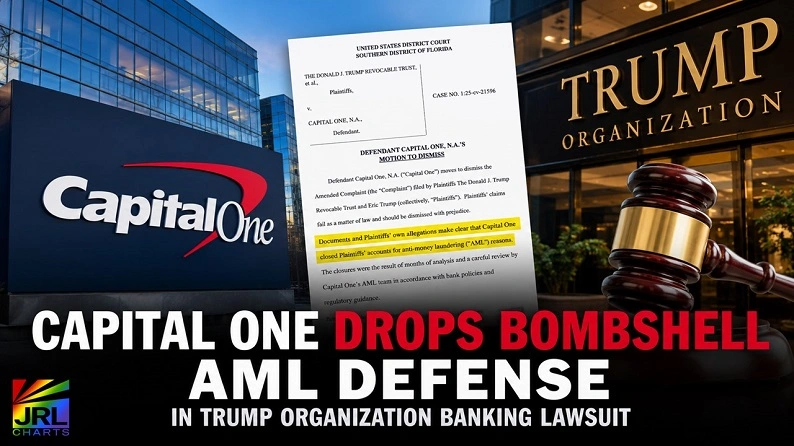
MIAMI, FL — (August 2, 2026) — Capital One has asked a federal court to dismiss the Trump Organization’s lawsuit over the closure of more than 300 bank accounts, arguing that the decision followed an extensive internal anti-money laundering (AML) review rather than political considerations.
The filing, submitted Friday in the U.S. District Court for the Southern District of Florida, marks the first time a major financial institution has publicly linked anti-money laundering compliance concerns to its decision to end its banking relationship with the Trump Organization.
Now Trending on LGBT Business, Finance and Politics News on JRL CHARTS
• Education Department Drops LGBTQ+ Student Data From Civil Rights Survey
• Americans Flood FCC With Opposition to LGBTQ TV Warning Labels
• Scott Bessent’s Economic Statecraft Speech Sparks Global Debate Over U.S. Financial Power
• Federal Judge Voids Trump-IRS Settlement That Created Controversial Weaponization Fund
• LGBTQ Consumers Shift Spending Away from Target, Walmart and Amazon
• Get the Latest In LGBT Politics News on JRL CHARTS
Capital One Rejects Political Motivation Claims
The Trump Organization and Eric Trump filed suit in 2025, alleging Capital One closed hundreds of company accounts because of political bias following the January 6, 2021 attack on the U.S. Capitol.
Capital One strongly disputes those allegations.
According to the bank’s latest court filing, the account closures resulted from “months of analysis and a careful review” conducted by its anti-money laundering compliance team under established banking policies and federal regulatory guidance.
Importantly, the filing does not accuse the Trump Organization of committing money laundering. Instead, Capital One argues that federal banking regulations required it to evaluate transaction activity and make risk-based decisions regarding customer relationships.
Bank Says Suspicious Transaction Patterns Triggered Review
Capital One told the court that transaction patterns identified during its review matched categories commonly monitored under federal anti-money laundering guidance.
The bank further argued that federal confidentiality laws prevented it from disclosing certain details surrounding its compliance review or discussing specific transaction concerns with account holders.
Capital One also rejected allegations that its actions constituted unlawful “debanking,” saying the plaintiffs relied on selective quotations while ignoring the broader context contained within court filings.
Lawsuit Has Already Been Amended Multiple Times
The litigation has already encountered procedural setbacks for the plaintiffs.
The federal court previously dismissed two versions of the complaint while allowing amended filings. Capital One now argues that the latest amended complaint filed in July continues to suffer from the same legal deficiencies and should be dismissed with prejudice.
Banking Industry Faces Growing Political Pressure
The dispute arrives amid a broader national debate over “debanking” and whether financial institutions improperly deny services based on political or ideological considerations.
President Donald Trump has repeatedly criticized major financial institutions over alleged political discrimination. During his second term, his administration issued executive actions aimed at prohibiting discriminatory debanking practices, while additional litigation involving other major banks has continued to shape the national conversation over banking compliance and customer risk management.
What Happens Next
The court must now determine whether Capital One’s latest motion successfully defeats the amended complaint or whether the Trump Organization’s lawsuit will proceed into discovery.
Because the case centers on banking compliance, anti-money laundering obligations, and allegations of politically motivated account closures, the ruling could have broader implications for how financial institutions balance regulatory compliance with increasingly scrutinized customer relationships.
For continuing coverage of corporate litigation, Wall Street compliance, banking regulation, and the financial stories impacting the LGBTQ business community, stay with JRL CHARTS LGBT Business Finance News.
His reporting focuses on federal court rulings, legislative developments, international human rights issues, and government actions impacting LGBTQ communities worldwide.
With nearly two decades of experience, Goldberg is recognized for his balanced analysis, investigative insight, and commitment to accurate, fact-based journalism that informs readers on the political forces shaping equality and justice.
- Stocks Up 12%, Bonds Under Pressure — Morningstar Reveals Wall Street’s Growing Divide - October 26, 2026
- American Express Profits Surge 28% — Then Comes the 3,500 Job Cut Bombshell - October 26, 2026
- Jamie Dimon Sounds the Alarm: 5 Economic Threats That Could Shake America - October 25, 2026