By: Paul Goldberg – Senior Correspondent | LGBT Politics USA News
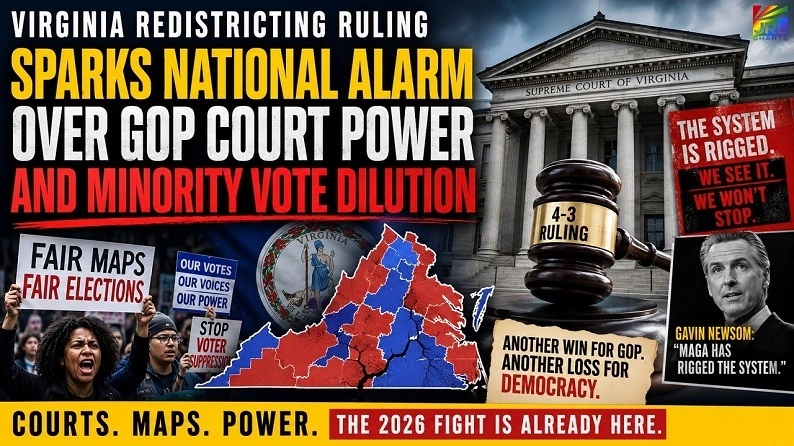
RICHMOND, VA — (May 8, 2026) — A controversial ruling by the Virginia Supreme Court has ignited a national firestorm after justices struck down a voter-approved redistricting map — a decision that hands Republicans a major advantage heading into the 2026 elections and intensifies fears that America’s judicial system is being weaponized to reshape political power.
The 4-3 ruling invalidates a Democratic-backed congressional map that could have flipped multiple GOP-held seats. Instead, the decision preserves a more favorable electoral landscape for Republicans — one that could prove decisive in determining control of the U.S. House. But critics warn: this is not an isolated ruling. It’s part of a pattern.
Related LGBT Business Finance & Politics News on JRL CHARTS:
• Project 2025 Already 50% Complete: Inside Trump’s Plan Reshaping America
• U.S. Banking Rule Ends ‘Reputational Risk’ Barrier, Expands Access for Legal Businesses
• LGBTQ Corporate Participation Plunges 65% in 2026 as DEI Retreat Reshapes Business Landscape
• Oil Surges Past $100 as Strait of Hormuz Crisis Rattles Global Markets
• LGBTQ Corporate Participation Drop 65% in 2026 as DEI Retreat Reshapes Business Landscape
A Growing Pattern: Courts Reshaping Elections
Across the country, courts — particularly those dominated by conservative appointees — are increasingly playing a central role in determining electoral outcomes.
Legal analysts and watchdog groups have pointed to a striking trend: an overwhelming majority of politically sensitive rulings in recent years have favored Republican-aligned outcomes, especially in cases involving redistricting, voting access, and election law.
In several high-profile cases, rulings have stunned legal scholars who expected different outcomes based on precedent, only to see courts side with GOP-backed arguments.
This trend has led to growing concern that judicial decisions are no longer just interpreting the law — but actively influencing the political balance of power.
The Court Strategy: A Decade in the Making
The roots of this moment trace back to a long-term strategy by Republican leadership to reshape the judiciary at every level — from district courts to federal appellate benches and ultimately the Supreme Court of the United States.
Through aggressive appointments over the past decade, conservatives have secured dominant majorities across federal appellate courts, which often serve as the final word on major legal disputes since the U.S. Supreme Court accepts only a limited number of cases.
The impact is profound:
- Federal appellate courts now tilt heavily conservative
- State supreme courts in key battlegrounds are increasingly aligned
- Judicial rulings are shaping election maps before voters ever cast a ballot
Critics argue that this judicial realignment has created a system where outcomes in politically charged cases are becoming more predictable — and increasingly favorable to Republican interests.
Newsom Sounds the Alarm
California Governor Gavin Newsom amplified the growing alarm, warning that the system itself is being manipulated.
In a widely circulated post on X, Newsom declared that conservatives have “rigged the system,” pointing to coordinated redistricting efforts and court rulings across multiple Republican-led states.
His message reflects a broader Democratic argument: that control of the courts has become just as critical — if not more — than control of legislatures.
No vote in Tennessee (+1 GOP)
No vote in Florida (+4 GOP)
No vote in Missouri (+1 GOP)
No vote in North Carolina (+2 GOP)
No vote in Texas (+5 GOP)Virginia’s voter-approved maps thrown out.
MAGA has rigged the system.
— Gavin Newsom (@GavinNewsom) May 8, 2026
Southern States Move in Lockstep
The Virginia ruling lands amid a wave of aggressive redistricting moves across the South:
- Alabama has advanced new maps that could weaken gains made by Black voters after previous court interventions
- Louisiana is already reshaping districts following recent federal rulings affecting minority representation
- Tennessee has redrawn maps that critics say dismantle key Democratic and minority-heavy districts
Taken together, these moves point to a coordinated regional strategy — one that leverages both legislative power and favorable court rulings to reshape electoral maps ahead of 2026.
Minority Voting Power at Risk
At the center of the redistricting fight is the future of minority representation.
Voting rights advocates warn that new maps — combined with court rulings that weaken enforcement of protections — could significantly reduce the political influence of:
- Black voters
- Latino voters
- LGBTQ communities
- Urban Democratic strongholds
In many cases, districts that once allowed minority voters to elect candidates of their choice are being redrawn in ways that dilute their impact — a practice long challenged under federal law but now facing new judicial interpretations.
Why This Moment Is Different
What makes the current situation uniquely alarming, analysts say, is the alignment between legislative strategy and judicial outcomes.
In previous decades, aggressive maps were often blocked or reversed by courts. Today, those same strategies are increasingly being upheld — or enabled — by a judiciary that has shifted significantly to the right.
The result is a powerful feedback loop:
- Legislatures draw aggressive maps
- Courts uphold or unlock them
- Political power becomes further entrenched
2026: An Election Shaped Before It Begins
The implications for the 2026 midterms are massive.
Control of Congress could hinge not just on campaigning or voter turnout — but on how district lines have already been drawn and defended in courtrooms.
For many voters, especially in Southern states, the concern is stark:
Are elections still being decided at the ballot box — or in the courts?
The Bottom Line
The Virginia Supreme Court ruling is more than a state-level decision. It is a warning sign of a broader transformation in how political power is being determined in the United States.
With courts playing an increasingly decisive role, the fight over redistricting has evolved into a battle over the very structure of American democracy — one where the rules of representation are being rewritten in real time.
Stay with JRL CHARTS LGBT Politics USA as we continue exposing how court rulings, redistricting battles, and political power plays are shaping the future of American elections.
His reporting focuses on federal court rulings, legislative developments, international human rights issues, and government actions impacting LGBTQ communities worldwide.
With nearly two decades of experience, Goldberg is recognized for his balanced analysis, investigative insight, and commitment to accurate, fact-based journalism that informs readers on the political forces shaping equality and justice.
- GameStop Hit With Federal Lawsuit After Gay Employee Reports Threats — Then Gets Fired - October 16, 2026
- Meta Paid 29 Anti-LGBTQ Accounts as 2026 Midterm Misinformation Spreads - October 14, 2026
- Orbán’s Anti-LGBTQ Legacy Crumbles as Hungary Votes 139–51 for Change - October 13, 2026