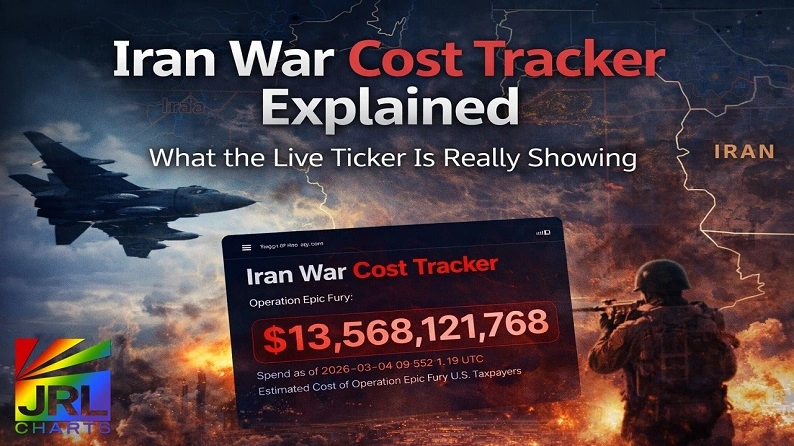
By: Paul Goldberg, Senior Correspondent | LGBT Politics & Global Affairs
LAS VEGAS — (March 3, 2026) — A website called the Iran War Cost Tracker is rapidly going viral across social media platforms, drawing global attention with a live ticker that estimates the financial cost of ongoing military escalation involving Iran.
As the numbers climb in real time, millions are asking the same question: What exactly is this tracker measuring — and how accurate are the figures?
Here’s what the site shows, how such war-cost tools typically work, and why it’s fueling debate worldwide.
Related LGBT Breaking Military News Coverage on JRL CHARTS:
• Spain Refuses Use of US Military Bases for Iran Operations as Aircraft Redeploy to Germany
• Get the Latest in LGBT Politics USA Exclusively on JRL CHARTS
• Trump Announces Major US Military Operation Against Iran
• US Trade Deficit Hits Five-Month High Amid Import Boom
• Pentagon Halts HIV-Positive Recruit Training as Florida Cuts Put HIV Medications at Risk
• Supreme Court Strikes Down Bulk of Trump Tariffs in Landmark Emergency Powers Ruling
What Is the Iran War Cost Tracker?
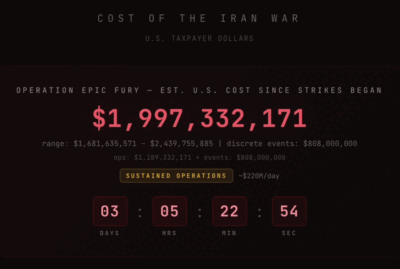
The website iran-cost-ticker.com presents itself as a real-time financial counter estimating the cost of military operations tied to the current Iran conflict. The ticker updates continuously, displaying what it claims are escalating operational expenses tied to airstrikes, military deployments, and munitions usage.
The homepage includes strong language framing the conflict in moral and political terms — rhetoric that has contributed significantly to its viral spread.
However, beyond the headline messaging, the site’s primary function is financial: it estimates the economic cost of war in near real time.
How Does a Live War Cost Ticker Work?
War cost trackers are not new. Similar tools were used during the Iraq and Afghanistan wars to estimate U.S. taxpayer expenditures.
Typically, such trackers rely on:
-
Public military budget allocations
-
Estimated daily operational costs
-
Cost-per-munition calculations
-
Aircraft deployment and fuel usage estimates
-
Personnel and logistics modeling
-
Historical cost comparisons from prior conflicts
These figures are often extrapolated using publicly available defense spending data combined with operational estimates.
It’s important to note that real-time war cost trackers generally provide projections, not audited government-confirmed totals. The numbers reflect modeled estimates based on known cost structures rather than official daily accounting statements.
Why Is the Iran Cost Tracker Going Viral?
Several factors are driving its rapid circulation:
-
Real-Time Visual Impact – Watching financial figures climb live creates a powerful psychological effect.
-
Global Political Tension – Escalating conflict in the region has heightened public interest.
-
Economic Anxiety – Citizens worldwide are concerned about how military spending impacts inflation, taxes, and domestic funding priorities.
-
Strong Political Framing – The site uses provocative language, which has amplified social media sharing.
As of this week, the tracker has been widely shared on X (formerly Twitter), Threads, and Reddit, with users debating both the cost figures and the broader humanitarian implications of the conflict.
What the Tracker Shows — And What It Doesn’t
While the ticker focuses on financial cost, it does not independently verify battlefield developments, nor does it serve as a real-time casualty database.
Additionally:
-
It does not represent official government accounting.
-
It does not clarify methodology in granular detail.
-
It presents cumulative financial totals without broader context such as defense baseline budgets or existing military appropriations.
Financial modeling tools like this are often best viewed as illustrative estimates, not definitive government reports.
The Broader Economic Impact of Military Escalation
Military conflicts historically carry both direct and indirect costs.
Direct costs may include::
-
Equipment and munitions
-
Personnel deployment
-
Air and naval operations
-
Intelligence and logistics
Indirect costs can extend to:
-
Increased oil price volatility
-
Currency fluctuations
-
Sanctions and trade disruptions
-
Long-term veteran care and reconstruction funding
Whether one supports or opposes military intervention, the economic dimension of modern warfare is significant and increasingly scrutinized by the public.
Why It Matters
The viral spread of the Iran War Cost Tracker reflects a broader shift in how citizens engage with global conflict. Real-time digital tools now allow individuals to track financial metrics of war in ways that were not widely accessible during previous decades.
As geopolitical tensions continue to evolve, public interest in transparency — both financial and humanitarian — is likely to intensify.
The Iran War Cost Tracker may not provide official accounting, but its rapid circulation signals something larger: global audiences are demanding visibility into the cost of conflict.
And in the digital age, numbers move just as fast as headlines.
For continued coverage of global politics, military developments, and the economic forces shaping international affairs, stay with JRL CHARTS Global Affairs — delivering analysis beyond the headlines.

His reporting focuses on federal court rulings, legislative developments, international human rights issues, and government actions impacting LGBTQ communities worldwide.
With nearly two decades of experience, Goldberg is recognized for his balanced analysis, investigative insight, and commitment to accurate, fact-based journalism that informs readers on the political forces shaping equality and justice.
- Taipei Gay Bar Raid Sparks Outrage as Police Face LGBTQ Backlash - October 11, 2026
- LGBTQ Voters Are Fired Up for the 2026 Midterms — HRC Survey Reveals 87% Plan to Vote - October 11, 2026
- OnlyFans and MYM Escape Sweeping French Crackdown After Parliament Showdown - October 8, 2026