By: Paul Goldberg – Senior Correspondent | Breaking Military News
WASHINGTON, D.C. — (August 29, 2026) — President Donald Trump’s administration has taken its battle over transgender military service directly to the U.S. Supreme Court, asking the justices to intervene before a federal trial examines whether the Pentagon’s sweeping policy forcing transgender troops from service violates the Constitution.
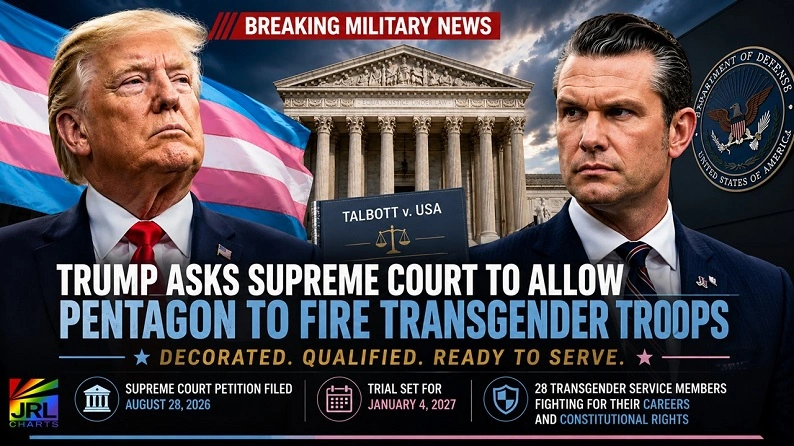
The Justice Department filed its petition Friday, August 28, seeking Supreme Court review of a federal appeals court ruling protecting transgender service members challenging the policy from being discharged while their lawsuit proceeds.
Trending LGBT Breaking Military News Coverage on JRL CHARTS:
• Pentagon Backs Off — For Now — in Explosive Stars and Stripes Press Freedom Fight
• Navy Weighs Scrapping USS Doris Miller Name for Trump in Historic Carrier Shakeup
• VA Loses Again as Judge Blocks Third Attempt to Cancel AFGE Contract
• Did the Pentagon Force Scouting America to Change Its Transgender Policy?
• VA Restructures LGBTQ+ Veteran Programs Under New Federal Policy Changes
• Breaking Military News involving LGBTQ Service Members and Security
At the center of the escalating constitutional battle is Talbott v. USA, a challenge brought by 28 transgender current and prospective service members against the Trump administration’s military policy.
The move could transform a dispute over the careers of decorated service members into a major Supreme Court test of how far a president and the Pentagon can go in restricting transgender Americans from serving in the U.S. Armed Forces.
Trump Administration Calls Appeals Court Ruling “Gravely Erroneous”
Solicitor General D. John Sauer is asking the Supreme Court to overturn the protections maintained by the U.S. Court of Appeals for the District of Columbia Circuit.
The administration characterized the appeals court decision as “gravely erroneous,” arguing that the Pentagon must receive substantial judicial deference when determining who is qualified to serve in the military.
The government maintains that Defense Secretary Pete Hegseth’s policy regulates gender dysphoria and associated medical treatment rather than discriminating against transgender people as a class.
That distinction is critical to the administration’s case because it is seeking a more deferential constitutional standard under which the Pentagon would generally need to demonstrate a rational relationship between its policy and legitimate military objectives such as readiness and effectiveness.
Two federal courts, however, have sharply questioned that explanation.
Federal Judges Found Evidence of Anti-Transgender Animus
U.S. District Judge Ana Reyes previously issued a blistering assessment of the administration’s transgender military policy, finding that the plaintiffs were likely to succeed in their constitutional challenge.
Reyes described the policy as “soaked in animus and dripping with pretext” and called it “a solution in search of a problem.”
The D.C. Circuit subsequently preserved protections for the service members in June.
In the divided appellate ruling, Judges Robert Wilkins and Judith Rogers concluded that the plaintiffs were likely to succeed in demonstrating that the policy violated their constitutional rights.
Wilkins wrote that the policy appeared to be driven by a “bare desire to harm” transgender people rather than legitimate military requirements.
Those findings now sit at the heart of the administration’s request for Supreme Court intervention.
Talbott Trial Could Put Pentagon’s Justifications Under the Microscope
The timing of the Supreme Court petition is especially significant.
Judge Reyes has certified a class covering transgender service members and prospective troops, dramatically expanding the potential impact of the litigation beyond the original plaintiffs.
A two-week federal trial is scheduled to begin January 4, 2027.
That proceeding could subject the administration’s stated military-readiness justifications to extensive factual scrutiny, including evidence and testimony concerning the performance, medical treatment and service records of transgender troops.
Rather than waiting for that trial and subsequent appeals to play out, the administration is asking the Supreme Court to take up the constitutional dispute now.
Trump’s 2025 Military Policy Goes Beyond His First-Term Restrictions
The Supreme Court has confronted transgender military restrictions before, but it has never issued a final ruling after a full trial declaring such a ban constitutional.
Trump first announced restrictions on transgender military service in 2017.
Then-Defense Secretary Jim Mattis subsequently developed a more detailed policy in 2018. That framework generally restricted military service by people diagnosed with gender dysphoria who had transitioned or sought to transition while preserving exceptions for some personnel who had already begun transitioning under previous Defense Department rules.
Multiple federal courts blocked that policy.
In 2019, the Supreme Court issued 5-4 emergency orders permitting the restrictions to take effect while litigation continued. The justices did not, however, issue a final ruling declaring the policy constitutional.
President Joe Biden rescinded those restrictions in 2021 and restored open military service for transgender Americans.
The policy implemented under Hegseth following Trump’s return to office goes significantly further.
It eliminated protections that previously allowed some already-serving transgender troops to remain in uniform and established a waiver process that challengers argue provides virtually no meaningful path for continued service.
Supreme Court Already Allowed Hegseth Policy to Operate During Separate Lawsuit
The current case also arrives after an important Supreme Court action in Shilling v. Trump, a separate challenge to the administration’s transgender military policy.
In May 2025, six Supreme Court justices allowed the administration to enforce the policy while the Shilling litigation proceeded in Washington state.
But that unsigned emergency order did not resolve the ultimate constitutional question.
It determined what the administration could do while litigation continued — not whether excluding transgender Americans from military service is constitutional.
The Talbott petition potentially moves the Supreme Court closer to confronting that larger question.
Decorated Transgender Troops Face Removal From Service
The legal battle is not theoretical for the service members involved.
Many of the plaintiffs have established military careers and records of successful service. Most of the currently serving challengers have already been placed on administrative leave as the Pentagon moves forward with implementing its policy.
The administration is now asking the nation’s highest court to remove the judicial protections preventing those service members from being discharged.
The plaintiffs are represented by the National Center for LGBTQ Rights (NCLR) and GLBTQ Legal Advocates & Defenders (GLAD Law).
The organizations argue that there is no legitimate military justification for categorically removing qualified transgender personnel who are already meeting the same professional and readiness standards required of other service members.
A Supreme Court Fight With Consequences Far Beyond 28 Service Members
What began as a challenge brought by individual transgender troops is rapidly becoming a potentially historic constitutional confrontation.
The immediate dispute involves 28 challengers, but the outcome could reach much further. With Talbott now certified as a class action, the litigation could ultimately affect transgender Americans currently serving in the Armed Forces as well as those seeking to enlist.
The Supreme Court could consider whether to accept the case during the term beginning in October.
If the justices agree to hear it, the nation’s highest court could finally confront a question it avoided resolving during Trump’s first presidency: Can the federal government constitutionally exclude otherwise-qualified transgender Americans from military service?
For the service members whose careers are already hanging in the balance, that question is no longer an abstract political debate.
It could determine whether they are permitted to continue wearing the uniform they have already earned.
JRL CHARTS Breaking Military News will continue tracking the Talbott litigation and the escalating Supreme Court battle over transgender military service as the case moves toward its scheduled January 2027 trial.

His reporting focuses on federal court rulings, legislative developments, international human rights issues, and government actions impacting LGBTQ communities worldwide.
With nearly two decades of experience, Goldberg is recognized for his balanced analysis, investigative insight, and commitment to accurate, fact-based journalism that informs readers on the political forces shaping equality and justice.