By: Paul Goldberg – Senior Correspondent | LGBT Politics News
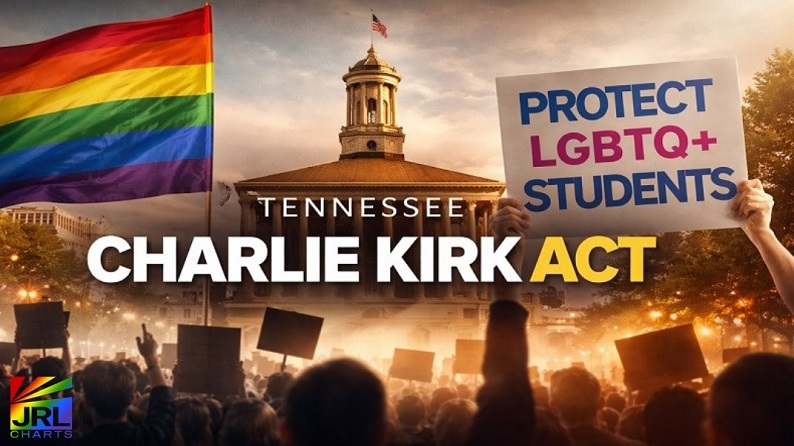
LAS VEGAS — (April 20, 2026) — In a move igniting nationwide debate over free speech and LGBTQ+ rights, Tennessee lawmakers have approved the controversial “Charlie Kirk Act,” legislation that could penalize students and faculty who protest campus speakers with anti-LGBTQ+ views.
The bill now heads to Governor Bill Lee for final approval. If signed into law, it will significantly expand protections for invited speakers at public colleges and universities—while restricting how students can respond in protest.
Related LGBT Politics News on JRL CHARTS:
• Project 2025 Already 50% Complete: Inside Trump’s Plan Reshaping America
• U.S. Banking Rule Ends ‘Reputational Risk’ Barrier, Expands Access for Legal Businesses
• LGBTQ Corporate Participation Plunges 65% in 2026 as DEI Retreat Reshapes Business Landscape
• US Trade Deficit Hits Five-Month High Amid Import Boom
• Supreme Court Strikes Down Bulk of Trump Tariffs in Landmark Emergency Powers Ruling
• Get the Latest in LGBT Politics USA Exclusively on JRL CHARTS
At the center of the legislation is a clause prohibiting institutions from discriminating or retaliating against individuals based on their views on “homosexuality or transgender behavior,” regardless of whether those views are rooted in religious or secular beliefs. Critics argue this language effectively shields anti-LGBTQ+ rhetoric under the banner of free expression.
The measure also requires schools to adopt principles modeled after the University of Chicago Freedom of Expression Policy. That framework emphasizes that universities should not limit speech simply because it is considered offensive or controversial by members of the campus community.
Under the proposed law, several common forms of protest could trigger disciplinary action. Students and faculty may face penalties—including suspension or expulsion—for actions such as disrupting events, staging walkouts deemed significantly disruptive, blocking access to venues, or interfering with a speaker’s ability to present.
Republican State Representative Gino Bulso, who sponsored the bill, stated that the legislation is intended to protect civil discourse rather than promote any political ideology. He noted that the act is named after Charlie Kirk, citing his advocacy for free expression.
Kirk, a controversial conservative commentator, gained national attention for inflammatory remarks about race and LGBTQ+ individuals, including statements criticizing same-sex relationships and transgender rights. His speaking appearances frequently sparked backlash on college campuses, including a high-profile event at Utah Valley University where students petitioned unsuccessfully to block his appearance.
Opponents of the bill argue that it creates a chilling effect on student activism and disproportionately impacts LGBTQ+ students and allies who rely on protest as a form of expression. Democratic State Representative Justin Jones criticized the measure, pointing to past incidents where educators faced consequences for publicly condemning Kirk’s rhetoric.
Supporters, however, maintain that the law reinforces the principle that open debate—even when uncomfortable—is essential to higher education.
As the legislation awaits the governor’s signature, civil rights organizations and student groups are preparing for potential legal challenges, setting the stage for a broader national battle over free speech, campus protest, and LGBTQ+ protections.
Stay with JRL CHARTS for continuing coverage on LGBTQ+ rights, campus policy battles, and breaking international news shaping the global community.
His reporting focuses on federal court rulings, legislative developments, international human rights issues, and government actions impacting LGBTQ communities worldwide.
With nearly two decades of experience, Goldberg is recognized for his balanced analysis, investigative insight, and commitment to accurate, fact-based journalism that informs readers on the political forces shaping equality and justice.
- Welker Corners Treasury Secretary Bessent Over Trump Economy: “636 Days” - October 18, 2026
- Wall Street Gets Hammered as AI Stocks Tumble and Oil Prices Surge — LGBTQ Businesses Brace for Fallout - October 18, 2026
- Bank of America Faces Historic $1.2B Reckoning as Q3 Profits Plunge 17% - October 17, 2026