By: Keith Witchka — Senior Correspondent | Gay Adult Industry News
CHICAGO, IL — (October 28, 2026) — Illinois-based gay adult entertainment studio FlavaWorks Entertainment has secured a significant procedural victory in its federal copyright infringement lawsuit targeting the former operators and alleged users of Gay-Torrents.org.
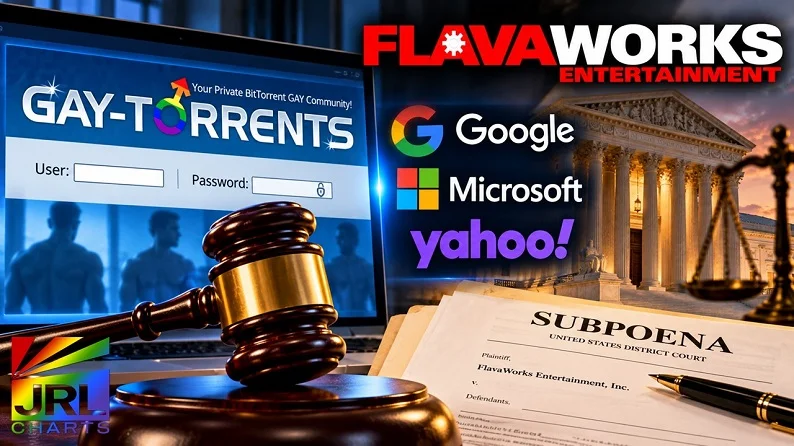
U.S. District Judge John Robert Blakey has authorized the studio to issue limited subpoenas to Google, Yahoo, Microsoft, AT&T, Cloudflare and Newfold Digital, potentially allowing FlavaWorks to identify anonymous defendants accused of unlawfully distributing copyrighted adult entertainment productions.
The October 14 ruling marks another development in the studio’s ongoing campaign against online piracy, an issue that continues to challenge subscription-based adult entertainment producers and digital content owners.
Trending LGBTQ Entertainment News on JRL CHARTS:
• Now Trending in LGBT Business Finance News
• Pure Fire Music Videos – Only on JRL CHARTS Gay Music News
• Get the Latest in LGBTQ Culture and Politics Worldwide
• Top Movie Picks in Comedy, Drama and Thriller Films on JRL CHARTS
FlavaWorks Targets 39 Users in Gay-Torrents Copyright Lawsuit
The litigation began in April 2026 when FlavaWorks filed suit in the U.S. District Court for the Northern District of Illinois against individuals and entities allegedly connected to Gay-Torrents.org.
The original complaint targeted approximately 325 anonymous site members, alongside alleged operators, administrators and other defendants.
Following amendments to the complaint, the studio narrowed its targeted member group to 39 users.
The lawsuit alleges unauthorized distribution of FlavaWorks’ copyrighted productions through the private BitTorrent tracker, which subsequently went offline.
Among the defendants is Byzona Ltd., a Bulgarian company identified in the litigation as allegedly connected to the website’s operations and payment infrastructure.
The allegations remain subject to the judicial process.
Google, Microsoft and Yahoo Face Limited Subscriber Subpoenas
Judge Blakey’s order permits FlavaWorks to request specific subscriber information associated with identified email accounts and domains linked to the defendants.
The authorized requests may include account holders’ names, mailing addresses, telephone numbers, secondary or recovery email addresses, and recent IP address information with associated timestamps.
However, the court did not approve every discovery request.
The ruling does not authorize the broader billing-information demands sought by FlavaWorks or a separate subpoena to payment processor Stripe.
The affected service providers and defendants also retain the right to challenge the subpoenas before information is disclosed.
Why FlavaWorks Is Targeting Email Accounts Instead of IP Addresses
One of the case’s more notable developments involves the studio’s approach to identifying alleged infringers.
Rather than relying exclusively on internet service providers to connect IP addresses with subscribers, FlavaWorks is pursuing identifying information associated with email accounts.
The studio argues that IP addresses can identify an internet connection without necessarily identifying the individual responsible for online activity.
Shared networks, household connections and virtual private networks can complicate attempts to establish individual identity.
FlavaWorks maintains that email account information could provide additional evidence linking specific individuals to the accounts identified in its investigation.
Whether that evidence establishes liability remains a separate question for the court.
Copyright Enforcement Raises Stakes for Adult Film Studios
For subscription-based adult entertainment companies, unauthorized distribution can undermine the commercial value of copyrighted productions and membership platforms.
Studios invest in production, performers, postproduction, technology and digital distribution, making intellectual property protection an important business consideration.
The FlavaWorks litigation highlights how copyright owners are pursuing digital evidence through major technology providers when investigating suspected unauthorized distribution.
However, the ruling also underscores the legal distinction between obtaining subscriber information and proving copyright infringement.
An account’s association with a website does not, by itself, establish that its owner committed the alleged violations.
FlavaWorks Lawsuit Moves Into Its Next Legal Phase
The October ruling allows FlavaWorks to pursue additional identifying evidence, but the case remains unresolved.
Service providers and affected account holders may seek to quash the subpoenas, while any information ultimately produced would still need to be evaluated in the context of the underlying copyright claims.
For the gay adult entertainment industry, the case represents another closely watched dispute involving digital piracy, online anonymity and the enforcement of intellectual property rights.
The Bottom Line: FlavaWorks has gained access to a potentially important legal discovery process, but the court has not determined that the targeted defendants are liable for copyright infringement.
Stay connected with JRL CHARTS Gay Adult Industry News for continuing coverage of FlavaWorks Entertainment, copyright enforcement, digital piracy litigation and the legal developments impacting the global gay adult entertainment industry.
A veteran member of the JRL CHARTS editorial team, Witchka brings 20 years of experience with the publication covering studios, performers, new releases and developments across the international gay adult entertainment industry.
His reporting combines two decades of industry knowledge with JRL CHARTS’ continuing coverage of the studios, talent and business trends shaping the gay adult entertainment market.
- FlavaWorks Scores Major Court Ruling in Gay-Torrents Piracy Battle - October 28, 2026
- Darius Bishop Delivers a 5-Star Performance in BelAmiOnline Solo Debut - October 28, 2026
- Drake Von’s 5 Criminal Charges Dismissed — But His DUI Case Isn’t Over - October 26, 2026