By: Paul Goldberg – Senior Correspondent | LGBT Business Finance News
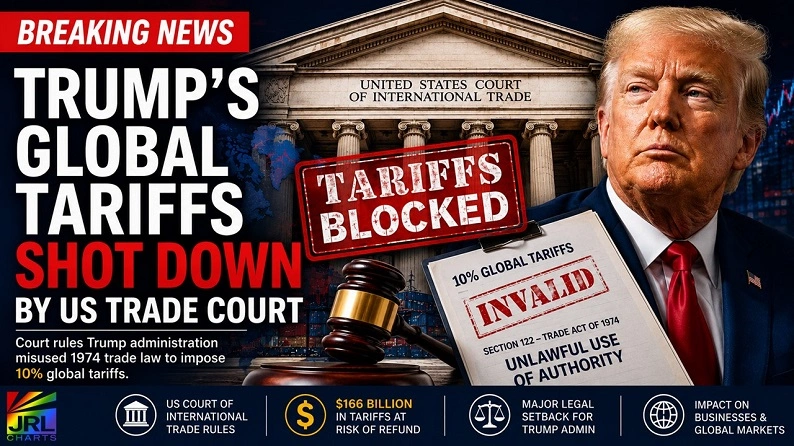
WASHINGTON, D.C. — (May 7, 2026) — In a major legal and economic setback, the United States Court of International Trade has blocked former President Donald Trump’s proposed 10% global tariffs on most U.S. imports, ruling that the policy was not legally justified under federal trade law.
In a 2–1 decision, the three-judge panel determined that the Trump administration improperly invoked Section 122 of the Trade Act of 1974, which allows temporary import surcharges under limited circumstances tied to balance-of-payments deficits.
Related LGBT Business Finance & Politics News on JRL CHARTS:
• Project 2025 Already 50% Complete: Inside Trump’s Plan Reshaping America
• U.S. Banking Rule Ends ‘Reputational Risk’ Barrier, Expands Access for Legal Businesses
• LGBTQ Corporate Participation Plunges 65% in 2026 as DEI Retreat Reshapes Business Landscape
• Oil Surges Past $100 as Strait of Hormuz Crisis Rattles Global Markets
• LGBTQ Corporate Participation Drop 65% in 2026 as DEI Retreat Reshapes Business Landscape
Court Finds Misuse of Emergency Trade Powers
According to the ruling, the administration’s attempt to reimpose tariffs—after an earlier legal defeat—failed to meet the statutory requirements outlined in the 1974 law.
The White House had argued that Section 122 provided authority to apply tariffs of up to 15% for a period of 150 days to address what it described as “fundamental international payments problems.” However, the court rejected that interpretation, concluding the legal threshold had not been met.
This marks the second major legal barrier to the policy, following an earlier decision by the US Supreme Court, which ruled that Trump’s 2025 tariff framework was not authorized under the International Emergency Economic Powers Act.
Billions in Tariffs Now at Stake
The financial implications of the ruling are significant. Approximately $166 billion in tariff revenues from earlier rounds are now under scrutiny, with legal analysts warning that a final adverse ruling could require the federal government to refund a substantial portion of collected duties.
Small and mid-sized businesses—many of which filed lawsuits challenging the tariffs—have argued that the policy created unfair cost burdens and violated established trade rules.
The latest decision is widely viewed as a win for importers, retailers, and supply chain operators, particularly those dependent on global sourcing.
White House Response and Ongoing Legal Battle
Despite the ruling, Trump has continued to defend his tariff strategy, arguing that the courts have limited executive flexibility on trade enforcement.
In a recent public statement, he criticized the earlier Supreme Court decision and suggested that the administration would pursue alternative legal pathways to achieve similar tariff outcomes.
Trump railed against SCOTUS decision in an April on Truth Social:
They said I can charge tariffs, but I have to do it a different way. And because of what they did, we have to pay back $160 billion. All they had to do is add one sentence, just one sentence. And that’s — you don’t have to pay anything taken in thus far back. But because they didn’t add — and by the way, it was a close call too. There were justices that were powerful that I was right on the tariffs. But because we lost by just two votes, you know, just little vote, two votes, we have to pay back $165 billion. They could have, with a little one sentence — you don’t have to paid back tariffs that have already been received, you start from this point, and you do it a different way. So we’re doing it a different, we’re going to end up with the same.
Legal experts expect the case to move through further appeals, setting up a potential high-stakes showdown over presidential trade authority and the limits of emergency economic powers.
Market and Business Impact
For the broader market, the ruling introduces both short-term uncertainty and long-term clarity:
- Retailers and importers may benefit from reduced cost pressures
- Global suppliers could see improved trade stability
- Financial markets are likely to monitor refund obligations and policy shifts closely
The decision also reinforces the judiciary’s role in checking executive authority in global trade policy, a factor that could shape future administrations’ approach to tariffs and economic intervention.
His reporting focuses on federal court rulings, legislative developments, international human rights issues, and government actions impacting LGBTQ communities worldwide.
With nearly two decades of experience, Goldberg is recognized for his balanced analysis, investigative insight, and commitment to accurate, fact-based journalism that informs readers on the political forces shaping equality and justice.
- CVS Hit with $315 Million Opioid Settlement — What LGBTQ+ and Cancer Patients Need to Know - October 17, 2026
- LGBTQ+ Support Vanishes from Alabama University Website as Scholarship Questions Mount - October 17, 2026
- GameStop Hit With Federal Lawsuit After Gay Employee Reports Threats — Then Gets Fired - October 16, 2026