By: Paul Goldberg, Senior Correspondent | Election 2026 News
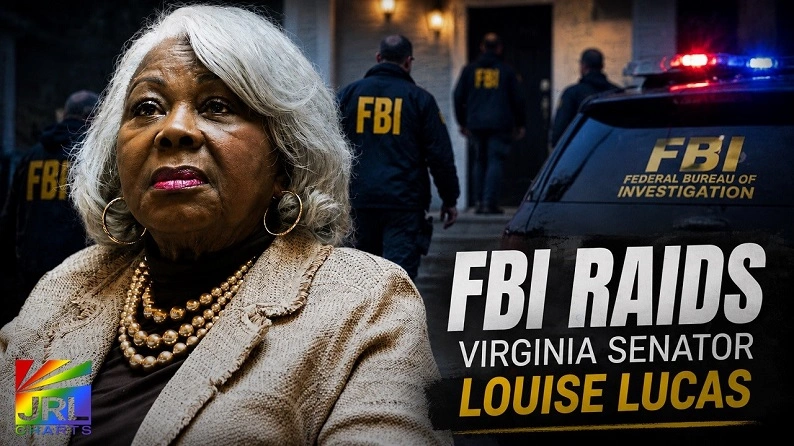
PORTSMOUTH, VA — (May 6, 2026) — Federal agents with the Federal Bureau of Investigation launched a sweeping, multi-location raid targeting Virginia state Sen. L. Louise Lucas, striking not only her official office but also her personal business operations—including a cannabis dispensary—in a dramatic escalation that is fueling accusations of political intimidation amid an already explosive nationwide redistricting battle tied to the influence of Donald Trump.
This comes as Donald Trump has publicly called on Republican-led states—both in television appearances and on Truth Social—to pursue aggressive redistricting strategies ahead of the 2026 elections, triggering a nationwide political escalation.
Related LGBT Politics News on JRL CHARTS:
• Trump FY2027 Budget Proposal Draws Criticism Over LGBTQ+ Program Cuts
• Republicans Escalate Anti-Trans Push as 2026 Midterms Take Shape
• Trump Warns GOP: “Democrats Will Win Everything” Without SAVE Act Power Grab
• Project 2025 Already 50% Complete: Inside Trump’s Plan Reshaping America
• U.S. Banking Rule Ends ‘Reputational Risk’ Barrier, Expands Access for Legal Businesses
• LGBTQ Corporate Participation Plunges 65% in 2026 as DEI Retreat Reshapes Business Landscape
The maps championed by L. Louise Lucas give Democrats the advantage in four congressional seats, placing her directly in the crosshairs of one of the most explosive redistricting battles in years.
Federal agents executed a court-authorized search warrant at Lucas’ Portsmouth office Wednesday morning. While the FBI confirmed the operation, officials declined to disclose what evidence was sought or the exact focus of the investigation, stating only that the probe is ongoing.
National Backlash Grows Over Redistricting Power Moves
Across the country, frustration is building among voters from both major parties as redistricting battles intensify. Critics argue that aggressive map redrawing efforts in multiple states are reinforcing a system where politicians effectively choose their voters—rather than voters choosing their representatives.
That concern isn’t limited to Democrats. A growing number of Republican voters, particularly independents and suburban conservatives, have also voiced unease about the long-term impact of extreme partisan map drawing. Election law experts have warned for years that when districts are engineered to guarantee outcomes, it weakens accountability and reduces competitive elections—regardless of which party benefits.
At the center of the backlash is a core democratic principle: representation should be determined by voters, not predetermined by political strategy. Critics say that when districts are redrawn in ways that heavily favor one party, it can dilute opposing voices and reduce the incentive for elected officials to respond to a broader constituency.
Supporters of aggressive redistricting, largely within Republican leadership, argue that both parties have historically used map drawing to their advantage and that current efforts are part of a long-standing political practice. However, opponents counter that the scale and timing of recent moves—particularly amid shifting legal protections tied to the Voting Rights Act—have raised new concerns about fairness and transparency.
Public reaction has also been amplified on social media platforms like Truth Social and others, where voters, activists, and political commentators are openly debating whether the current wave of redistricting represents strategic politics—or a deeper erosion of democratic norms.
As the 2026 election cycle approaches, the stakes are becoming increasingly clear: control of Congress may hinge not just on voter turnout, but on how district lines are drawn in key battleground states. And for many Americans across the political spectrum, that reality is fueling growing demands for clearer standards, independent commissions, and reforms designed to ensure that elections remain competitive, transparent, and reflective of the will of the people.
Expanded Multi-State + Legal Context (Stronger Framing)
The raid unfolds amid a rapidly expanding redistricting push across Republican-controlled states. Following Trump’s public calls for map changes, states such as Texas led early efforts, while others—including Florida and additional GOP-led legislatures—have begun accelerating discussions or actions to revisit congressional districts.
This surge has been amplified by recent court rulings that have significantly weakened enforcement of Section 2 of the Voting Rights Act, limiting legal challenges to voting maps and giving state lawmakers broader authority to redraw districts with fewer federal constraints.
The result is a nationwide scramble over congressional boundaries, with control of the U.S. House potentially hinging on how these maps are redrawn in the months ahead.
Indiana Political Fallout (Carefully Framed but Sharp)
The political pressure tied to redistricting efforts is already showing consequences inside Republican ranks. In states like Indiana, internal party divisions over alignment with Trump’s broader election strategy have spilled into primary battles, where several incumbents who broke from party expectations faced significant backlash at the ballot box.
As the 2026 election cycle accelerates, the battle over who controls the map—and ultimately, who controls Congress—is no longer happening quietly behind closed doors. It is unfolding in real time, across multiple states, with consequences that could reshape the balance of power in Washington.
For millions of Americans watching from both sides of the political divide, the question is becoming harder to ignore: are elections still being decided by voters, or by the lines drawn around them?
Stay with JRL CHARTS LGBTQ Politics USA for real-time coverage on voting rights, election policy, and the political battles shaping America’s future.
His reporting focuses on federal court rulings, legislative developments, international human rights issues, and government actions impacting LGBTQ communities worldwide.
With nearly two decades of experience, Goldberg is recognized for his balanced analysis, investigative insight, and commitment to accurate, fact-based journalism that informs readers on the political forces shaping equality and justice.
- GameStop Hit With Federal Lawsuit After Gay Employee Reports Threats — Then Gets Fired - October 16, 2026
- Meta Paid 29 Anti-LGBTQ Accounts as 2026 Midterm Misinformation Spreads - October 14, 2026
- Orbán’s Anti-LGBTQ Legacy Crumbles as Hungary Votes 139–51 for Change - October 13, 2026