LGBT Business Finance News — Irreversible shock waves hit markets as investors rush for safe havens
By: Paul Goldberg, Senior Correspondent | LGBT Business Finance News
LAS VEGAS — (March 6, 2026) — Global markets tumbled for a second straight day Friday as escalating conflict between Iran, Israel and the United States sent shockwaves through financial markets, triggering a sharp sell-off across equities while investors rushed into traditional safe-haven assets such as gold and energy commodities.
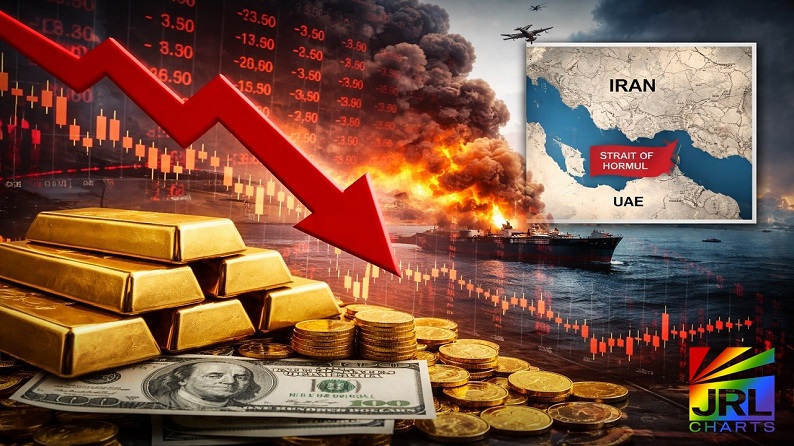
Wall Street’s losses intensified after Iranian officials announced that the Strait of Hormuz — the world’s most critical oil shipping route — has effectively been closed, threatening roughly 20% of global oil supply and igniting fears of a massive energy shock that could ripple across the global economy.
Oil prices surged sharply following the announcement, pushing energy markets toward levels not seen in nearly two years and sparking renewed inflation fears among economists and policymakers.
Related Iran vs Israel and USA War Coverage on JRL CHARTS:
• Viral Iran War Cost Tracker Explained: What the Live Ticker Is Really Showing
• Spain Refuses Use of US Military Bases for Iran Operations as Aircraft Redeploy to Germany
• US Strikes Failed to Destroy Iran’s Nuclear Program, Intelligence Suggests
• LGBTQ Corporate Participation Plunges 65% in 2026 as DEI Retreat Reshapes Business Landscape
• Supreme Court Strikes Down Bulk of Trump Tariffs in Landmark Emergency Powers Ruling
• Get the Latest in LGBT Business and Finance News Exclusively on JRL CHARTS
Wall Street Suffers Second Straight Day of Heavy Losses
Major U.S. stock indexes plunged again as investors reacted to the rapidly worsening geopolitical situation in the Middle East.
The Dow Jones Industrial Average suffered one of its sharpest drops of the year, while the S&P 500 and Nasdaq also posted steep declines as traders rushed to unload risk-heavy assets amid fears that the conflict could escalate into a prolonged regional war.
European and Asian markets mirrored the sell-off as global investors recalibrated their risk outlook in response to the escalating conflict and the potential disruption of global energy supply chains.
Market analysts warn that if the Strait of Hormuz remains blocked for an extended period, the resulting spike in oil prices could quickly spread inflationary pressure throughout the global economy.
Investors Rush to Gold as Safe Havens Return
With global markets rattled, investors quickly shifted capital into traditional safe-haven assets.
Gold prices climbed sharply as traders sought protection from market volatility, while energy stocks surged alongside rising crude oil prices.
However, one of the most surprising developments in the current market turmoil has been the unexpected weakness in U.S. Treasury bonds, which typically attract investors during periods of uncertainty.
Instead of rallying, Treasury yields have moved higher as traders sell bonds amid liquidity pressures — an unusual dynamic that has left market strategists warning that the traditional safety net for investors may be weakening.
February Jobs Report Adds to Economic Anxiety
Compounding investor fears, the latest U.S. labor data revealed that American businesses unexpectedly cut jobs in February, signaling that economic momentum may already be slowing before the full impact of the geopolitical crisis is felt.
The weaker-than-expected employment report stunned economists who had forecast modest job growth for the month.
Rising layoffs, combined with escalating geopolitical tensions and surging oil prices, have fueled concerns that the U.S. economy could face a period of stagflation-like pressure in the months ahead.
Energy Shock Could Reshape Global Markets
The closure of the Strait of Hormuz represents one of the most serious threats to global energy stability in decades.
The narrow waterway between Iran and Oman is responsible for transporting roughly one-fifth of the world’s petroleum supply, making it one of the most strategically important shipping routes on the planet.
If the disruption continues, energy analysts warn that oil prices could spike dramatically, triggering ripple effects across transportation, manufacturing and consumer prices worldwide.
Such a shock could complicate monetary policy decisions for central banks already struggling to balance inflation control with slowing economic growth.
Markets Enter Period of Extreme Volatility
For investors, the convergence of geopolitical conflict, energy disruption, weakening job growth and unstable bond markets has created a perfect storm of uncertainty.
Market volatility is expected to remain elevated as traders monitor developments in the Middle East and attempt to gauge whether the conflict could expand into a broader regional confrontation.
With global supply chains, energy markets and financial systems all reacting simultaneously, analysts warn that markets may face a turbulent period ahead.
Stay with JRL CHARTS LGBT Business Finance News as we continue to monitor the global economic fallout from the escalating Iran conflict and its growing impact on markets, energy prices and the broader financial system.

// Affiliate Disclosure: JRL CHARTS is a digital news and media platform. We do not host, stream, or sell adult content. Some outbound links may contain affiliate tracking to licensed studio-owned platforms (e.g., LatinBoyz, AEBN, BiLatin Men). These links lead to legal, age-gated distributors and are provided strictly for editorial and informational purposes only.