By: Paul Goldberg – Senior Correspondent | LGBT Politics News
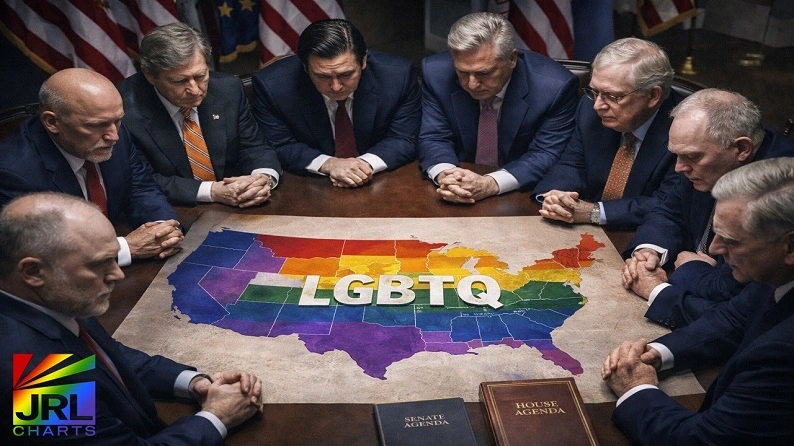
WASHINGTON, D.C. — April 8, 2026 — Republicans appear to be sharpening a familiar political strategy ahead of the 2026 midterm elections: intensifying attacks on transgender rights and broader LGBTQ inclusion as part of a wider culture-war message.
While there is no hard evidence that this strategy was triggered specifically by fallout from any one foreign-policy episode, recent federal actions, state ballot efforts, and campaign messaging all point in the same direction — transgender issues are once again being used as a high-visibility political wedge.
Related Transgender Politics News on JRL CHARTS:
• “God Made Trans People” Campaign Hits Kansas Highways as Rights Battle Intensifies
• Get the Latest in LGBT Politics USA Exclusively on JRL CHARTS
• Tennessee Republicans Advance Bill Targeting Transgender Teachers’ Honorifics
• Pennsylvania House Panel Advances Bills to Strengthen LGBTQ Protections
• Tennessee House Passes Bill to Delegitimize Same-Sex Marriage Recognition
• BREAKING NOW On LGBT Politics News USA – See What’s Trending
The evidence points to an existing strategy, not a sudden pivot
The strongest evidence does not show Republicans suddenly discovering LGBTQ issues after a foreign-policy setback. Instead, it shows that anti-trans politics have remained central to the party’s messaging for months.
The Washington Post reported that Republican attacks on transgender issues were among the most pervasive lines of attack in the 2024 cycle, with the GOP spending tens of millions of dollars on such ads, and Democrats are already preparing for similar attacks in 2026.
That matters because it suggests continuity, not improvisation. The current pattern looks less like an emergency substitution and more like a proven playbook being carried forward into another election year.
Trump’s administration is already moving policy in that direction
The Trump administration added to that momentum this week by terminating six civil-rights settlement agreements that had protected transgender students in schools and colleges. The Education Department said the prior agreements reflected a misreading of Title IX, while critics described the move as part of a broader rollback of transgender protections.
That step did not happen in isolation. It fits a larger pattern of federal action aimed at narrowing recognition of gender identity and elevating transgender issues inside education, sports, and civil-rights enforcement. In political terms, that gives Republican candidates and allied groups a live policy agenda to point to on the campaign trail.
Conservative outside groups are helping drive the message
Another signal is the growing influence of conservative advocacy groups such as Moms for Liberty. AP reported this week that the organization now has significant access inside the Trump White House and has been involved in complaints and advocacy tied to transgender sports and bathroom policies. The group, once focused largely on school-board politics, is now carrying that message to Capitol Hill and into federal policymaking circles.
That development matters because election messaging rarely comes only from candidates. It is often built and amplified by aligned groups, advocacy networks, donors, and activists who keep a message alive across multiple fronts. In this case, the anti-LGBTQ and especially anti-trans frame is clearly being sustained both by government action and movement infrastructure.
State-level ballot fights show the issue is being positioned for voters
The clearest proof that this is election strategy, not just ideological signaling, may be at the state level. In Nevada, The Nevada Independent reported that Republican Gov. Joe Lombardo described a proposed ballot measure blocking transgender women from female sports as part of his “game plan” for reelection. That is unusually direct evidence that anti-trans policy can be viewed by Republican officials as a turnout and persuasion issue.
Nationally, the ACLU says it is tracking hundreds of anti-LGBTQ bills in 2026, many focused on transgender people, identity documents, health care, education, and public expression. That volume underscores that the issue is not confined to a few isolated speeches or cable-news segments. It is embedded in active legislative and electoral campaigns.
What is still unproven is the Iran-war connection
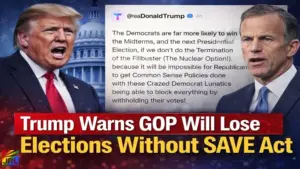
The opinion argument that Republicans will target LGBTQ people because of political damage from Iran-related fallout is harder to prove. Reuters has reported that Trump is pressing Republicans to advance measures he believes would help “guarantee” victory in the midterms, but available reporting does not establish a direct line between any Iran-related political trouble and a new anti-LGBTQ push.
That distinction matters for credibility. It is fair to argue that Republicans may intensify culture-war politics when facing political pressure. It is less solid to present that as a confirmed reaction to one overseas conflict unless reporting or internal strategy documents show it directly. Right now, the evidence supports the broader pattern, not that narrower claim.
The larger takeaway for LGBTQ voters and allies
The underlying warning still stands: LGBTQ voters, especially transgender Americans, should assume these issues will remain central in Republican politics through November 2026. Federal policy rollbacks, state legislation, ballot measures, and aligned activist groups all suggest the pressure is not easing.
At the same time, the political debate is likely to be broader than one slogan or one wedge issue. Cost of living, voting rules, immigration, schools, and executive power are all competing for attention in the midterms. Reuters reported last month that Trump was pressing lawmakers to adopt voting restrictions as part of his electoral strategy, showing that Republicans are likely to run on multiple fronts at once, not only LGBTQ issues.
Bottom line
There is real evidence that Republicans are preparing to use anti-trans and anti-LGBTQ themes in the 2026 midterms. But the most accurate version of the story is this: it is not a newly invented strategy born from one foreign-policy setback. It is an already active strategy that may become even more visible as the election gets closer.
JRL CHARTS will continue tracking the 2026 election cycle, federal policy shifts, and every major LGBTQ rights battle shaping the national political landscape.

// Affiliate Disclosure: JRL CHARTS is a digital news and media platform. We do not host, stream, or sell adult content. Some outbound links may contain affiliate tracking to licensed studio-owned platforms (e.g., LatinBoyz, AEBN, BiLatin Men). These links lead to legal, age-gated distributors and are provided strictly for editorial and informational purposes only.