By: Paul Goldberg — Senior Correspondent | LGBT Business Finance News
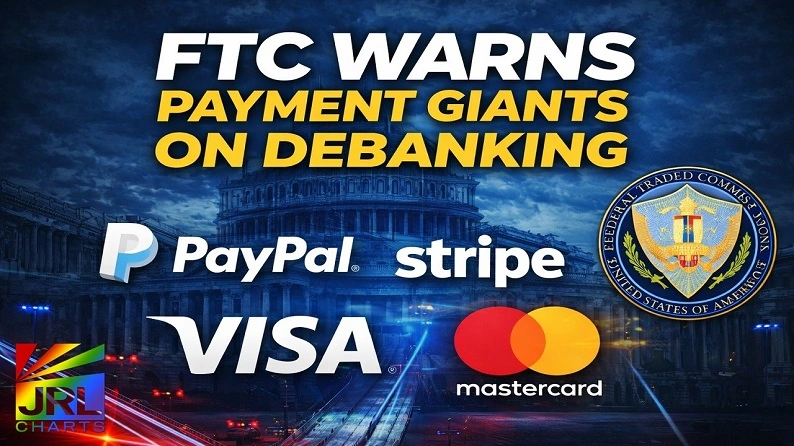
WASHINGTON — (March 26, 2026) — A major escalation in the debate over financial access is underway after Federal Trade Commission Chairman Andrew Ferguson issued formal warnings to the CEOs of PayPal, Stripe, Visa and Mastercard over alleged “debanking” practices targeting lawful businesses.
In letters sent Thursday, Ferguson cautioned that denying financial services based on a customer’s legal business activity — including industries that may be politically controversial — could trigger federal investigations and enforcement action.
Related LGBT Business Finance News Coverage on JRL CHARTS:
• Why Gas Prices Are Spiking Again Across the U.S. — And What Comes Next
• Oil Surges Past $100 as Strait of Hormuz Crisis Rattles Global Markets
• Iran War Sparks Global Market Freefall — Hormuz Closed, Stocks Plunge, Jobs & Bonds in Crisis
• LGBTQ Corporate Participation Plunges 65% in 2026 as DEI Retreat Reshapes Business Landscape
• Get the Latest in LGBT Politics USA Exclusively on JRL CHARTS
The warning aligns with the August 7, 2025 executive order issued under the Trump administration, which prohibits financial institutions from restricting access to accounts, loans, or payment services based on political affiliation, religious beliefs, or lawful commercial activity.
Payment Giants Under Scrutiny
The FTC’s action places direct pressure on both payment processors and global card networks, signaling a broader regulatory focus beyond traditional banks.
Ferguson emphasized that excluding businesses from financial systems due to reputational concerns or political pressure is “inconsistent with American values”, particularly when those businesses are operating legally.
The letters further warn that deplatforming, account termination, or service denial could be interpreted as unfair or deceptive practices under federal law.
New Pressure on Visa and Mastercard Networks
Notably, the FTC’s warning extends beyond fintech platforms to payment networks themselves.
According to Ferguson, Visa and Mastercard must ensure that their partner financial institutions do not engage in unlawful debanking practices. The letters suggest that turning a blind eye to such behavior could expose the networks to regulatory consequences.
This introduces a new layer of accountability, effectively placing indirect pressure on banks through the payment infrastructure they rely on.
Regulatory Gaps Leave Room for Interpretation
Despite the federal push, significant ambiguity remains.
Agencies such as the Office of the Comptroller of the Currency (OCC) have acknowledged that industries — including adult entertainment — have faced banking restrictions tied to perceived reputational risks. However, enforcement priorities remain unclear.
While proposed rules aim to prevent regulators from penalizing institutions for serving “politically disfavored but lawful” businesses, banks may still justify account closures under “safety and soundness” standards — a broad category that allows continued discretion.
Impact on Adult Industry and High-Risk Sectors
For sectors frequently labeled as “high-risk,” including adult content creators, wellness brands, and alternative media platforms, the FTC’s warning could signal a potential shift.
These industries have long reported challenges in maintaining stable access to banking and payment processing services, often facing sudden account shutdowns despite operating within legal frameworks.
However, analysts note that enforcement may not be applied evenly. While the executive order frames protections broadly, political priorities could influence which industries ultimately benefit from regulatory intervention.
What Happens Next
The FTC’s move marks one of the most direct federal challenges to debanking practices in recent years.
If enforcement follows, financial institutions and payment networks may be forced to re-evaluate risk policies, onboarding standards, and account termination practices — particularly for lawful but controversial industries.
For businesses operating in vulnerable sectors, the outcome could determine whether access to financial infrastructure becomes more stable — or remains subject to shifting regulatory and political pressures.
Stay with JRL CHARTS – LGBT Business Finance News Division, as we track how federal regulators reshape financial access policies impacting B2B markets, high-risk industries, and the future of digital commerce.

// Affiliate Disclosure: JRL CHARTS is a digital news and media platform. We do not host, stream, or sell adult content. Some outbound links may contain affiliate tracking to licensed studio-owned platforms (e.g., LatinBoyz, AEBN, BiLatin Men). These links lead to legal, age-gated distributors and are provided strictly for editorial and informational purposes only.