By: Paul Goldberg — Senior Correspondent | LGBT Politics News
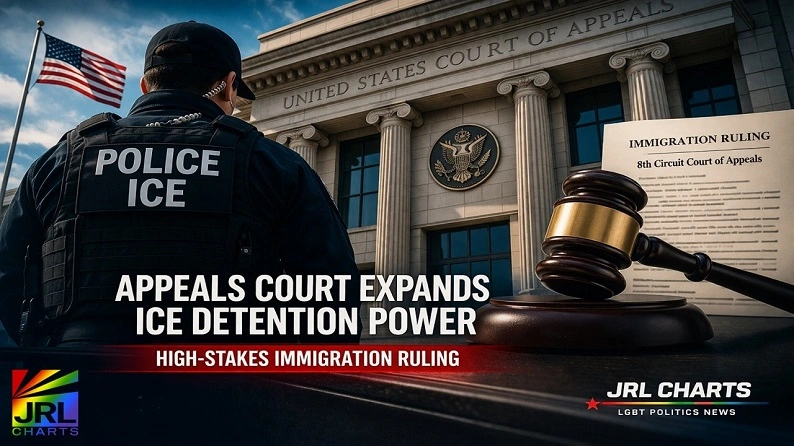
WASHINGTON — (March 25, 2026) — A second federal appeals court has ruled in favor of the Trump administration’s expanded immigration enforcement strategy, reinforcing a controversial policy that allows U.S. Immigration and Customs Enforcement (ICE) to detain a broad range of individuals facing deportation without bond hearings.
In a 2-1 decision, the 8th U.S. Circuit Court of Appeals determined that federal law permits — and in some cases requires — the detention of noncitizens during removal proceedings, even if they have no criminal history or have lived in the United States for many years. The ruling marks another significant legal victory for the administration’s immigration agenda.
Related LGBT Politics News Coverage on JRL CHARTS:
• Ohio Lawmaker Facing Misconduct Allegations Pushes Bill to Jail Drag Queens
• California Sheriff Seizes 650,000 Ballots in Explosive Election Power Grab
• FBI Seizure of Arizona Voting Records — 2nd Election Raid Raises Alarms Over State Voting Rights
• Trump Calls Democratic Party America’s ‘Greatest Enemy’ After Declaring “Death of Iran”
• Trump Warns GOP: “Democrats Will Win Everything” Without SAVE Act Power Grab
• DEMOCRACY UNDER SIEGE: GOP Bulldozes SAVE Act that Could Erase LGBTQ & Minority Votes
The decision carries immediate consequences in states under the 8th Circuit’s jurisdiction, including Minnesota, where numerous detainees had previously secured favorable rulings from district courts. Many of those cases challenged the administration’s interpretation of immigration law, arguing that long-term residents should be eligible for bond hearings.
The appellate panel, led by Judge Bobby Shepherd and joined by Judge L. Steven Grasz, concluded that the statutory framework supports broader detention authority. However, Judge Ralph Erickson issued a dissent, raising concerns about how the law has historically been applied across multiple administrations.
For decades, both Republican and Democratic administrations interpreted the relevant immigration statute — originally enacted in 1996 — as applying primarily to individuals arriving at the border. Under that approach, long-term residents were generally allowed to request bond hearings while their cases proceeded.
That interpretation shifted in 2025 when ICE leadership expanded the scope of the law to include individuals already residing in the United States without formal admission status. The move was later supported by the Board of Immigration Appeals, triggering a surge in enforcement actions and legal challenges nationwide.
Supporters of the policy argue that the law provides clear authority for detention. Attorney General Pam Bondi called the ruling a “major court victory,” emphasizing that the administration intends to continue enforcing immigration statutes as written.
Critics, however, point to the broader legal landscape. Hundreds of federal district judges across the country have previously ruled against the administration’s interpretation in thousands of individual cases, often citing constitutional due process concerns.
Notably, the 8th Circuit’s ruling — like a similar decision issued last month by the 5th Circuit Court of Appeals — did not directly address whether prolonged detention without bond hearings violates constitutional protections. That issue remains central to ongoing litigation in multiple jurisdictions.
Legal experts say the question of due process could ultimately determine how far the administration’s detention policy can extend. In Texas, for example, some district judges have continued ordering the release of detainees on constitutional grounds despite the appellate ruling.
Additional cases are currently pending in other federal circuits, including the 9th and 7th Circuits, where early signals suggest courts may take a different view. Immigration advocates are also seeking further review from full appellate panels, setting the stage for a potential showdown at the U.S. Supreme Court.
At the heart of the debate is whether a decades-old statute can be applied as broadly as the administration contends — and whether such an interpretation aligns with longstanding legal precedent and constitutional safeguards.
As the legal battle continues, the outcome could reshape immigration enforcement nationwide, with significant implications for millions of individuals — including LGBTQ immigrants — navigating the U.S. legal system.
Stay with JRL CHARTS LGBT Politics News for continued coverage of federal court rulings, immigration policy shifts, and the evolving legal landscape shaping America’s future.

- Federal Appeals Court Expands ICE Detention Power in High-Stakes Immigration Ruling - March 25, 2026
- Ohio Lawmaker Facing Misconduct Allegations Pushes Bill to Jail Drag Queens — Hypocrisy Sparks Outrage - March 24, 2026
- California Sheriff Seizes 650,000 Ballots in Explosive Election Power Grab - March 23, 2026
// Affiliate Disclosure: JRL CHARTS is a digital news and media platform. We do not host, stream, or sell adult content. Some outbound links may contain affiliate tracking to licensed studio-owned platforms (e.g., LatinBoyz, AEBN, BiLatin Men). These links lead to legal, age-gated distributors and are provided strictly for editorial and informational purposes only.