By: Paul Goldberg – Senior Correspondent | LGBT Business Finance News
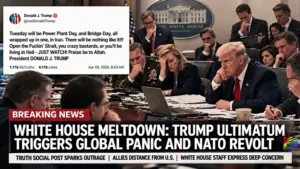
WASHINGTON — (March 22, 2026) — Global tensions surged to a new high after President Donald Trump declared the “death of Iran” in a dramatic social media post—before pivoting to call the Democratic Party America’s “greatest enemy.”
The remarks come as conflict in the Middle East intensifies, threatening global energy markets, shipping routes, and geopolitical stability.
“Now with the death of Iran, the greatest enemy America has is the Radical Left, Highly Incompetent, Democrat Party!” Trump wrote in a post on Truth Social.
The statement followed a stark warning issued just hours earlier, in which Trump threatened direct military action tied to one of the world’s most critical oil chokepoints.
“If Iran doesn’t FULLY OPEN, WITHOUT THREAT, the Strait of Hormuz, within 48 HOURS… the United States of America will hit and obliterate their various POWER PLANTS, STARTING WITH THE BIGGEST ONE FIRST!” Trump wrote.
Iran Responds as Strait of Hormuz Crisis Deepens
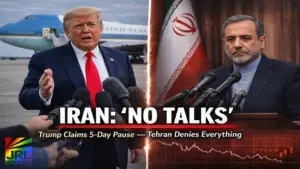
Iranian officials responded swiftly, signaling that any U.S. strike on energy infrastructure would trigger widespread retaliation across the region.
Iranian State media carried warnings from military leadership that American-linked facilities—including fuel depots, desalination plants, and digital infrastructure—would be targeted if attacks proceed.
Related LGBT Politics News Coverage on JRL CHARTS:
• Trump Warns GOP: “Democrats Will Win Everything” Without SAVE Act Power Grab
• DEMOCRACY UNDER SIEGE: GOP Bulldozes SAVE Act that Could Erase LGBTQ & Minority Votes
• Trump’s SAVE Act Is Dead After GOP Senator Says Bill Won’t Pass
• Pennsylvania House Panel Advances Bills to Strengthen LGBTQ Protections
• Tennessee Republicans Advance Bill Targeting Transgender Teachers’ Honorifics
Iran’s leadership also pushed back on U.S. attempts to stabilize oil markets.
Here’s the official response posted by Iran’s parliamentary speaker:
Lifting sanctions on Iranian oil currently stranded at sea? Sorry—we’re sold out. pic.twitter.com/WAO73Gt159
— محمدباقر قالیباف | MB Ghalibaf (@mb_ghalibaf) March 21, 2026
Iran has since moved to control access through the Strait of Hormuz, one of the most vital shipping lanes in the world.
Officials confirmed that vessels tied to the United States, Israel, and allied nations are being restricted, while ships from BRICS nations and “friendly” countries—including China and India—are being allowed passage.
Iran’s envoy to the International Maritime Organization reinforced the policy, stating the strait remains open to all vessels except those that “belong to our enemies.”
Oil Shock and LNG Crisis Loom
The disruption of the Strait of Hormuz—responsible for roughly 20% of global oil shipments—has already triggered rising crude prices and fears of a prolonged supply shock.
The situation is worsening in the liquefied natural gas sector.
Qatar, which produces approximately one-fifth of the world’s LNG supply, has halted exports following missile strikes on its Ras Laffan facility. Analysts warn that within days, global markets could face severe shortages.
Countries reliant on imported energy are now bracing for skyrocketing fuel costs, as competition for U.S. and alternative LNG supplies intensifies across Europe and Asia.
Escalation Across Israel and the Gulf
Meanwhile, violence continues to spread across the region.
Iranian missile strikes targeting southern Israeli cities—including Dimona and Arad—have left dozens injured, including children. Israeli Prime Minister Benjamin Netanyahu described the situation as a “miracle” that fatalities were avoided and urged civilians to seek shelter during alerts.
Casualty figures continue to climb on both sides:
- Iran reports over 1,400 deaths and 18,000+ injuries from U.S.-Israeli strikes
- Israel has recorded 15–28 deaths and over 3,000 injuries
- Gulf states and U.S. bases have also reported fatalities
The Islamic Revolutionary Guard Corps (IRGC) has warned that any attack on Iran’s power infrastructure would result in the complete closure of the Strait of Hormuz, escalating the crisis even further.
A Global Flashpoint With Political Fallout
Trump’s dual message—declaring Iran’s collapse while targeting domestic political opponents—has drawn intense scrutiny as the crisis unfolds.
With global markets rattled, energy supply chains under threat, and military tensions rising, the situation surrounding Iran and the Strait of Hormuz is rapidly evolving into one of the most significant geopolitical flashpoints of 2026.
Stay with JRL CHARTS NETWORK‘ Breaking Military News Division for real-time coverage of global conflicts, political power shifts, and the economic forces shaping the future.

// Affiliate Disclosure: JRL CHARTS is a digital news and media platform. We do not host, stream, or sell adult content. Some outbound links may contain affiliate tracking to licensed studio-owned platforms (e.g., LatinBoyz, AEBN, BiLatin Men). These links lead to legal, age-gated distributors and are provided strictly for editorial and informational purposes only.