By: Paul Goldberg — Senior Correspondent | LGBT Politics News
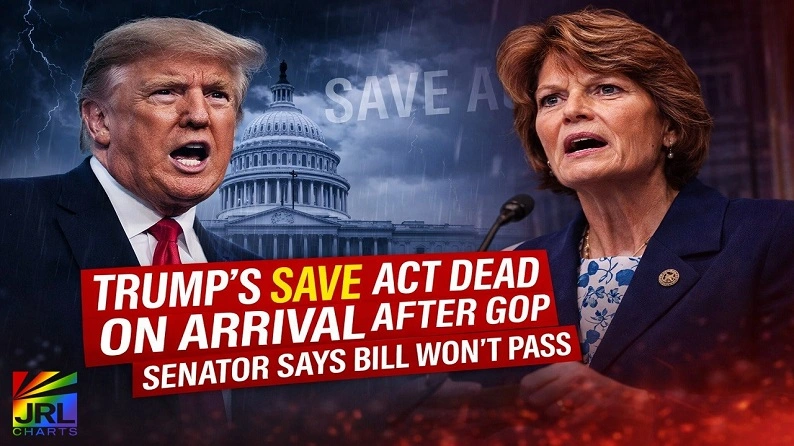
WASHINGTON — (March 17, 2026) — A key Republican senator says former President Donald Trump’s controversial voter identification proposal, known as the Safeguard American Voter Eligibility (SAVE) Act, may already be effectively stalled in the U.S. Senate.
Senator Lisa Murkowski, widely considered a swing vote in closely divided legislative debates, told reporters Tuesday that she is not prepared to support advancing the bill and suggested it lacks the votes needed to move forward.
“I’m not prepared to go down this uncertain and ill-defined path that we’re looking at,” Murkowski said when asked about the legislation.
The SAVE Act has become a top priority for Trump and several Republican lawmakers who argue that stricter voter verification rules are necessary to protect election integrity.
Related LGBT Business Finance News Coverage on JRL CHARTS:
• Pennsylvania House Panel Advances Bills to Strengthen LGBTQ Protections
• EU Court Rules Transgender Citizens Must Have IDs Reflecting Lived Gender
• Family of Gay Gamer Detained by ICE Warns Deportation to Cameroon Could Be Deadly
• Oil Surges Past $100 as Strait of Hormuz Crisis Rattles Global Markets
• Iran War Sparks Global Market Freefall — Hormuz Closed, Stocks Plunge, Jobs & Bonds in Crisis
• LGBTQ Corporate Participation Plunges 65% in 2026 as DEI Retreat Reshapes Business Landscape
What the SAVE Act Would Do
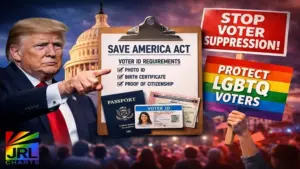
The proposed legislation would require Americans to provide documented proof of citizenship — such as a passport or birth certificate — when registering to vote in federal elections.
The bill would also significantly limit mail-in voting, allowing exceptions primarily for military personnel, illness, disability, or travel-related circumstances.
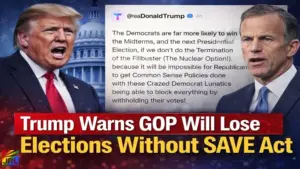
Trump has pushed aggressively for the measure, declaring on social media that it should take priority over other legislation until it becomes law.
Senate Support Appears Weak
Despite strong backing from conservative lawmakers, the proposal faces a steep path in the Senate, where most legislation must secure 60 votes to overcome a filibuster.
Senator Mike Lee, one of the bill’s leading advocates, has urged Republican leadership to consider forcing a standing filibuster in an effort to pressure Democrats to block the bill publicly on the Senate floor.
But Murkowski indicated the numbers simply are not there.
According to congressional reporters covering the debate, another Republican senator speaking anonymously also raised concerns that the proposal could create unintended consequences for voters in states where mail-in voting has become widely used.
Some Republican-led states — including Utah and Montana — have long relied on absentee and vote-by-mail systems, particularly in rural areas where distances to polling locations can be significant.
Concerns Over Rural and Administrative Impact
Murkowski has previously warned that the SAVE Act could create complications for states like Alaska, where many communities are located far from traditional polling places and rely heavily on alternative voting methods.
The senator also cautioned against imposing sweeping federal election rules on states that already manage their own voting systems.
“The Constitution provides states the authority to regulate the times, places and manner of elections,” Murkowski said in a prior statement. “One-size-fits-all mandates from Washington rarely work in places like Alaska.”
Potential Effects on LGBTQ Voters
Voting rights advocates say the SAVE Act could also create additional hurdles for marginalized communities, including some LGBTQ Americans.
For example, transgender voters may face challenges if their government-issued documentation — such as birth certificates or passports — does not reflect their current name or gender identity.
In those cases, obtaining updated documentation can require navigating lengthy legal processes or administrative costs, which civil rights groups say could discourage participation in elections.
Advocacy organizations also note that mail-in voting options have become an important alternative for individuals who may feel uncomfortable or unsafe voting in person due to discrimination or harassment.
Legislative Outlook
While election security remains a major political issue heading into the next federal election cycle, Murkowski’s comments highlight the difficulties facing sweeping federal election reforms in a closely divided Senate.
Without broader bipartisan support, the SAVE Act appears unlikely to advance in its current form — potentially forcing lawmakers to revisit narrower proposals focused on election administration and voter verification.
For continuing coverage of U.S. election policy and legislative battles affecting LGBTQ Americans and all voters, follow JRL CHARTS – LGBT Politics Division, delivering timely reporting on the political developments shaping civil rights, democracy, and voter access nationwide.

// Affiliate Disclosure: JRL CHARTS is a digital news and media platform. We do not host, stream, or sell adult content. Some outbound links may contain affiliate tracking to licensed studio-owned platforms (e.g., LatinBoyz, AEBN, BiLatin Men). These links lead to legal, age-gated distributors and are provided strictly for editorial and informational purposes only.