By: Paul Goldberg – Senior Correspondent | Idaho LGBT Politics
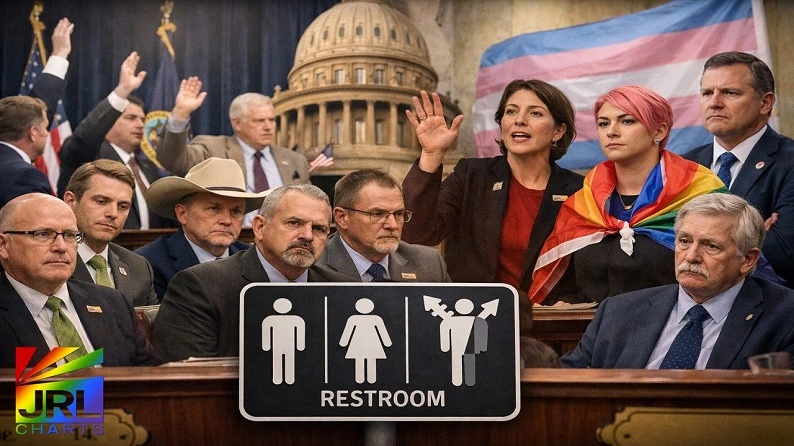
BOISE, Idaho — (March 17, 2026) — The Idaho House of Representatives has approved controversial legislation that would impose criminal penalties on individuals who use public bathrooms or changing facilities that do not correspond with their biological sex at birth.
House Bill 752 passed Monday in a 54–15 vote, with six Republicans joining all nine House Democrats in opposing the measure — a rare moment of dissent inside the state’s Republican supermajority legislature.
Related LGBT Business Finance News Coverage on JRL CHARTS:
• Pennsylvania House Panel Advances Bills to Strengthen LGBTQ Protections
• EU Court Rules Transgender Citizens Must Have IDs Reflecting Lived Gender
• Family of Gay Gamer Detained by ICE Warns Deportation to Cameroon Could Be Deadly
• Oil Surges Past $100 as Strait of Hormuz Crisis Rattles Global Markets
• Iran War Sparks Global Market Freefall — Hormuz Closed, Stocks Plunge, Jobs & Bonds in Crisis
• LGBTQ Corporate Participation Plunges 65% in 2026 as DEI Retreat Reshapes Business Landscape
The Republican lawmakers who broke ranks were Marco Erickson, Ben Fuhriman, Dan Garner, Clay Handy, Dustin Manwaring, and Jack Nelsen, signaling unease among some GOP members about the bill’s potential legal and enforcement consequences.
Proposed Criminal Penalties
If enacted, House Bill 752 would make it a misdemeanor offense for individuals who “knowingly and willfully” enter restrooms or changing rooms designated for the opposite sex in government buildings and private businesses.
Under the proposal:
-
First offense: misdemeanor punishable by up to one year in jail
-
Second offense within five years: felony charge carrying up to five years in prison
Supporters argue the legislation is necessary to protect privacy and safety in gender-segregated facilities.
Representative Cornel Rasor, the Republican sponsor of the bill, said during floor debate that the proposal aims to prevent potential misconduct while maintaining emergency and single-use bathroom exceptions.
“This legislation prevents discomfort and voyeurism escalation and assaults,” Rasor said, adding that the bill attempts to balance public safety with limited exceptions.
Expansion of Prior Restrictions
The measure would expand a 2023 Idaho law requiring public schools to regulate bathrooms and locker rooms according to a student’s biological sex at birth. Idaho lawmakers have increasingly pursued legislation targeting transgender issues, including a previous law making it a felony for doctors to provide gender-affirming medical care to transgender minors.
Critics warn that the new proposal could create legal uncertainty and enforcement challenges for police.
Both the Idaho Fraternal Order of Police and the Idaho Sheriffs’ Association voiced concerns during legislative testimony.
Law enforcement groups said the bill lacks clear enforcement mechanisms and could place officers in difficult situations when responding to complaints involving restroom access.
The sheriffs’ association recommended adding a “duty to depart” provision requiring individuals to leave a facility when asked before facing criminal charges — a step they argue would make enforcement more practical.
Divided Reaction During Debate
Democratic lawmakers strongly criticized the measure during debate on the House floor.
Representative Chris Mathias warned that forcing transgender people to use facilities inconsistent with their gender identity could create safety risks.
“The truth of the matter is — forcing people who don’t look like the sex that they were born with, or transgender folks — forcing them to use other people’s bathrooms is going to put a lot of people in danger,” Mathias said.
Conservative advocacy groups supporting the bill argued that the legislation would protect privacy rights for women and girls.
Joel Fischer, policy director for the Idaho Family Policy Center, told lawmakers that parents expect gender-segregated spaces to remain protected.
“No parent should fear that their young daughters will encounter a member of the opposite sex while using a department store bathroom or changing facility,” Fischer testified.
During committee hearings, transgender Idaho resident Nixon Matthews described the emotional toll of navigating public spaces under increasingly restrictive legislation.
“Every single day when I’m out in public, I have to decide — do I feel like going to jail today, or do I feel like being attacked?” Matthews told lawmakers.
What Happens Next
The bill now moves to the Idaho Senate for consideration. The chamber is also dominated by Republicans, who hold a 29–6 majority, increasing the likelihood the measure could advance.
If passed by the Senate, the bill would be sent to the desk of Brad Little, who has not publicly signaled opposition to the proposal.
The legislation represents the latest development in an ongoing national debate over transgender rights and access to public facilities — an issue that continues to divide lawmakers, advocacy groups, and communities across the United States.
For continuing coverage of U.S. legislative developments impacting LGBTQ communities, follow JRL CHARTS — LGBT Politics, delivering verified reporting and analysis on the policies shaping equality, civil rights, and political power across America.

// Affiliate Disclosure: JRL CHARTS is a digital news and media platform. We do not host, stream, or sell adult content. Some outbound links may contain affiliate tracking to licensed studio-owned platforms (e.g., LatinBoyz, AEBN, BiLatin Men). These links lead to legal, age-gated distributors and are provided strictly for editorial and informational purposes only.