By: Paul Goldberg, Senior Correspondent | LGBT Politics News
Source Credit: Reporting based on coverage by the Associated Press (AP)
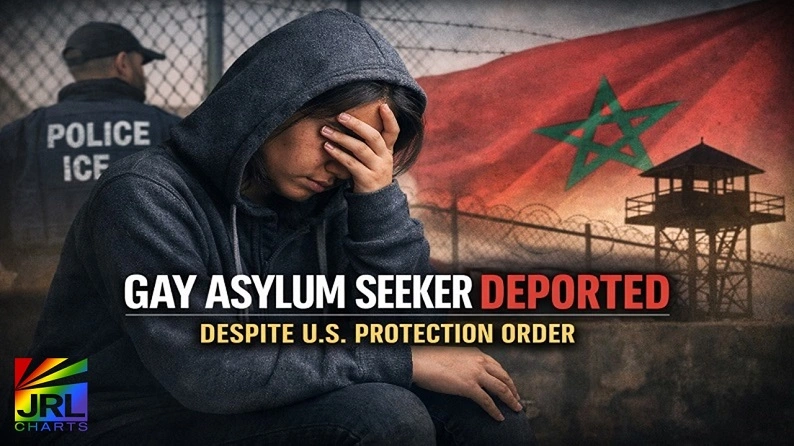
LAS VEGAS — (February 24, 2026) — A 21-year-old gay woman who fled Morocco after alleged violent persecution says she has been returned to her homeland following a controversial third-country deportation process — despite receiving a U.S. immigration judge’s protection order barring her removal to Morocco.
Related LGBT Politics News Coverage on JRL CHARTS:
• ICE Agent Who Killed Queer Minneapolis Mother Identified as Trump Supporter, Family Confirms
• Major Update on LGBTQ+ Identification in America as Gallup Releases 2025 Data
• Anti-Immigration Hawks Exploit Shooting to Target LGBTQ+ Asylum Seekers
• Get the Latest in LGBT Politics USA Exclusively on JRL CHARTS
The case, first reported by the Associated Press, is raising renewed questions about the use of third-country deportation agreements and their impact on LGBTQ asylum-seekers fleeing nations where homosexuality remains criminalized.
In Morocco, same-sex relationships are punishable by up to three years in prison under Article 489 of the penal code.
The woman, identified only as Farah for safety reasons, told the AP she is now in hiding.
“It is hard to live and work with the fear of being tracked once again by my family,” she said.
The Associated Press reported that it reviewed her protection order and confirmed portions of her account through legal representatives.
Allegations of Family Violence and Forced Flight
Farah says she fled Morocco after she and her partner were allegedly beaten by their families when their relationship was discovered. According to her account, she was expelled from her home, later located by relatives, and claims there was an attempt on her life.
Seeking safety, she and her partner traveled to Brazil on visas before embarking on a weeks-long journey through six countries en route to the United States, where they formally requested asylum in early 2025.
Instead of release pending adjudication, she says she was detained for nearly a year in facilities in Arizona and Louisiana.
“It was very cold,” she told the AP, describing thin blankets and inadequate medical care during detention.
Protection Order Issued — Yet Deportation Followed
Although her asylum request was denied, Farah received a protection order from a U.S. immigration judge in August. The order determined that deportation to Morocco would place her life in danger.
Her partner, who did not receive similar protection, was deported.
Despite the protection order, Farah was reportedly removed through a third-country deportation framework — a policy mechanism that allows migrants to be sent to countries other than their homeland under bilateral or diplomatic agreements.
According to the Associated Press, she was among two women later returned to Morocco after being initially removed via Cameroon.
U.S. and International Responses
The U.S. Department of Homeland Security previously confirmed deportations to Cameroon in January, stating:
“We are applying the law as written. If a judge finds an illegal alien has no right to be in this country, we are going to remove them. Period.”
DHS has asserted that third-country agreements “ensure due process under the U.S. Constitution.”
The U.S. State Department declined to comment to the Associated Press regarding diplomatic communications with Cameroon. Cameroon’s Foreign Ministry did not respond to inquiries.
The International Organization for Migration (IOM) told the AP it was aware of removals and stated its role is to provide accurate information and ensure any return is voluntary. However, legal advocates cited in the AP report argue that asylum options were not clearly presented prior to deportation.
Millions in Third-Country Agreements
Cameroon is reportedly one of at least seven African nations receiving third-country deportees under U.S. agreements, alongside South Sudan, Rwanda, Uganda, Eswatini, Ghana, and Equatorial Guinea.
Documents cited by the Associated Press indicate some countries have received millions of dollars in connection with these agreements. A report from Democratic staff of the Senate Foreign Relations Committee estimated that at least $40 million has been spent to deport roughly 300 migrants to third countries.
Internal administration documents reviewed by the AP indicate 47 such agreements are in various stages of negotiation.
Broader LGBTQ Human Rights Concerns
Human rights advocates argue that LGBTQ asylum seekers face heightened risks when deported to nations criminalizing same-sex relationships. In Morocco, LGBTQ individuals frequently report harassment, family violence, and legal vulnerability.
Farah told the AP she was troubled by rhetoric framing migrants as threats.
“The USA is built on immigration and by immigrant labor, so we’re clearly not all threats,” she said. “What was done to me was unfair… to go through so much and lose so much, only to be deported in such a way, is cruel.”
AP Correction Note
The Associated Press later issued a correction clarifying that the two women interviewed had been on the first deportation flight in January — not on the most recent flight — and that eight of the initial deportees had protection orders while the ninth individual was stateless.
JRL CHARTS includes this clarification to ensure full transparency and factual accuracy.
As third-country deportation agreements expand, JRL CHARTS will continue monitoring their legal implications and impact on LGBTQ asylum seekers navigating an increasingly complex immigration system.

// Affiliate Disclosure: JRL CHARTS is a digital news and media platform. We do not host, stream, or sell adult content. Some outbound links may contain affiliate tracking to licensed studio-owned platforms (e.g., LatinBoyz, AEBN, BiLatin Men). These links lead to legal, age-gated distributors and are provided strictly for editorial and informational purposes only.