By: Paul Goldberg, Senior Editor | LGBT News International
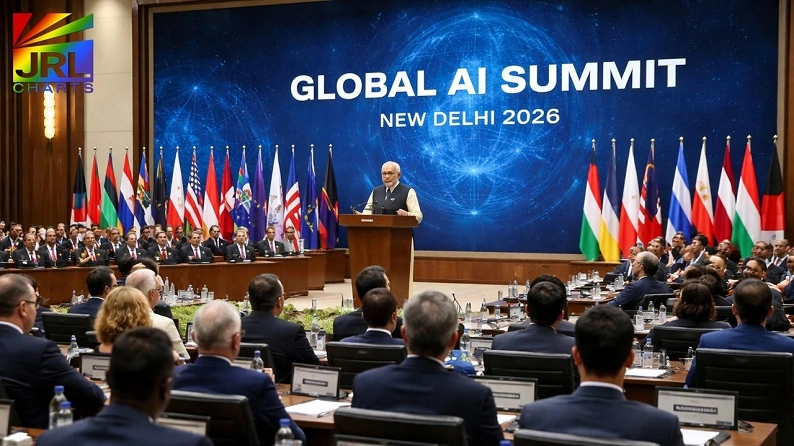
BRUSSELS — (February 22, 2026) — Eighty-eight countries and regional blocs, including the United States, the United Kingdom, and the European Union, have endorsed an India-led declaration on artificial intelligence following the fourth Global AI Summit in New Delhi. However, the agreement stops short of imposing binding safety requirements on the rapidly expanding technology.
Related LGBT News International Coverage on JRL CHARTS:
• UK Veterans Threaten Legal Action Over Ministry of Defence LGBT Compensation Criteria
• EU Launches Digital Services Act Investigation Into Shein Over Online Safety Compliance
• Get the Latest in LGBT Politics USA Exclusively on JRL CHARTS
• US Trade Deficit Hits Five-Month High Amid Import Boom
The declaration recognizes “the importance of security in AI systems,” but relies primarily on voluntary frameworks and industry-led measures rather than enforceable international standards.
Access and Adoption Take Priority
Indian Prime Minister Narendra Modi positioned the summit around what he described as the “democratization” of artificial intelligence. The declaration calls for expanding affordability and access to AI resources, promoting wide-scale adoption across sectors and economies.
The final text, released Saturday, reflects minimal changes from earlier draft versions circulated prior to the summit.
While previous AI summits — including the inaugural 2023 meeting in the United Kingdom — emphasized safety guardrails and risk mitigation, this year’s gathering marked a noticeable shift toward commercialization, deployment, and global accessibility.
Major Powers Sign On
The European Union, United States, United Kingdom, and Russia all endorsed the declaration, representing a diplomatic success for India’s host government. Notably, both Washington and London had declined to sign during last year’s summit process.
Heads of state from the U.S. and China were not present at the New Delhi meeting, citing scheduling conflicts and competing domestic priorities. Their absence allowed India and other middle-power nations to shape the narrative around global AI governance.
United Nations Secretary-General António Guterres delivered a keynote address urging that the future of artificial intelligence should not be shaped by “a few billionaires,” highlighting growing concerns over concentrated control within the private sector.
Open-Source Movement Gains Recognition
The declaration also offered explicit support for open-source AI development, acknowledging that publicly accessible models can contribute to scalability, replicability, and cross-sector innovation.
The text states that “open-source AI applications and other accessible AI approaches, where appropriate, can contribute to scalability, adaptability, and diffusion of AI use cases.”
Advocates of open-source development argue that wider access reduces reliance on a small group of dominant technology firms and promotes global participation in AI research and deployment.
Ongoing Debate Over AI Safety
Critics of the declaration have pointed to the absence of binding safety commitments as a missed opportunity to establish global guardrails on issues such as algorithmic bias, cybersecurity vulnerabilities, and autonomous systems risk.
Supporters, however, contend that voluntary cooperation and expanded access will accelerate innovation while allowing national regulators to determine appropriate oversight frameworks domestically.
The debate reflects broader geopolitical competition over who sets the standards for the next generation of artificial intelligence infrastructure.
For ongoing coverage of global technology governance, AI regulation, and international policy developments, stay with JRL CHARTS LGBT News International — where global innovation meets geopolitical impact.

// Affiliate Disclosure: JRL CHARTS is a digital news and media platform. We do not host, stream, or sell adult content. Some outbound links may contain affiliate tracking to licensed studio-owned platforms (e.g., LatinBoyz, AEBN, BiLatin Men). These links lead to legal, age-gated distributors and are provided strictly for editorial and informational purposes only.