By: Paul Goldberg, Senior Editor | JRL CHARTS Financial News
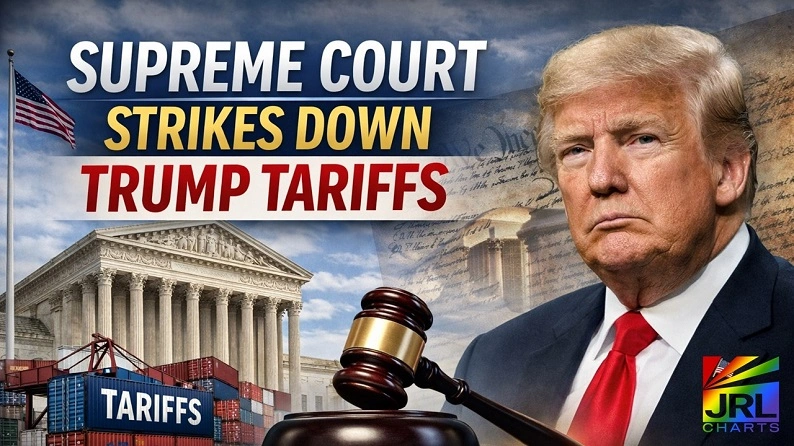
LAS VEGAS — (February 20, 2026) — In a sweeping and historic decision, the United States Supreme Court struck down the bulk of President Donald Trump’s second-term tariff regime on Friday, ruling that his reliance on emergency powers under the International Emergency Economic Powers Act (IEEPA) to impose broad global tariffs was unlawful.
Related Business Financial News Coverage on JRL CHARTS:
• Get the Latest in LGBT Politics USA Exclusively on JRL CHARTS
• US Trade Deficit Hits Five-Month High Amid Import Boom
• Disney Gay Days Pauses 35th Anniversary Event Amid Sponsorship Challenges
• Pentagon Cuts Harvard Ties Over DEI, Wokeness, and LGBTQ Policy Disputes
The ruling dismantles what the Trump administration described as the cornerstone of its economic and foreign policy agenda — a tariff framework that generated nearly $289 billion in federal revenue as of January 2026, according to the Bipartisan Policy Center.
The Constitutional Boundary
Chief Justice John Roberts, writing for the majority, emphasized the judiciary’s constitutional role under Article III.
“We claim no special competence in matters of economics or foreign affairs,” Roberts wrote. “We claim only, as we must, the limited role assigned to us by Article III of the Constitution. Fulfilling that role, we hold that IEEPA does not authorize the President to impose tariffs.”
The Court concluded that while IEEPA permits regulation of imports in response to national emergencies posing “unusual and extraordinary” threats, it does not authorize across-the-board tariff imposition.
Trump became the first president in the nearly 50-year history of IEEPA to attempt using the statute as a mechanism for sweeping tariff enforcement.
What Was at Stake
Beginning in February 2026, President Trump declared national emergencies related to:
-
Fentanyl trafficking (impacting tariffs on Canada, China, and Mexico)
-
Persistent trade deficits
-
Reciprocal trade practices with global partners
Lower federal courts allowed the tariffs to remain in effect while the Supreme Court reviewed the case.
Notably, the Court’s ruling does not impact sector-specific tariffs imposed under separate statutory authorities — including existing levies on steel, aluminum, and copper — which remain intact.
The Dissent
Three conservative justices dissented: Brett Kavanaugh, Clarence Thomas, and Samuel Alito.
Justice Kavanaugh argued that tariffs are historically recognized tools to regulate importation and therefore fall within the statutory meaning of “regulate.”
“Statutory text, history, and precedent demonstrate that the answer is clearly yes,” Kavanaugh wrote. “Like quotas and embargoes, tariffs are a traditional and common tool to regulate importation.”
Kavanaugh suggested that the administration may have relied on the “wrong statutory box,” leaving open the possibility that tariffs could be restructured under a different law.
Economic Fallout: Refunds and Legal Battles Ahead
The Supreme Court did not outline a process for refunding businesses that paid now-invalidated tariffs — setting the stage for complex litigation in lower courts.
Major corporations — including Costco, companies within the Toyota Group, Revlon, and hundreds of smaller enterprises — have already initiated legal actions to preserve claims for potential reimbursement.
The underlying Supreme Court case stemmed from lawsuits brought by Democratic-led states and two coalitions of small businesses.
Legal experts anticipate a nationwide wave of refund claims that could involve billions of dollars.
Separation of Powers Victory
Ilya Somin, an attorney representing several businesses that challenged the tariffs, described the decision as a landmark constitutional moment.
“Today, the Supreme Court rightly ruled that IEEPA does not give the President the power to impose tariffs on imports from any country, of any product, at any rate, for any amount of time,” Somin stated. “It’s a major victory for the constitutional separation of powers, for free trade, and for American consumers.”
Political and Legislative Implications
While the ruling represents a significant defeat for President Trump, it does not eliminate tariff authority entirely.
Congress retains constitutional power to enact tariffs, and the administration may attempt to rely on alternative statutory frameworks.
This decision marks the first time the Supreme Court has issued a final merits ruling on the legality of one of Trump’s second-term policy initiatives — a notable shift from prior emergency appeal victories.
Markets are expected to react as businesses evaluate potential refunds, supply chain adjustments, and regulatory recalibrations.
For continued breaking coverage on constitutional law, federal economic policy, and global trade developments, stay with JRL CHARTS Financial News — where legal authority meets economic intelligence.

- Mass Layoffs Rock The Advocate and Out as Equalpride Acquires ‘Them’ - March 2, 2026
- LGBTQ Corporate Participation Plunges 65% in 2026 as DEI Retreat Reshapes Business Landscape - February 22, 2026
- Trump Targets Netflix Board Member Susan Rice After ‘Take a Knee’ Remarks Spark Political Firestorm - February 21, 2026
// Affiliate Disclosure: JRL CHARTS is a digital news and media platform. We do not host, stream, or sell adult content. Some outbound links may contain affiliate tracking to licensed studio-owned platforms (e.g., LatinBoyz, AEBN, BiLatin Men). These links lead to legal, age-gated distributors and are provided strictly for editorial and informational purposes only.