By: Paul Goldberg, Senior Editor | JRL CHARTS – LGBTQ Politics
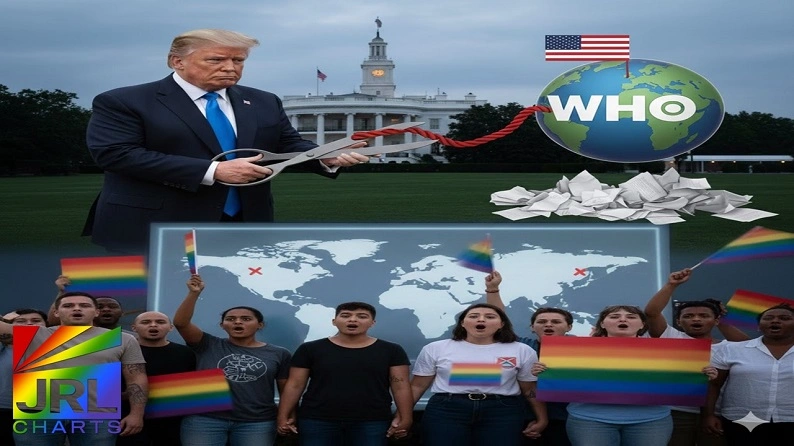
WASHINGTON, D.C. — (January 26, 2026) — The United States has officially ended its long-standing partnership with the World Health Organization (WHO), finalizing a withdrawal first announced by President Donald Trump more than a year ago.
Related LGBTQ News Coverage Links on JRL CHARTS:
• Get the Latest in LGBT Politics USA Exclusively on JRL CHARTS
• BREAKING NOW on JRL CHARTS Headline News
• Democrats Enter 2026 Midterms With Momentum — But LGBTQ Civil Rights Are Now on the Ballot
• NIH Defies Court-Restored LGBTQ Grants, Confirms Funding Will End in 2026
• Pentagon Halts HIV-Positive Recruit Training as Florida Cuts Put HIV Medications at Risk
The move brings to a close America’s decades-long role as one of the world’s most influential supporters of global health coordination, marking a major shift in U.S. international health policy.
The Trump administration said the decision was driven by what it described as the WHO’s mishandling of the COVID-19 pandemic, resistance to internal reforms, and growing political pressure from member nations.
Move harms LGBTQ Communities Worldwide.
Advocates also warn that the U.S. withdrawal from the WHO could have serious consequences for LGBTQ communities worldwide, particularly in regions where access to healthcare is already limited. The World Health Organization has played a key role in supporting HIV/AIDS prevention, transgender healthcare access, mental health initiatives, and anti-discrimination health policies in developing nations. Reduced U.S. involvement and funding may weaken these programs, leaving vulnerable LGBTQ populations with fewer resources, less political protection, and diminished access to life-saving treatment and education.
Since helping establish the organization in 1948, the United States had served as one of WHO’s largest financial contributors and most powerful members. Federal officials confirmed that nearly $280 million in funding has now been halted, and all U.S. personnel assigned to WHO offices have been recalled.
Public health leaders have sharply criticized the decision.
“Withdrawing from the World Health Organization is scientifically reckless,” said Dr. Ronald Nahass, president of the Infectious Diseases Society of America. “Global cooperation is not a luxury. It is a biological necessity.”
Despite the withdrawal, officials at the U.S. Department of Health and Human Services (HHS) insist that America will remain active in international health efforts.
In a statement, HHS said the U.S. will pursue global health initiatives through “existing and new engagements” with foreign governments, private organizations, nonprofit groups, and faith-based partners.
Federal agencies including the Centers for Disease Control and Prevention (CDC), National Institutes of Health (NIH), and Food and Drug Administration (FDA) are expected to continue working directly with international counterparts.
“We are not withdrawing from being a leader on global health,” a senior HHS official told The Washington Post.
However, critics argue that recent staffing cuts and funding reductions have already weakened America’s global health infrastructure.
Health Secretary Robert F. Kennedy Jr. has also announced plans to end U.S. support for Gavi, the international vaccine alliance that provides immunizations in lower-income countries. At the same time, reductions in CDC personnel have limited overseas disease monitoring programs.
“It’s almost laughable that the administration believes it can lead global health from the sidelines,” said Lawrence Gostin, a Georgetown University law professor who works closely with WHO programs. “They’ve dismantled many of the systems that made U.S. leadership possible.”
WHO officials say the U.S. must still resolve outstanding financial commitments before the withdrawal process is fully complete. The organization’s executive board is scheduled to review the situation in February.
Experts also warn the decision may disrupt major international health initiatives, including upcoming meetings to determine seasonal flu vaccine formulations. These discussions guide vaccine production months in advance and have historically relied on U.S. scientific participation.
HHS officials said negotiations are ongoing to determine whether American researchers will be allowed to attend future WHO conferences.
Public health analysts caution that reduced coordination could weaken global disease surveillance, delay outbreak responses, and undermine international preparedness efforts.
As the withdrawal takes effect, the long-term impact on pandemic response, vaccine development, and international cooperation remains uncertain.
For continued coverage of U.S. policy, global health, and LGBTQ political affairs, follow JRLCHARTS.com — Your Source for LGBT Politics USA News and Analysis.

// Affiliate Disclosure: JRL CHARTS is a digital news and media platform. We do not host, stream, or sell adult content. Some outbound links may contain affiliate tracking to licensed studio-owned platforms (e.g., LatinBoyz, AEBN, BiLatin Men). These links lead to legal, age-gated distributors and are provided strictly for editorial and informational purposes only.